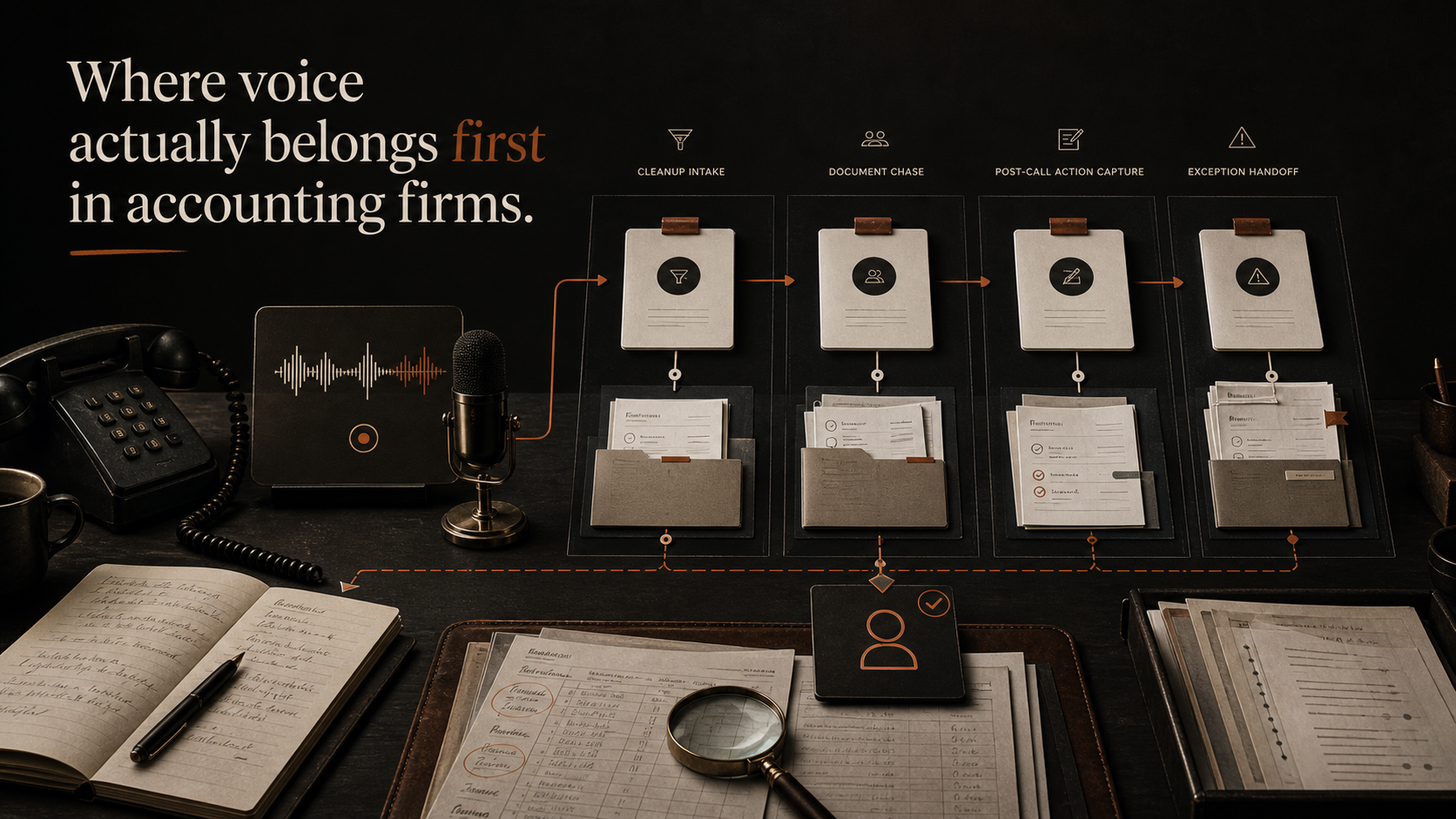
Open-source realtime voice just crossed an important threshold.
Not because every voice-agent pitch was suddenly telling the truth. Not because firms are now spiritually prepared for a broad rollout. And definitely not because one slick demo means the workflow problem packed its bags and left.
What changed is simpler. Realtime voice is finally good enough that operators should stop dismissing it as toy-level nonsense.
That does not mean you should slap a voice agent across the whole firm like ranch dressing on a bad salad. It means you should get more specific. Fast.
Because for most accounting firms, the right first move is not "voice everywhere." It is one ugly repetitive workflow where your team is still repeating itself like the month-end version of Groundhog Day.
The dumb way people are going to do this
A lot of firms are going to see the open-source voice wave and ask: "How do we use voice AI in the business?"
That question is how you end up with:
- a novelty pilot nobody owns
- a fake all-in-one automation fantasy that dies the second it meets an actual client file
- a lot of internal excitement from people who will not be the ones cleaning up the mess later
In other words, theater. Very expensive theater. The kind where everyone claps for the demo and then your seniors are still chasing the same payroll support three Tuesdays later.
Where voice actually belongs first
Voice belongs where people are still burning time on repetitive intake, follow-up, status, recap, or handoff work every single week.
Not as a replacement for judgment. Not as a gimmick. Not so someone on LinkedIn can announce that the future has arrived in their bookkeeping firm.
Voice works best as an interface layer on top of one narrow workflow that already hurts.
When the workflow is clear, voice can do useful things:
- collect the first-pass story
- route the next action
- structure the recap
- reduce repetitive coordination drag
When the workflow is vague, voice just gives your confusion a microphone.
Four accounting workflows worth testing first
1. Cleanup intake
This is one of the cleanest first-use cases in accounting. A voice-led intake layer can gather the first-pass picture before a reviewer opens the file.
The value is not replacing human review. The value is getting a cleaner intake packet, better scoping, and fewer wasted cycles before the real work begins.
2. Client document chase and status triage
This is where a shocking amount of firm life goes to die. Voice helps if it is attached to a real routing problem: what is still missing, what period is needed, what support is acceptable, what remains blocked, and who needs to act next.
The value is fewer repetitive touches from staff and less reopening the same file because one dumb open item survived another round.
3. Post-call action capture
Useful calls create messy aftermath. Voice can help turn the spoken recap into a structured handoff that actually moves the workflow forward.
Most teams think they need a smarter model. Most of the time they need cleaner prep and a cleaner close.
4. Internal exception handoff
This is where workflow quality quietly gets strangled. A voice-guided handoff can force structured capture before the issue escalates again.
This is not glamorous. It is expensive when it breaks. And it breaks constantly.
What to sell instead of a generic voice bot
If you are serious about this category, do not sell a generic voice bot. Sell a scoped workflow install.
- one workflow
- one painful work object
- one clear human handoff
- one success measure
For example:
- voice-led cleanup intake
- voice-led document chase
- voice-led post-call action capture
- voice-led internal exception routing
That is a real offer. It is concrete enough to test, price, improve, and hand to a buyer without sounding like you inhaled one too many AI podcasts.
The filter before you touch anything
Before touching voice, ask:
- Which workflow keeps eating time every week?
- What exact work object moves through it?
- Where should human judgment take over?
- What would look measurably cleaner two weeks after install?
If those answers are fuzzy, the workflow is not ready. That is the bottleneck. Not the model. Not the API. Not your fifth brainstorming session about "the future of AI in accounting."
The practical move
Open-source realtime voice is worth taking seriously now. But most firms should not respond by trying to put a voice agent everywhere.
They should respond by picking one ugly repetitive workflow and testing whether voice can reduce coordination drag there first.
That is the move. Not a broad rollout. Not a category slogan. One workflow. One work object. One cleaner handoff.
That is where the first honest value lives.
Get the free accounting-oriented implementation
If you want the practical next step instead of more AI sermon content, the free GitHub implementation is here:
https://github.com/mgubuan/AccountingVoice
Start from the open-source voice-agent work that kicked this conversation off, fork it, make it accounting-oriented, and use it on one workflow first instead of your whole firm at once.
Use it for things like cleanup intake, document chase, post-call recap and action capture, and exception routing.