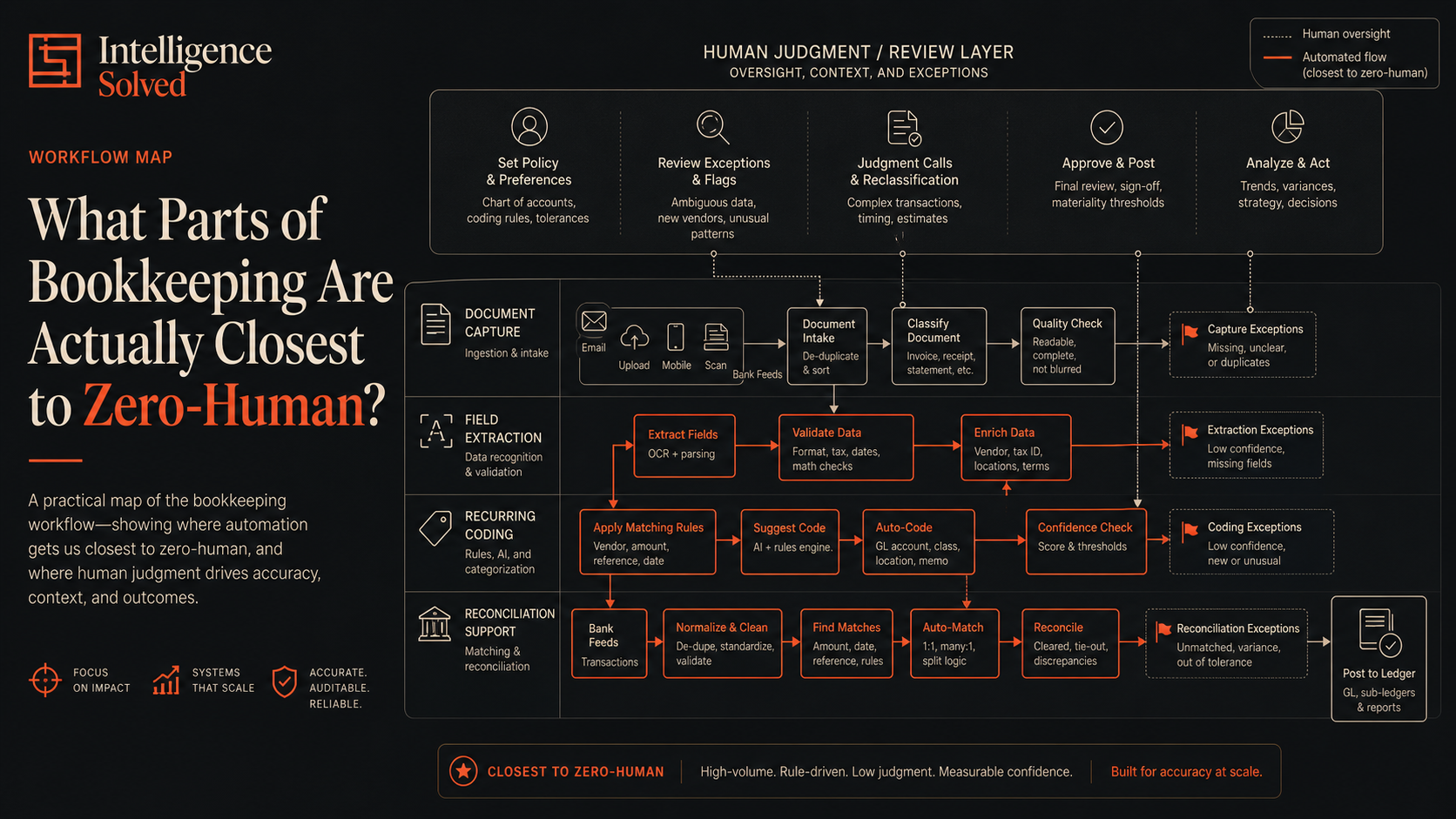
A lot of the AI talk aimed at bookkeeping firms is still too broad to be useful. “Automate the books” sounds exciting, but it hides the real operating question. Small firms do not need a slogan. They need to know exactly which workflow steps are genuinely getting close to zero-human handling, which ones still break under ambiguity, and where the first safe capacity gains actually live.
The practical answer is not “all of bookkeeping.” It is the front-end work that is repetitive, high-volume, rules-based, and easy to compare against a source document or a known pattern. That is where automation is getting strongest. The judgment layer is a different story.
The real test is not intelligence. It is workflow structure.
The tasks closest to zero-human are not necessarily the tasks with the fanciest AI demos. They are the tasks with the cleanest operating structure. If the input format is recognizable, the output fields are predictable, and the cost of a first-pass miss can be caught by review, automation has room to work. If the task depends on client intent, tax nuance, messy source support, or consequence-heavy judgment, the automation story gets weaker fast.
That is why the best framing is not “What can AI do?” It is “Which bookkeeping steps already behave like controlled, repeatable production work?” Those are the steps most likely to move toward zero-human handling.
The bookkeeping steps closest to zero-human right now
1) Document capture and collection routing
Receipts, invoices, bills, statements, and recurring support files are increasingly being pulled into a defined intake path with less human chasing than before. This is not because the accounting got smarter by itself. It is because the workflow improved: one request path, one upload expectation, one place to recognize whether the file arrived.
When firms tighten the intake rule, the “human work” starts shifting from grabbing files manually to reviewing whether the intake gate did its job. That is a very different labor profile.
2) First-pass field extraction
Vendor names, transaction dates, invoice totals, memo fields, account references, and repeated line-item structures are strong candidates for zero-human first-pass handling. OCR and extraction systems are not perfect, but they are increasingly good enough to remove the need for humans to key in the same standard fields over and over.
The win here is not “trust the extraction blindly.” The win is that humans stop spending skilled time retyping obvious data that can be checked faster than it can be entered.
3) Familiar transaction coding
Known vendors, recurring subscriptions, stable account usage, and repeated bookkeeping patterns are often the next closest lane. If a transaction looks substantially like what the system has already seen many times before, the software can often suggest or apply a first-pass code with limited human involvement.
This is where many firms confuse automation with replacement. Familiar coding patterns can get close to zero-human. Judgment-heavy edge cases cannot.
4) Matching and reconciliation support
Routine transaction matching, statement-to-ledger comparisons, and first-pass reconciliation narrowing are also strong candidates. A system can often reduce the search space before a human gets involved. That means fewer manual touches on the routine layer and faster movement toward the items that actually need thought.
Again, the useful role is assistive first-pass reduction, not independent accounting judgment.
5) Repetitive missing-document follow-up
This is less flashy than “AI bookkeeping,” but it is one of the highest-value workflow wins. Repeated reminders for recurring missing items can often be standardized, triggered, and routed with much less human effort. For many small firms, that alone can remove a surprising amount of invisible monthly drag.
Where the zero-human story breaks
The boundary shows up wherever the work becomes ambiguous, consequential, or context-heavy. Final review, exception handling, mixed-use expenses, messy books, timing nuance, weird owner behavior, unusual support, and judgment-heavy classifications still need humans. Not because software is useless, but because the cost of being wrong rises faster than the convenience of a faster guess.
This is the line too many firms blur. They assume that if a system can do eighty percent of a pattern, it must be close to full autonomy. In bookkeeping, that last twenty percent is often where the real risk lives.
The better operating model
The useful goal is not “no humans.” The useful goal is “only the uncertain work reaches a human.” That is a much stronger model for a small bookkeeping firm because it preserves judgment where it matters while removing touches where humans add the least value.
When the front-end volume gets lighter, skilled people can spend more time on exceptions, cleanup, reviewer confidence, and client-specific interpretation. That is where capacity opens up without pretending the software is making professional decisions by itself.
How to decide what to automate first
Start by asking which step in your workflow is both repetitive and easy to verify. Then ask whether the input is stable enough to standardize, whether the output can be checked quickly, and whether the downside of a first-pass miss is low if it is caught by exception review. That is usually the best first lane.
If the step requires context reconstruction, client interpretation, or defensible judgment, it is probably a bad first candidate no matter how good the demo looks.
Closing thought
The front end of bookkeeping is getting closest to zero-human. The judgment layer is not. That is not a failure. It is the actual opportunity. Firms that understand that split can install automation where it creates real capacity and keep humans where trust, review, and accountability still belong.