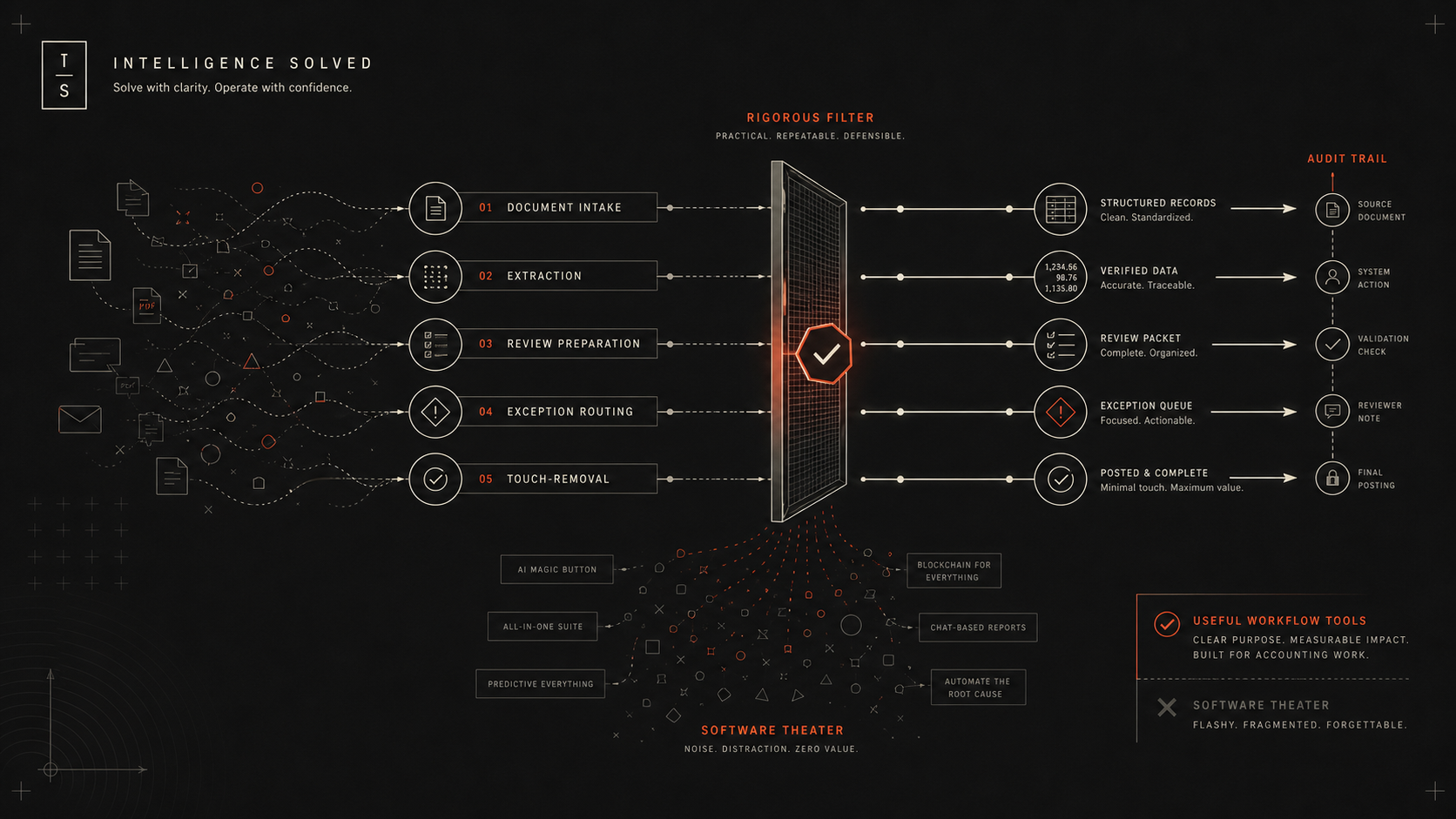
The wrong way to buy AI is by demo quality. A lot of tools look impressive for ten minutes. That does not mean they are useful in a real monthly accounting workflow. If you ask what AI tool is actually useful for accountants right now, the best answer is blunt: the useful tool is the one that removes real touches from a painful repeated step.
That is the filter. If a tool does not reduce friction inside document collection, source processing, first-pass coding, reconciliation support, review preparation, follow-up loops, or exception routing, it may be interesting, but it is probably not useful enough yet.
The strongest category right now
The strongest near-term category is not “AI replaces the accountant.” It is AI that shrinks repetitive front-end work and improves review readiness. That includes tools that help with reading receipts, invoices, and statements, extracting usable fields, suggesting coding from repeated patterns, matching transactions, flagging uncertain items, automating repetitive document requests, and preserving a cleaner source trail for the next handoff.
That is where real value tends to show up first because the workflow pain is obvious and the downside can be bounded through review.
The wrong buying questions
Too many firms still ask which tool feels smartest, sounds most futuristic, or looks closest to full automation. Those are entertaining questions, but they are weak operating questions. They bias the buyer toward software theater instead of workflow leverage.
The better questions are simpler. Where does the workflow clog every month? Where are humans touching work that should be routine? Where are senior people wasting time on low-value admin? Does the tool reduce real touches, or does it just create new output to inspect? What still breaks after the tool does its part?
What useful looks like in practice
A useful AI tool usually improves one ugly recurring step instead of trying to “change the profession.” It may quietly make intake cleaner, coding more consistent, prep-before-review stronger, exception visibility sharper, or follow-up less manual. That may sound boring. Good. Boring is where the leverage lives.
The best tools often disappear into the workflow because they reduce labor without demanding that the team stop thinking. They help the right work happen with fewer touches.
What still makes a tool weak
A weak tool is one that impresses the buyer but does not make the next handoff cleaner. If the output still needs the same amount of inspection, if the source context is still messy, if the firm cannot explain what the tool actually removed from the process, or if it introduces a new layer of review without reducing the old one, the value is probably weaker than the homepage suggests.
This is why many firms feel like they are “trying AI” without really improving the workflow. The tool got added, but the touch count did not actually fall.
A better buying rule
Buy the tool that removes touches, not the tool that makes the homepage sound futuristic. That rule forces the buyer back into real workflow economics. If the tool cannot point to a repeated painful step and visibly reduce the labor around it, it is probably not the first tool worth buying.
How to test a tool before overcommitting
Pick one recurring monthly bottleneck and map exactly how many touches it currently takes. Then test whether the tool reduces those touches without increasing reviewer uncertainty. If the workflow gets cleaner, faster, and easier to trust, you are probably looking at something useful. If it just gives you another polished thing to review, keep your wallet shut.
Closing thought
A useful AI tool does not need to “change accounting.” It needs to make one painful recurring workflow step visibly easier. That is enough. Firms that buy with that discipline will usually get more value than firms that buy whatever sounds most advanced in a sales demo.