Finance and accounting teams do not need more generic AI excitement. They need people who can turn AI into reliable operating systems.
That is why ReviewedIt matters.
On the surface, ReviewedIt looks like a GitHub project for journal-entry review. It has a README, context files, stage folders, references, and output paths. But the more important signal is not that Mark built a software artifact. The important signal is the skill underneath it: the ability to design AI-native finance workflows that are structured, reviewable, and governed by human judgment.
That is the gap many accounting and finance teams are about to feel.
They may have access to AI tools. They may have people experimenting with prompts. They may even have automation inside parts of the close, review, or reporting process. But the harder question is whether anyone can design the workflow around the AI well enough for professional work.
Can the team control the context?
Can it separate source facts from interpretation?
Can it route exceptions instead of forcing every item into a single answer?
Can it prepare a decision packet a qualified reviewer can actually trust?
Can it keep human approval clear instead of hiding judgment inside a tool?
Those are the skills ReviewedIt demonstrates.
AI-Native Finance Work Is Workflow Design
The weak version of AI adoption in finance is simple: paste a messy accounting problem into a chat window, get a confident response, and hope the reviewer can tell whether it is right.
That may be useful for brainstorming. It is not enough for accounting review, controller workflows, month-end close, audit preparation, or client-service delivery inside a bookkeeping or CPA firm.
Professional finance work needs a control layer. It needs explicit inputs, stage boundaries, review criteria, evidence requirements, escalation paths, and approval rules. AI can help, but only if the workflow is designed around the realities of finance work.
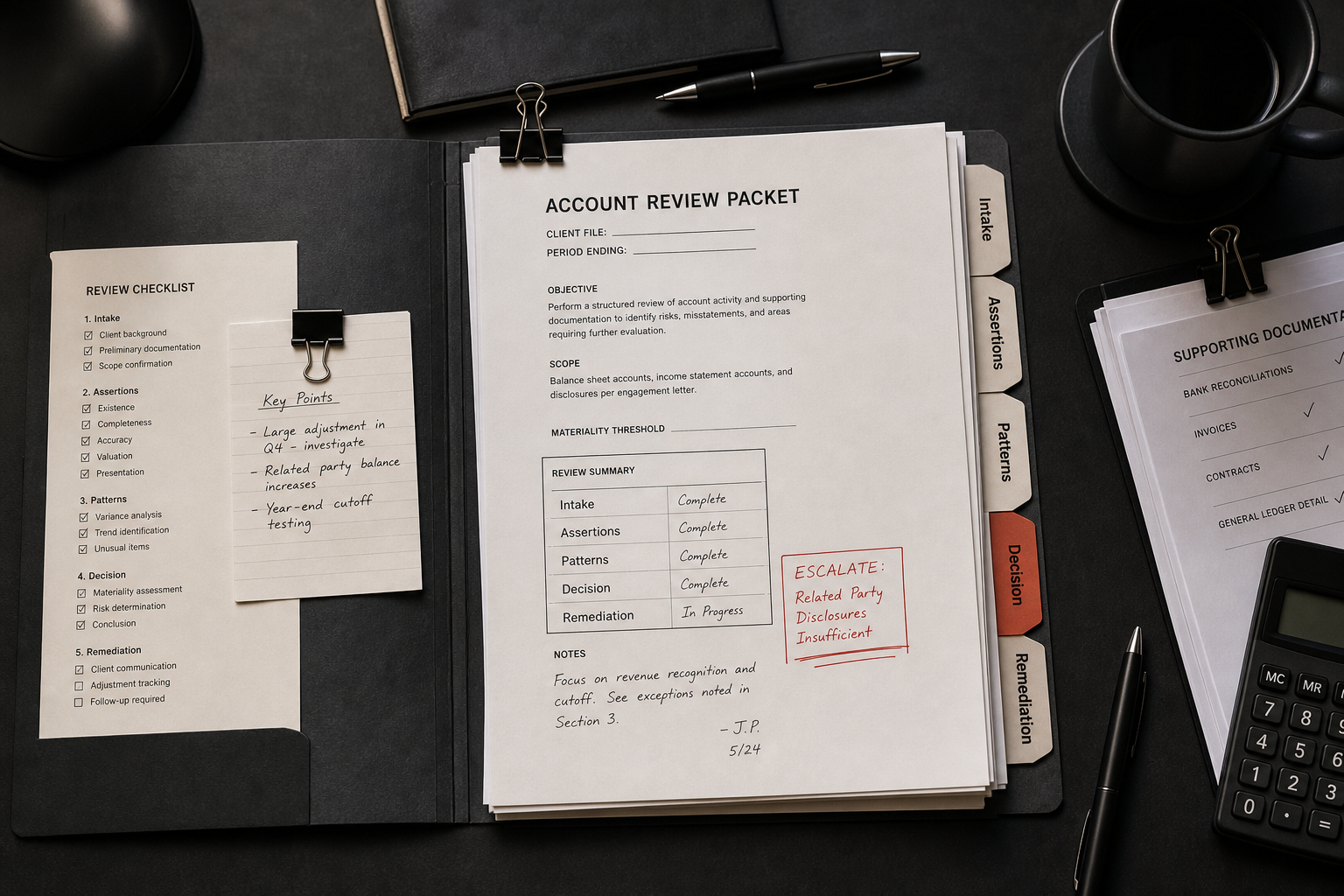
ReviewedIt is useful because it shows that kind of design. It treats journal-entry review as a staged workflow rather than a one-step prompt. The workflow moves through intake, assertion analysis, pattern detection, decision packaging, and remediation tracking. It describes routing categories such as approve, revise, hold, dual approval required, and do not post.
That structure matters more than the demo itself.
It shows the practical mindset teams need when they look for an AI workflow consultant, accounting automation partner, or finance AI implementation resource. The question is not just "Can this person use AI?" The question is "Can this person turn our review work into a controlled operating system?"
The Skills Finance Teams Need To Fill
The first missing skill is deterministic context control.
Most AI failures in finance come from uncontrolled context: missing source documents, stale assumptions, unclear standards, undefined review rules, or too much irrelevant information. ReviewedIt points toward a better pattern. It uses context files, stage-specific instructions, shared references, and output folders so the work has a defined operating environment.
Finance teams already understand this concept. A close checklist, workpaper index, approval matrix, and review binder all exist because context has to be controlled. AI does not remove that need. It makes context design more important.
The second missing skill is structured review discipline.
Good finance work separates what happened, what it means, what is missing, and what needs to happen next. ReviewedIt demonstrates that separation through assertion analysis, pattern context, reviewer briefings, and decision packaging. That is the difference between an AI answer and an AI-assisted review workflow.
The third missing skill is exception routing.
In accounting and finance, risk usually lives in the exceptions: unsupported entries, unusual timing, missing approvals, recurring cleanup issues, inconsistent treatment, or items that need a second reviewer. A mature AI-native finance workflow cannot treat every output as final. It needs routes like hold, revise, escalate, dual approval, or stop. ReviewedIt's routing categories make that operating logic visible.
The fourth missing skill is human-in-the-loop governance.
AI-native does not mean human-free. In finance, the better goal is human-governed. The system should gather the evidence, check the required context, surface likely issues, and package the review. The qualified human should still own the decision.
That distinction is critical for firms that care about trust, quality, and accountability.
Why This Matters For Accounting Firms And Finance Leaders
Many teams will try to close their AI skill gap by buying tools. Tools can help, but tools alone rarely fix the workflow.
If a bookkeeping firm has recurring review loops, the problem may not be a lack of software. It may be that intake, review, support requests, exception handling, and approval rules are not structured clearly enough.
If a controller keeps reopening close items, the gap may not be effort. It may be that the process does not create a clean decision packet with source facts, assumptions, reviewer notes, and unresolved issues.
If an accounting team wants to use AI safely, the gap may not be model access. It may be workflow architecture.
That is where Mark's skills are most relevant: designing the operating layer between AI capability and finance accountability.
ReviewedIt is proof of that skill set. It shows attention to the parts that matter in real work: stage design, context control, evidence separation, exception routing, reviewer briefings, and governance. It does not need to be positioned as a finished compliance product to be useful as proof. Its value is that it shows how judgment-heavy finance work can be made more explicit and reviewable.
What To Look For In An AI Workflow Partner
If your firm is trying to fill this skill gap, do not start by asking whether someone can build a chatbot.
Ask whether they can map one painful workflow from intake to review. Ask whether they can define the required context. Ask whether they can separate facts from interpretations. Ask whether they can design exception routes. Ask whether they know where human approval belongs. Ask whether they can turn the output into something a reviewer, manager, or partner can inspect quickly.
That is the difference between AI experimentation and AI-native finance operations.
The best first project is usually not a giant transformation. It is one workflow with obvious friction: month-end support review, journal-entry review, client cleanup intake, uncategorized transaction review, financial statement variance review, open-items follow-up, or partner review packet preparation.
Pick one workflow. Stage it. Control the context. Define the review outputs. Route the exceptions. Keep the human decision gate clear.
That is how AI becomes useful in finance without turning into unmanaged risk.