Accounting Firm AI Readiness Assessment: Find the First Workflow Worth Automating
Before you ask what AI can do, ask what your firm can control. If you cannot name the owner, review standard, exception path, and evidence for a task, the problem is not a lack of AI. The first workflow is not ready to move.
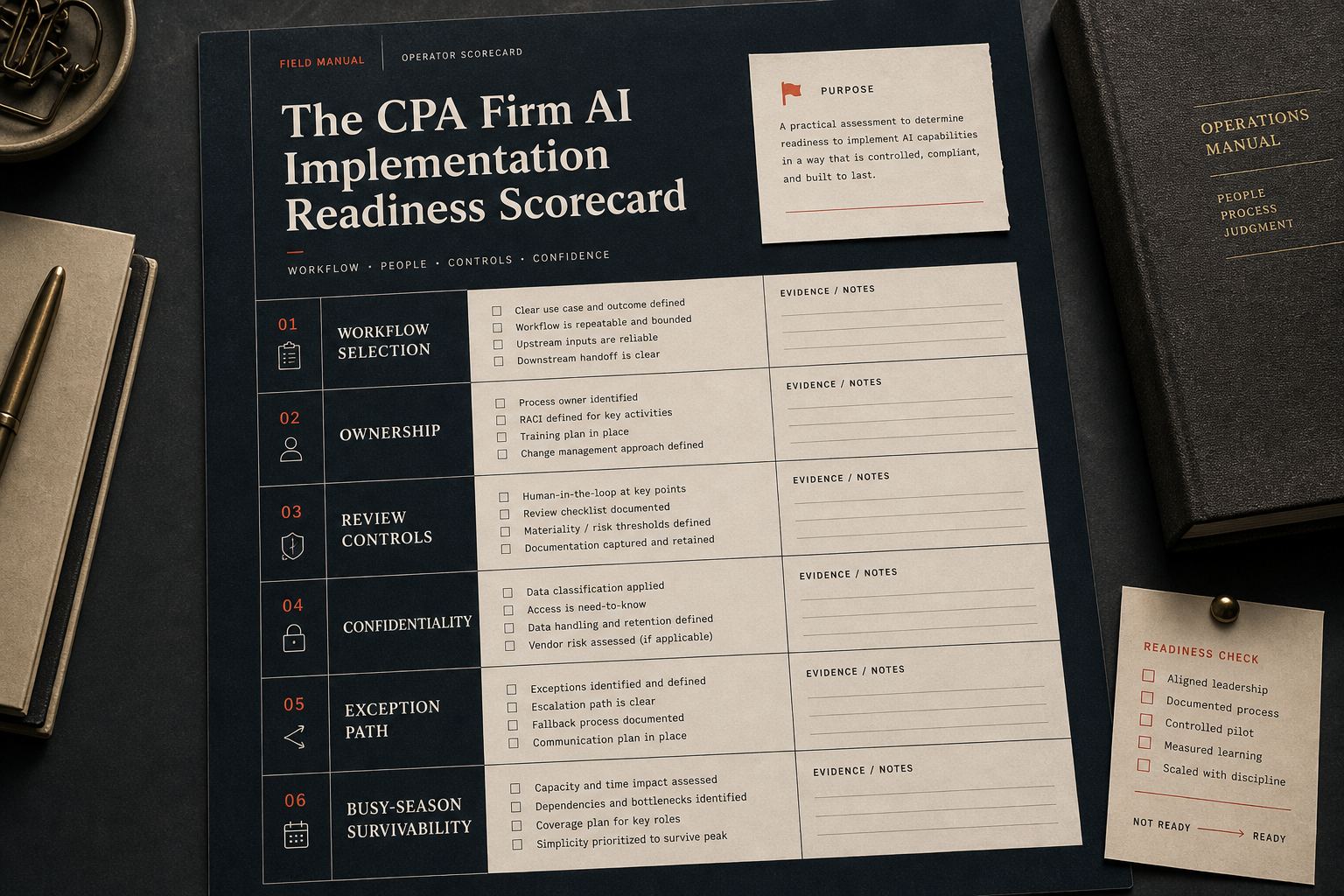
Is the work repeated? Are the inputs visible? Is an owner accountable? Is review defined? Is the exception path explicit? A “no” is not failure. It is the scope.
Choose a task with a visible boundary and reviewable output. Do not begin with the work that requires the most professional judgment and the least observable evidence.
The easy 80% is not the readiness test.
A model can handle the clean document and still fail on the one exception that changes the review decision. It can summarize the note and still miss who owns the unresolved item. It can move quickly and make the boundary harder to see.
An accounting automation assessment should make that risk visible before the firm invests in implementation. Readiness is not the number of tools in the stack. It is the quality of the workflow boundary. If the pressure is local and the reopen loop needs to be made visible first, use the Portland accounting workflow audit as the diagnostic starting point.
What must be true before a workflow moves?
- The starting and ending state are visible.
- The owner can review and decide what happens next.
- Confidential information has a defined handling path.
- Exceptions stop the workflow instead of disappearing.
- The firm can tell whether the workflow behaved as intended.
A practical accounting firm AI readiness screen
Use this on one candidate workflow. The goal is not a universal score. The goal is a decision about what deserves a first scope and what should stay human-led.
What work returns often enough that a clear boundary could matter?
Can the firm see the documents, fields, instructions, and missing states the workflow depends on?
Who is accountable for deciding whether the output can move forward?
What happens when the easy case is wrong, incomplete, late, or confidential?
Readiness as a workflow decision, not a badge.
We examine the work, the owner, the review standard, the exceptions, and the evidence. Then we decide whether the first move is implementation, integration, maintenance, or keeping the decision human-led.
- One candidate workflow at a time
- Explicit controls and data boundaries
- Evidence before expansion
- No assumption that every task should be automated
Separate the recurring process from the judgment-heavy edge cases.
Makes the first move smallerDecide what would show the workflow is behaving as intended.
Makes the decision testableKeep professional judgment and confidentiality visible where they matter.
Avoids false confidenceExpand only when the first workflow provides useful operating evidence.
Controls rollout riskBuilt by someone who knows the exception is the work.
The authority is not a readiness badge or a catalog of tools. It is knowing how close pressure, missing support, review notes, and accountable decisions behave when a workflow meets real accounting work.
Grounded in close deadlines, year-end audit standards, and operating pressure where evidence matters.
Judgment, confidentiality, approval, and exceptions stay with accountable people.
The assessment can point toward a first workflow, but it does not pretend every problem needs automation.
A useful readiness decision names the work, owner, evidence, and stop condition clearly enough to act.
Start with the same bounded package: $3,500 upfront.
The current offer scopes, installs, tests, and hands off one workflow in 21 days for $3,500. If the assessment shows a different first move, that answer is useful. Review the package and price before deciding whether a fit call is the right next step.
Turn the most appropriate candidate into a bounded, reviewable first workflow.
- Scope the work
- Define controls
- Install and test the boundary
Continue at $1,500/mo only when maintenance, tuning, or the next workflow has earned attention.
- Maintenance
- Operator support
- Evidence-led expansion
Questions worth answering before readiness work
No. A good assessment can tell you what should remain human-led or what needs better workflow definition first.
That is part of the boundary. The workflow should expose missing or unreliable inputs rather than quietly turn them into confident output.
Usually start with the clearest repeated bottleneck, not the broadest transformation story.
A decision about the first workflow, its controls, its evidence, and the conditions for a responsible next step.
Which recurring workflow is worth examining before you automate it?
Review the price and package first. Then bring the candidate workflow, the exception that worries you, and the person who must approve the output.