If a firm keeps discussing AI but nothing consistently reaches production, the problem is often misdiagnosed. Leaders assume the bottleneck is tool quality, limited time, or general resistance to change. Those factors can matter, but they are often secondary. The deeper blocker is that the workflow is not yet trustworthy enough to support AI-assisted work inside real delivery conditions. Staff do not know what they are allowed to trust. Managers do not know how review should change. Partners do not see enough control around confidentiality, exception handling, or accountability to approve broader use.
That is why implementation readiness should be treated as a workflow question, not just a technology question. NIST’s AI Risk Management Framework emphasizes governance, oversight, and accountability.[1] IFAC guidance commonly supports process redesign and operating discipline alongside technology adoption.[2] AICPA and CIMA guidance supports documented responsibilities, monitoring, and quality-management structure.[3] CPA.com and related accounting-technology resources reinforce staged, practical adoption rather than vague experimentation.[4] Taken together, those sources support a useful operator conclusion: a firm is more ready for AI when it can govern one workflow clearly than when it can describe AI broadly.
This scorecard is therefore not presented as an industry standard or regulatory test. It is Intelligence Solved’s practical readiness model, informed by the governance and workflow principles in those sources. The goal is to help a CPA firm diagnose where trust is still breaking before AI-assisted work enters a live operating lane.
The belief shift
Many firms still approach AI readiness with an old belief: if the technology is good enough, the workflow will eventually adapt around it. The sources above support the opposite direction. The workflow needs enough structure that the technology can be bounded, reviewed, and supervised meaningfully.[1][2][3] In other words, the readiness problem is usually not “find a better model.” It is “design a clearer operating environment.”
This shift matters because it changes where leadership looks for the constraint. Instead of asking why the team is not adopting the tool aggressively enough, the firm asks whether one real workflow has the scope, review rules, ownership, and exception handling needed to let adoption occur safely. That is a more useful readiness question because it can actually be answered by examining the process.
AI readiness in a CPA firm is less about excitement and more about whether one workflow is clear enough to trust under review.
How to use this scorecard
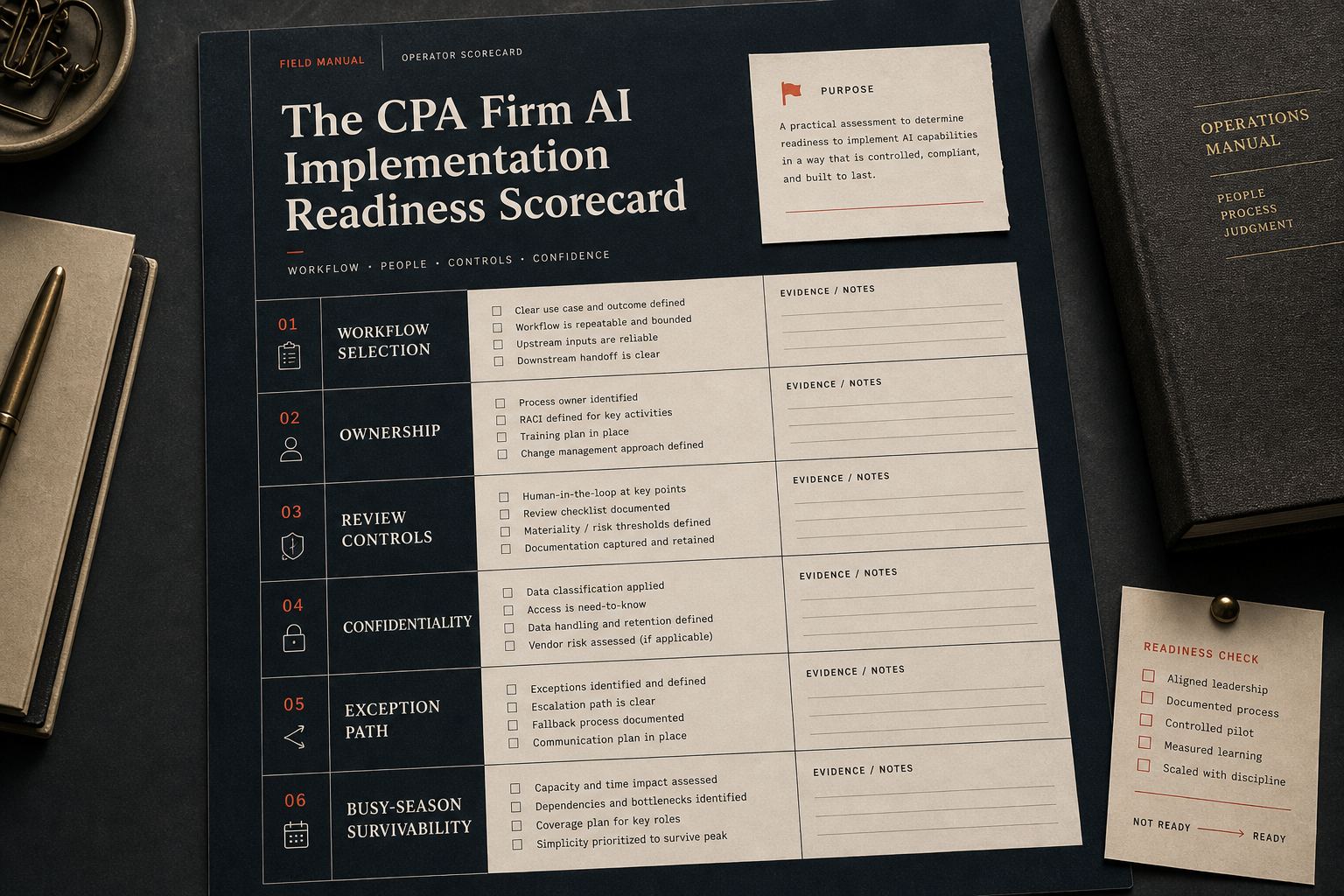
The scorecard below uses a simple 0-to-2 scale for each readiness dimension.
- 0 = not in place
- 1 = partially in place, informal, or inconsistent
- 2 = clearly defined and operational
The goal is not scoring theater. The goal is to expose where the workflow still depends on implied trust, private judgment, or undocumented rescue behavior. Low scores usually indicate that AI interest is ahead of implementation discipline. Higher scores do not guarantee success, but they do suggest that the firm is closer to a controllable first install.
A practical interpretation of the totals
- 0–6: AI interest is materially ahead of workflow readiness.
- 7–12: the firm has isolated signs of readiness, but trust still breaks inside production conditions.
- 13–18: one workflow may be close to a controllable pilot, but weak spots still need explicit repair.
- 19–24: the firm is much closer to a governed install and can support a more serious implementation conversation.
These ranges are part of Intelligence Solved’s synthesis, not an external benchmark. They are meant to help a team interpret patterns, not to claim a universal readiness threshold for the profession.
Readiness dimension 1: workflow selection clarity
Question: Has the firm chosen one specific workflow where AI assistance is being evaluated, or is the conversation still happening at the level of “AI for the firm” in general?
Why it matters: Governance and process guidance are much easier to apply to one bounded lane than to a vague aspiration.[1][2] A firm that cannot name the workflow usually cannot name the review rule, the owner, or the exception path either.
What good looks like: A concrete workflow is named, such as document follow-up for recurring tax work, unresolved-items summaries before review, or client email drafting with required human approval.
Failure pattern: The firm keeps discussing AI broadly, but nobody can point to a single live lane where the rules are defined.
This first dimension matters because it anchors everything else. If the workflow is still general, then ownership, review, confidentiality, and escalation discussions remain abstract too. Readiness begins when the firm can point to one real operating lane.
Readiness dimension 2: workflow ownership
Question: Is one person clearly accountable for the workflow design, adoption rules, and cleanup path if the AI-assisted step misfires?
Why it matters: AICPA/CIMA quality-management guidance supports documented responsibilities and monitoring.[3] Without named ownership, the firm often ends up with staff trying tools, managers reviewing around them, and partners silently holding the risk.
What good looks like: A named owner is responsible for the workflow, the review structure, and the exception route.
Failure pattern: Everyone touches the system, but no one owns the operating design.
Readiness dimension 3: human review checkpoints
Question: Can the team point to where human review is mandatory before AI-assisted output affects client work or workflow state?
Why it matters: Governance guidance consistently supports oversight and accountability.[1][2][3] If review checkpoints are implied instead of defined, the workflow becomes vulnerable to quiet overreliance.
What good looks like: The workflow includes explicit reviewer responsibility, clear signoff expectations, and a visible rule that professional judgment remains human-owned.
Failure pattern: The team assumes someone else will catch problems later.
Readiness dimension 4: output trust rules
Question: Do staff know what they are allowed to trust, what must be verified, and what may never move forward without confirmation?
Why it matters: A workflow becomes unstable when a polished output is mistaken for a trusted one. Trust rules tell the team whether the output is only a draft, a summary requiring verification, or a signal that further review is mandatory.
What good looks like: There are explicit rules for summaries, drafted communication, extracted details, and any output whose failure would create downstream rework.
Failure pattern: Different people trust the same output to different degrees, and no one can say what the baseline verification rule is.
Readiness dimension 5: confidentiality and data-handling boundaries
Question: Are the data-handling rules clear enough that leadership can approve the workflow with confidence?
Why it matters: Readiness is not just about workflow speed. It is also about whether the firm has translated its confidentiality expectations into operating rules. If leadership cannot see what data is allowed, where it is allowed, and how it is handled, adoption often stalls for rational reasons.
What good looks like: The workflow states what data may be used, where it may be used, and what restrictions apply before client-sensitive material enters the lane.
Failure pattern: The workflow sounds useful in theory, but partner approval stops because the data-handling boundary is still vague.
This dimension is often underestimated because the workflow may appear strong operationally while still failing the approval test. In practice, many installs slow down not at the drafting or summarization step, but at the moment leadership asks whether the data path itself is acceptable.
Readiness dimension 6: exception handling
Question: If AI output is wrong, incomplete, or ambiguous, does the team know exactly what happens next?
Why it matters: Bounded workflows still generate exceptions. Good readiness requires a visible fallback path, escalation route, and cleanup rule. Without that structure, the manager usually absorbs the recovery burden manually.
What good looks like: There is a named fallback, a named escalation owner, and a clear rule for when the file leaves the routine lane.
Failure pattern: The team discovers the exception process only after the output has already created confusion.
Readiness dimension 7: role clarity and staff safety
Question: Do employees understand how AI changes the workflow without reading that change as personal exposure or role replacement?
Why it matters: Adoption often looks like a motivation problem from the outside when it is actually a role-safety problem. Staff hesitate when using the workflow feels like a reputational risk, a hidden review burden, or a threat to role clarity.
What good looks like: The team knows the purpose of the assist, the limit of the tool, and where human judgment remains indispensable.
Failure pattern: Staff quietly avoid the workflow because using it feels unsafe even if leadership calls the issue “resistance.”
Readiness dimension 8: manager review load
Question: Does the workflow reduce manager review drag, or does it simply create another layer that must still be rechecked line by line?
Why it matters: A workflow is not truly ready if AI only accelerates drafting while managers still have to reconstruct the entire context manually. A better design makes the reviewer’s work narrower and more legible.
What good looks like: The workflow clarifies what the manager is reviewing and reduces context rebuilding.
Failure pattern: The model creates output faster, but the manager’s real burden is unchanged.
This is a crucial readiness test because manager rescue behavior can hide weakness elsewhere in the system. A workflow may appear to work only because experienced reviewers are silently repairing what the design never made clear enough in the first place.
Readiness dimension 9: partner confidence
Question: Could a partner look at the workflow and see enough scope control, review structure, confidentiality boundaries, and ownership to approve broader use?
Why it matters: Partner approval often stalls not because leaders dislike AI, but because the workflow still asks them to trust what has not been designed clearly enough to supervise.
What good looks like: The partner can see one coherent operating picture: what the workflow is, who owns it, what gets reviewed, what the exceptions are, and how sensitive data is handled.
Failure pattern: Enthusiasm exists, but the workflow still depends on leadership trust that has not been earned through design.
Readiness dimension 10: adoption behavior inside the team
Question: When staff avoid the AI-assisted step, can leadership tell whether the issue is tool quality, fear of error, role fear, or weak workflow support?
Why it matters: A readiness model should help the firm distinguish low initiative from rational resistance. If leadership cannot tell why adoption is weak, it may push the wrong intervention.
What good looks like: The firm can separate true tool limitations from trust failures created by weak controls.
Failure pattern: Leadership calls the problem resistance to change even though the workflow still leaves staff exposed.
This dimension is valuable because it keeps the scorecard honest about human behavior. Teams often look resistant when they are actually reading the workflow correctly and deciding that the risk is still too personal or too undefined.
Readiness dimension 11: busy-season survivability
Question: Would the workflow still hold up under deadline pressure, or would the team abandon it the moment review volume spikes?
Why it matters: A pilot that works only in quiet periods is not necessarily implementation-ready. A good workflow remains usable when the pace increases because the rules are simple, visible, and attached to actual operating behavior.
What good looks like: The workflow stays legible under pressure because staff do not need perfect memory to use it correctly.
Failure pattern: The process disappears during busy season because nobody trusts it under load.
Readiness dimension 12: implementation path
Question: Does the firm have a practical next-step plan for one controlled install, or is it still collecting ideas?
Why it matters: Readiness is incomplete without a path from concept to operating behavior. A firm can understand the risks well and still stay stuck if there is no defined install path for one workflow, one owner, one review structure, and one proof-of-control objective.
What good looks like: The firm can name the first lane, the first owner, the first review structure, and the first evidence that would prove the workflow became easier to trust.
Failure pattern: AI ideas accumulate, but no install path exists for turning one of them into controlled production behavior.
This last dimension matters because it converts readiness from diagnosis into action. A workflow can score well on several dimensions and still go nowhere if the firm never turns the score into a staged install sequence with named decisions and a narrow first objective.
Quick scoring template
- Workflow selection clarity: 0 / 1 / 2
- Workflow ownership: 0 / 1 / 2
- Human review checkpoints: 0 / 1 / 2
- Output trust rules: 0 / 1 / 2
- Confidentiality and data handling: 0 / 1 / 2
- Exception handling: 0 / 1 / 2
- Role clarity and staff safety: 0 / 1 / 2
- Manager review load: 0 / 1 / 2
- Partner confidence: 0 / 1 / 2
- Adoption behavior inside the team: 0 / 1 / 2
- Busy-season survivability: 0 / 1 / 2
- Implementation path: 0 / 1 / 2
What low scores usually mean
If the total score is low, the issue may look like low initiative or slow adoption on the surface. But low initiative is often what workflow distrust looks like from the inside. People hesitate when they do not know what they are allowed to trust, do not know who owns the risk, expect cleanup if the output is wrong, or believe review standards are still unclear.
This is why more tool exploration often fails to fix the problem. The bottleneck is not always interest. The bottleneck is whether the workflow feels safe enough to use. Until that changes, new demos may create more discussion without creating more production readiness.
What medium scores usually mean
Medium scores often indicate that the firm has several pieces of readiness in place, but not yet in a coherent operating picture. There may be a likely workflow candidate and some informal review habits, but ownership is still blurry, confidentiality rules are not translated into workflow language, or exception handling is still too dependent on manager rescue. In this zone, the firm may appear closer than it really is because isolated good practices can mask the absence of full install discipline.
The right response in this range is usually not broader experimentation. It is to tighten the weak dimensions until one workflow becomes truly governable end to end. That often means documenting what the team previously handled informally and making the human-review line explicit.
Medium scores are also where many firms mislabel the problem as simple execution delay. In reality, the team may be waiting for leadership to define the operating rules clearly enough that adoption feels safe rather than discretionary.
What high scores usually mean
Higher scores do not mean a workflow is guaranteed to succeed. They do suggest that the firm is much closer to a controlled install because the main trust surfaces are visible. The workflow has a clearer owner. The review line is explicit. Data handling is bounded. Exceptions have a path. Leadership can see what is being asked of the team.
That is the point where a serious pilot becomes more credible. The firm still needs to test the workflow in practice, but it is no longer relying on goodwill or improvisation to hold the system together. That distinction is what makes higher readiness materially different from high interest.
High scores also create a useful discipline for expansion. Once one workflow reaches this level of clarity, the firm has a reference pattern for what a second workflow should look like before broader rollout. That makes future decisions less speculative and more operating-driven.
Why this scorecard starts with workflow discipline
The order of the scorecard matters. It starts with workflow selection, ownership, and review rather than with tool capability because readiness usually breaks there first. A firm can have a promising model, supportive leadership, and curious staff, yet still fail to move into production because the workflow never became explicit enough to govern. Starting the scorecard with workflow discipline keeps the diagnosis anchored to what can actually be controlled.
This is also consistent with the conservative posture reflected in the cited sources. Governance frameworks and professional guidance are easier to apply when the operating lane is visible.[1][2][3] If the firm skips that visibility step, later conversations about trust, confidentiality, and adoption behavior become harder to resolve because everyone is talking about a different implicit version of the workflow.
That is why the scorecard is most useful when leadership applies it to one concrete lane rather than to “AI readiness” as a broad cultural topic. The narrower the lane, the more honest the scoring can become.
Why readiness should be evaluated at the workflow level, not the firm level
A firm can be ready in one lane and unready in another. That is one reason broad statements such as “we are ready for AI” or “we are not ready for AI” are usually less helpful than they sound. Readiness is often uneven because workflows differ in repetition, clarity, documentation quality, exception frequency, and review burden.
Evaluating readiness at the workflow level gives leadership a better decision surface. It allows the firm to say that one coordination-heavy lane may be ready for a governed pilot while another judgment-heavy lane still needs more design work or should remain fully human-led. That is a more precise and more responsible operating position than using one label for the entire practice.
It also protects the team from all-or-nothing adoption pressure. Staff do not have to decide whether they believe in AI generically. They only need to understand whether one named workflow has become safe enough to support in a bounded way.
Why weak workflow visibility makes readiness hard to score honestly
Some workflows look more ready than they are because experienced people are carrying them through undocumented effort. Status gets rebuilt in conversation. Exceptions are resolved informally. Review rules are remembered rather than written down. Ownership exists in practice, but only because specific people know how to compensate for ambiguity. When that happens, the workflow may appear stable from the outside even though it is fragile from an implementation standpoint.
The scorecard is useful precisely because it makes that hidden labor visible. If a team cannot describe the owner, the review checkpoint, the output-trust rule, or the escalation path without relying on one experienced person’s memory, readiness is lower than it may look. The issue is not competence. The issue is that the workflow still depends too heavily on private knowledge.
That distinction matters because AI can amplify hidden workflow weakness as easily as it can amplify good structure. A workflow that only works because certain people know how to rescue it is not automatically a strong candidate for assisted automation.
Why low scores should not automatically be read as failure
A low score does not mean the firm lacks capable people or sound judgment. It usually means the workflow still needs design before it can safely support assisted execution. In many cases, that is a useful finding because it prevents leadership from treating enthusiasm as proof of production readiness.
Low scores can therefore be operationally valuable. They identify where the first improvement work should happen: clarify ownership, define the review line, narrow the workflow scope, or establish exception rules. That kind of diagnosis is often more useful than another round of tool exploration because it tells the firm what must be true before technology can help responsibly.
Seen this way, the scorecard is not a pass-fail gate. It is a way to prioritize workflow repair so that one lane eventually becomes governable enough to test seriously.
Why medium scores often create the most confusion
Medium scores can be the hardest to interpret because they frequently coexist with visible progress and hidden fragility. Leadership sees some structure, some adoption interest, and some successful experiments. That creates a tempting story that the firm is nearly there. Yet the workflow may still rely on undocumented review behavior or implicit trust that will not hold up under deadline pressure.
That is why medium-scoring lanes should be examined carefully for rescue behavior. Is the workflow really stable, or is a manager informally correcting what the design never made clear? Are the data-handling rules truly understood, or are people just being cautious on their own? Is the implementation path real, or is it still only a set of ideas waiting for someone to formalize them?
Medium scores are often the point where a firm needs sharper operating judgment rather than more enthusiasm. The right move is usually to tighten the weak links until the lane becomes explicitly trustworthy instead of implicitly tolerated.
Why high readiness still requires restraint
Even a high-scoring workflow should not be treated as a blank check for broad rollout. High readiness means the workflow is much closer to a credible pilot because its trust surfaces are visible. It does not mean the firm should stop checking whether the lane behaves as expected in practice.
That restraint matters because pilots can still fail for honest reasons. The output may be harder to review than expected. The data path may need tighter controls. The exceptions may be more common than originally assumed. A high score should therefore create permission to test seriously, not permission to skip supervision.
In other words, a good score changes the next question from “should we keep talking about AI?” to “how do we test this one lane without weakening control?” That is progress, but it is still disciplined progress.
How leadership can use the scorecard without turning it into theater
A scorecard becomes theater when the numbers are used to signal modernity rather than to guide workflow choices. To avoid that outcome, leadership should pair the scoring exercise with one explicit operating decision: which lane is being evaluated, which weak dimensions need repair first, and what evidence will show that the repair worked.
This keeps the conversation practical. The score is not the deliverable. The clearer workflow is the deliverable. If the scoring discussion does not end with a more explicit owner, a more explicit review rule, or a more explicit exception path, then the exercise may have produced language without producing readiness.
Used well, the scorecard is not a branding tool for innovation. It is a discipline tool for deciding whether one workflow deserves to move closer to production.
What the scorecard reveals about the next implementation step
The most valuable output of the scorecard is often not the total. It is the pattern. A low score in workflow selection and ownership suggests the firm has not narrowed the lane enough yet. A weak score in review checkpoints and output trust rules suggests the workflow may produce polished ambiguity rather than governed assistance. A weak score in confidentiality and exception handling suggests leadership may still be rationally hesitant even if the operational concept is sound.
That pattern recognition matters because it turns the next step into a concrete design move. The firm does not need to fix everything at once. It needs to repair the trust surface that is most likely to block production behavior. That is why the scorecard works best as a workflow-planning aid rather than as a generic maturity badge.
Once the pattern is visible, the next conversation becomes more grounded. The team is no longer debating whether AI is important. It is deciding what specific workflow repair would make one lane safer to test.
That is also where the scorecard becomes useful to external implementation support. A workflow partner does not need the firm to solve the whole AI question in advance. It needs a clear picture of where trust currently breaks, which controls are already credible, and which dimensions are still too informal to support production use. The clearer that picture is, the more practical the next move becomes.
Diagnostic questions for leadership
- Where does adoption actually stop today: partner approval, manager review, staff hesitation, or missing workflow ownership?
- When a team member avoids an AI-assisted step, is the real issue tool quality or fear of what happens if the output is wrong?
- If this stays unresolved through the next busy season, where does the cost show up first: review drag, rework, or lost capacity?
- What would have to be true inside one current workflow for the team to trust an AI-assisted step without fearing cleanup, exposure, or unclear accountability?
These questions matter because they force leadership to localize the trust break. A readiness discussion stays vague until the firm can point to where the workflow stops being believable to the people expected to use it.
The next practical step
If a firm is serious about AI, the next move is not another round of demos in the abstract. The next move is to pick one workflow, score it honestly, and repair the readiness gaps that would make that lane unsafe or untrustworthy in production. That is how interest becomes an install path instead of a recurring discussion topic.
In many firms, this means identifying one workflow where the trust break is already visible: review prep, document and information follow-up, unresolved-items summaries, or another lane where hidden coordination work keeps reopening the file. Once that lane is scored and clarified, the firm has a much stronger basis for deciding whether AI belongs there now, later, or not at all.
A readiness scorecard is valuable only if it leads to one clearer workflow, one clearer owner, and one clearer review boundary.
The bottom line
The CPA firm AI implementation readiness problem is usually not solved by stronger interest or more impressive tools alone. It is solved when one workflow becomes bounded enough to supervise, clear enough to review, and safe enough for the team to use without private fear. Governance, quality-management, and process-design guidance all support that narrower interpretation of readiness.[1][2][3][4]
This scorecard is useful because it forces the conversation back into operating reality. It asks whether the firm has chosen a real workflow, named an owner, defined the review line, bounded the data-handling rules, and created an exception path that survives deadline pressure. If not, the firm is still earlier in readiness than its AI conversations may suggest.
It also helps leadership avoid a common category error: treating policy interest and production readiness as if they are the same thing. A firm may have intelligent partners, capable managers, and strong curiosity about new tools, yet still be unready because the workflow contract itself remains too loose. The scorecard creates a way to see that gap without turning the discussion into a referendum on whether the team is innovative enough.
The good news is that readiness can improve one workflow at a time. A firm does not need to solve every AI question at once. It needs to make one recurring lane trustworthy enough that AI assistance becomes a controlled operating move instead of a speculative hope.
That is why the first-workflow decision matters so much. It is not merely a pilot choice. It is the firm’s first proof about whether it can combine new technology with stable oversight, stable review, and stable accountability. A good first lane creates confidence because it shows that workflow discipline and technology discipline can reinforce each other instead of competing with each other.
Once that happens, the conversation changes. The firm is no longer debating AI in abstract terms. It is deciding which next workflow has enough structure to deserve support. That is a much stronger operating position than chasing broad adoption before the first lane is truly under control.
If you want to stress-test one real workflow against this scorecard
Bring the workflow to Intelligence Solved. We can scope the first implementation-readiness pass around the actual trust breakpoints, review surfaces, and exception paths that are stopping production use.
Sources
- NIST, AI Risk Management Framework, nist.gov.
- IFAC Knowledge Gateway, digital transformation and practice guidance, ifac.org/knowledge-gateway.
- AICPA/CIMA professional resources and quality management standards resources, aicpa-cima.com and quality management standards.
- CPA.com resources on AI and firm technology adoption, cpa.com.