AI Workflow Implementation for Accounting Firms: Stop Calling It “Done” When Review Has Not Started
Your team says the file is done. The reviewer opens it and finds three missing documents, a stale note, and no owner for the next question. That is not a motivation problem. It is an unfinished workflow. We scope and install one bounded process so “ready for review” means something your team can actually use. If the workflow is not yet defined well enough to scope, start with the accounting firm AI readiness assessment.
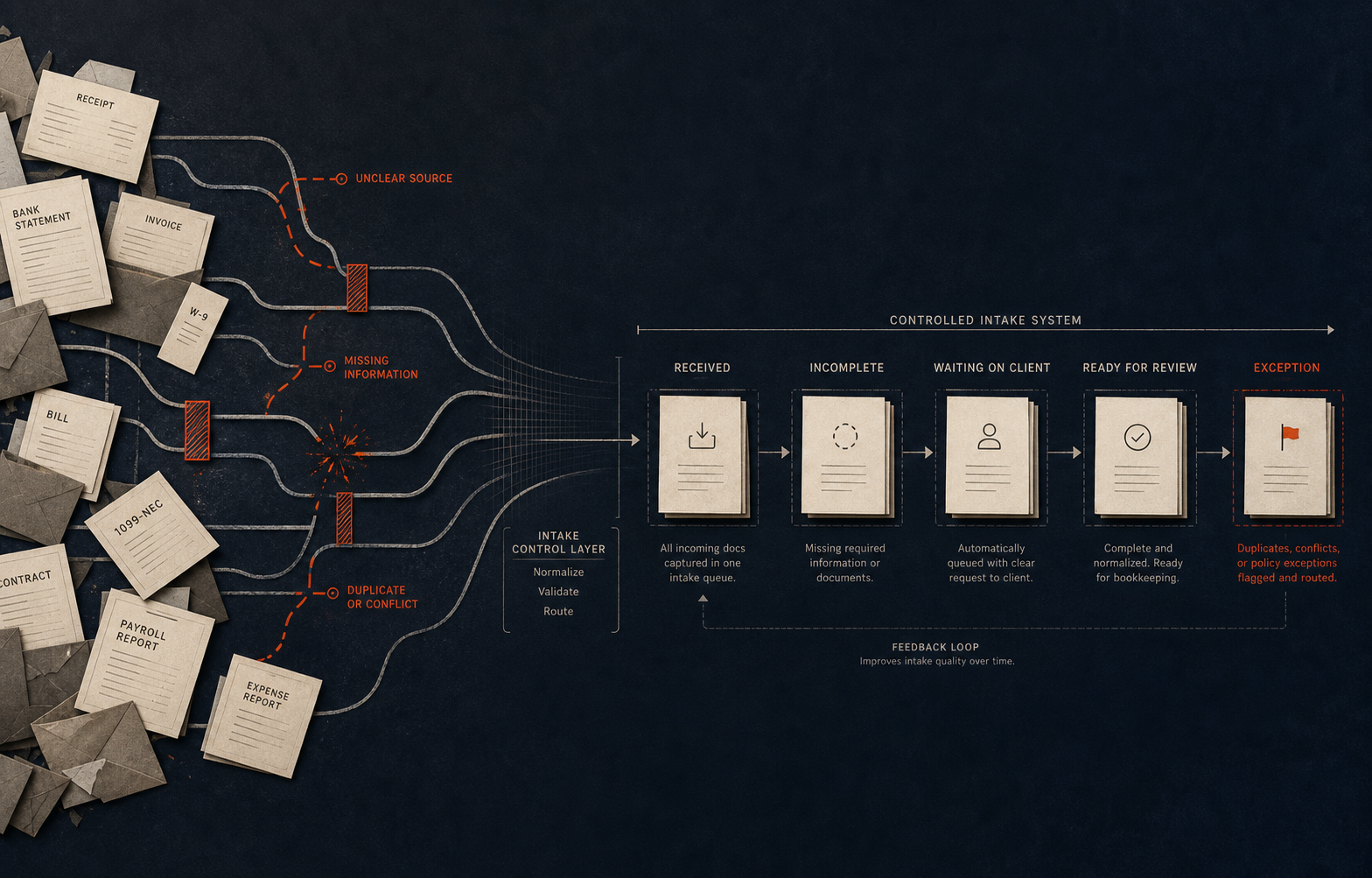
If nobody can name the required inputs, the review owner, and the stop condition, the file is not review-ready. It is merely out of someone’s queue.
Start with the repeated reopen loop. Then decide which steps deserve assistance, which decisions stay human, and what evidence says the install is working.
A clean trial balance can still hide a dirty handoff.
The wrong month gets uploaded. A client says the statement was sent. A reviewer leaves a note that only makes sense to the person who wrote it. The work looks nearly complete until the last ten percent turns into another round of chasing.
That is where accounting workflow optimization earns its keep: not by adding another dashboard, but by making the work, owner, review standard, and exception path visible before the file comes back.
What changes after the first workflow is scoped?
- The starting state is named instead of assumed.
- The next owner is visible before the handoff.
- “Ready for review” has observable conditions.
- Exceptions stop disappearing into email and memory.
- Human judgment remains explicit where the evidence is incomplete.
A 10-minute implementation test for the workflow that keeps reopening
Use this before you buy a platform or ask a model to touch the work. If the answers are fuzzy, that is useful evidence. It tells you the workflow needs definition before it needs automation.
What did the reviewer have to ask for after the file was marked complete?
Was it a document, a decision, a source-of-truth answer, or a clear next owner?
Who decides whether the work can move, and what evidence do they need?
What should the workflow do when the answer is incomplete instead of pretending it is done?
The Operator Bottleneck Scope + Install
A practical accounting automation solution starts with the work your firm already performs. We narrow one bottleneck, map its inputs and decisions, install the smallest useful boundary, test the messy cases, and hand off enough context for a qualified team to run it.
- One clearly scoped workflow target
- Implementation around real documents, notes, handoffs, and review checkpoints
- Explicit exception and escalation behavior
- Follow-up measures before expansion
Find the point where work stalls, reopens, or gets rebuilt by hand.
Prevents building the wrong thingUse the firm’s actual inputs and review language, not a generic automation template.
Makes the workflow usableTry the case where the easy 80% looks successful while the reviewer catches the important 20%.
Protects human judgmentLeave the rules, ownership, and evidence trail visible after the install.
Reduces shelfware riskBuilt for the pressure behind the spreadsheet.
The authority is not a logo wall. It is knowing what happens when a close deadline, a missing support schedule, a stale review note, and a client follow-up collide in the same week.
Grounded in publicly traded close deadlines, year-end audit standards, and multinational operating pressure.
Wrong file, wrong month, buried owner answers, repeated open items, and work that looks finished until review starts.
If a workflow cannot show what changed, what is missing, and who decides, it is not ready to be trusted.
The first result is a bounded workflow the team can inspect. Expansion has to earn its place.
One workflow scope + install: $3,500 upfront.
The current package is one workflow scoped, installed, tested, and handed off in 21 days. Optional $1,500/mo support comes only after the first workflow is live enough to evaluate. Review the complete package before you decide whether a fit call is worth your time.
Start with the process that keeps reopening work, stalling review, or consuming follow-up.
- Real workflow scope
- Human review and exception rules
- Usable handoff in 21 days
Continue only if the first workflow earns the next investment through observable use.
- Maintenance and tuning
- Operator support
- Next bottleneck when ready
Questions worth answering before implementation
No. The first question is whether one workflow can be made clearer with the tools and people already carrying it.
That is usually why the scope starts with the mess. We narrow the boundary before deciding what should be assisted.
Professional judgment, confidentiality decisions, exception approval, and any step the workflow cannot reliably observe.
Start with the one that is repeated, visible, and expensive in attention. A smaller first install creates better evidence for the next decision.
Which workflow would you fix if review started tomorrow?
Review the price and package first. Then bring the workflow that keeps coming back, the people it touches, and the question nobody can answer cleanly.