Portland Accounting Workflow Audit: Find the Reopen Loop Before Busy Season Does
Portland firms do not need another generic efficiency lecture. They need to see why a file is “done” until the reviewer asks for one more statement, one more explanation, or one more handoff. This Portland accounting workflow audit finds the repeat loop so your firm can choose one bounded problem to fix.
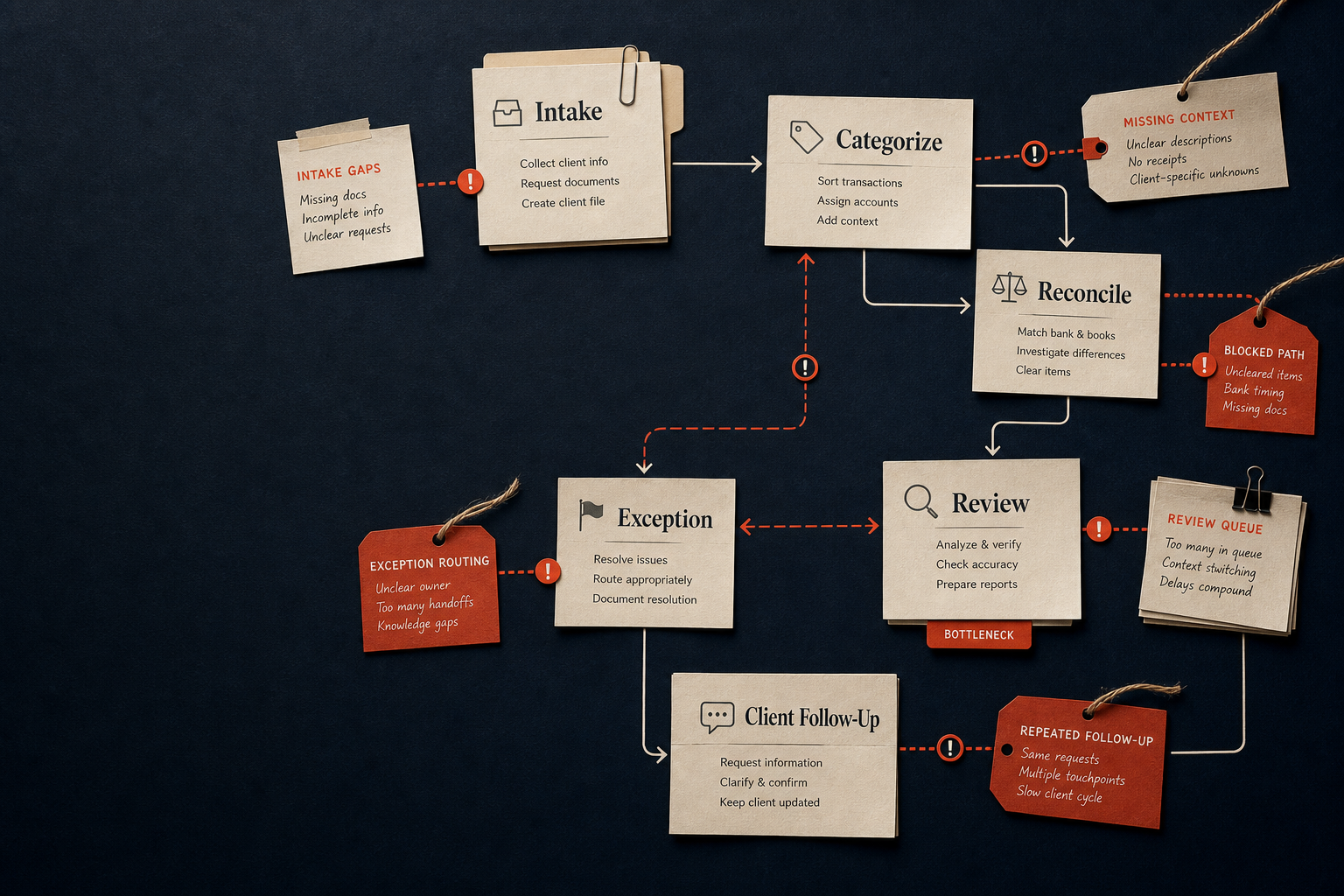
Was it a missing client document, a wrong month, an unanswered review note, or an owner nobody could identify? The answer is the beginning of the audit.
A process that feels manageable in a quiet month becomes visible when open items, client follow-up, and review deadlines arrive together.
The senior person remembers the workaround. The workflow does not.
A Portland bookkeeping team can look efficient right up until the work crosses a handoff. The client sent something, but not the right thing. The reviewer knows a note is stale, but not who owns the answer. The close moves, but the same question returns next month.
A tax season efficiency audit or month-end workflow audit should make that loop visible before the deadline makes it expensive in attention.
What the audit makes visible
- Where documents, requests, and decisions enter.
- Who owns the next action and escalation.
- What “complete” or “ready for review” means.
- Which exceptions repeat during close or busy season.
- What evidence would justify an AI-assisted step.
A five-question Portland workflow audit
Use this on one recurring client, close, or bookkeeping handoff. You do not need a new system to find the first loop. You need the people who touch the work and the last file that reopened.
Which email, portal, spreadsheet, or person started the work?
Which document, decision, or piece of context forced the follow-up?
Could the team name the owner without asking the senior person?
What made the file genuinely ready, and was that standard visible?
Which part of the loop is likely to return during tax season or month-end close?
A local audit with operator-level evidence.
The audit examines the actual work of a Portland-metro bookkeeping or accounting firm, then turns one recurring bottleneck into a decision: fix the workflow, integrate the handoff, maintain what is already installed, or keep the judgment human-led.
- One recurring local workflow
- Real documents, people, and review language
- Evidence-backed bottleneck map
- Clear first-workflow recommendation
Follow the file from intake to review instead of interviewing the process in the abstract.
Finds the real loopSeparate the missing input from the unclear owner and the broken review standard.
Makes the fix specificAsk what happens when the volume and deadline pressure arrive at the same time.
Surfaces fragile handoffsUse evidence to decide whether implementation, integration, or maintenance belongs next.
Controls scopeBuilt for the work Portland firms actually have to close.
The authority is not a city name pasted onto a generic landing page. It is the ability to discuss document intake, open items, close handoffs, review readiness, and the judgment required to keep an accounting workflow useful.
Built for bookkeeping and accounting firms serving local clients through recurring intake, close, and review pressure.
The audit looks for the loop that changes from tolerable to expensive when deadlines tighten.
Grounded in close deadlines, audit standards, and evidence-led operating judgment.
If the work does not support a clear first workflow, the right answer is a clearer decision, not an automation promise.
Start with the bounded package: $3,500 upfront.
The current package scopes, installs, tests, and hands off one workflow in 21 days for $3,500. Optional $1,500/mo support comes only after the first workflow is live enough to evaluate. Review the package and price before deciding whether an audit is the right first step.
Turn the Portland reopen loop into a bounded workflow decision and, when appropriate, a usable install.
- Scope the bottleneck
- Define review controls
- Install and test the boundary
Continue only when evidence says the first workflow earned the next investment.
- Maintenance and tuning
- Operator support
- Next bottleneck when ready
Questions worth answering before the audit
The route is built for Portland-metro bookkeeping and accounting firms, with the audit grounded in the firm’s actual work rather than a generic location page.
That is the point of tracing one real file or handoff. The audit can begin with the work that keeps returning.
It is a workflow audit first. AI is considered only when the evidence shows a bounded step that can be assisted responsibly.
Repeated people work often points to a missing boundary, owner, or review standard. The audit separates those causes before recommending a fix.
Which part of close is only “done” because someone remembers the workaround?
Review the price and package first. Then bring the file, handoff, or recurring open item that keeps returning during Portland tax season or month-end close.