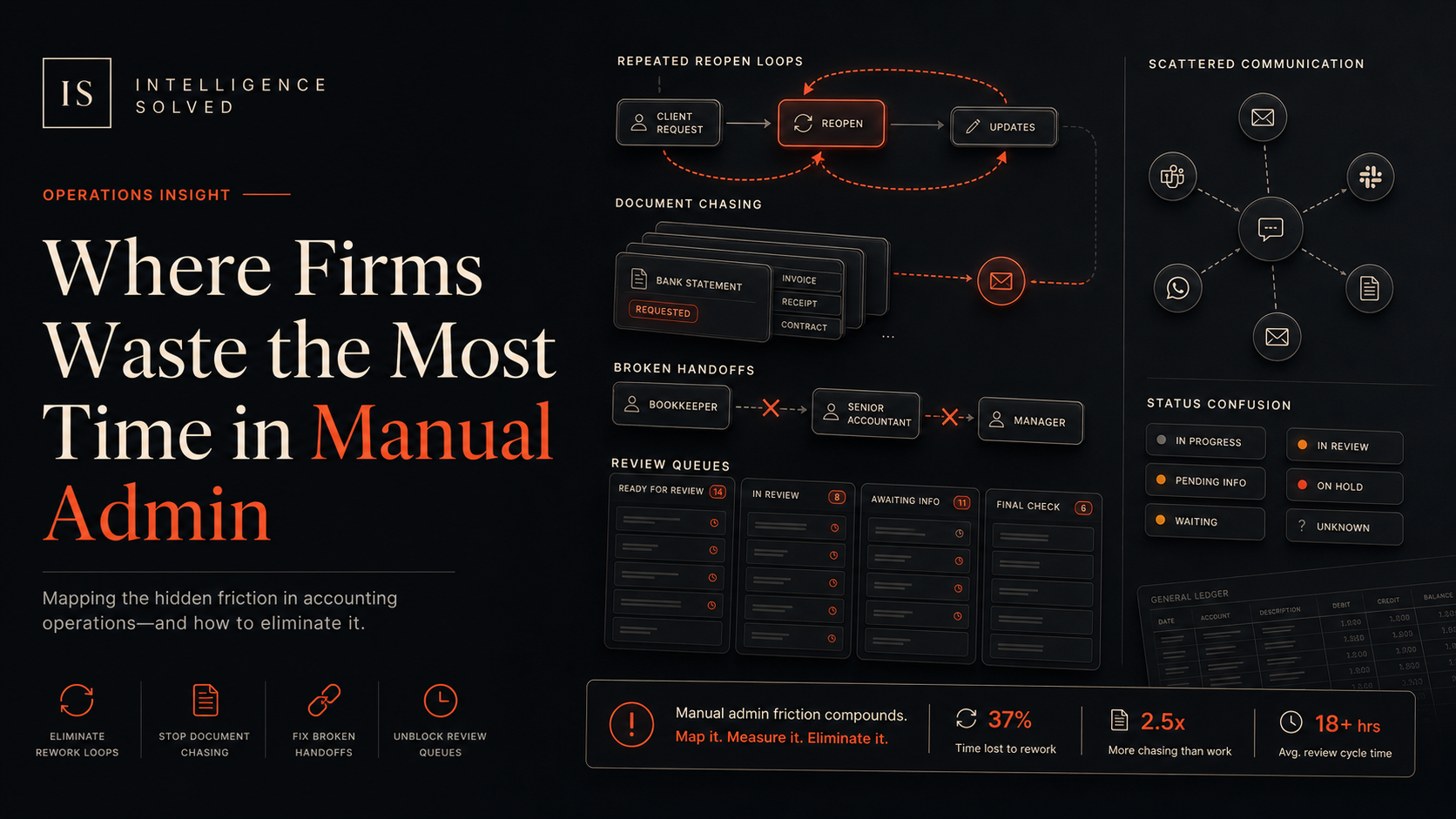
Most accounting and bookkeeping firms do not lose time because the team is lazy. They lose time because the workflow keeps reopening the same file. That is the hidden tax. Not one giant disaster. A hundred small loops that keep forcing people back into work they thought was already moving forward.
If you want the simplest diagnostic question, it is this: where does the file reopen? That is usually where manual admin waste is hiding.
Why manual admin feels bigger than it looks
Admin waste rarely shows up as one clean line item. It hides inside repeated touches: asking for the same document twice, rebuilding context after a delayed client answer, manually sending reminders, fixing prep that should have been cleaner before review, hunting across inboxes and notes for the actual answer, or moving work forward without a clear owner for the next step.
Each loop feels small in isolation. Together, they destroy margin, reviewer focus, and delivery predictability.
The biggest places firms waste time
1) Chasing documents, answers, and approvals
This is usually the biggest one. The problem is not just the delay. It is the restart cost. Every follow-up forces someone to remember what is missing, reconstruct what already happened, and re-enter the file mentally. That context-switching cost compounds faster than most firms realize.
2) Rework from incomplete prep
A file gets “done” once and then effectively done again. That is brutal for margin, especially when senior reviewers are now touching work that should have been cleaner before it reached them. Review should inspect judgment and risk, not clean up sloppy prep.
3) Broken handoffs
A lot of drag comes down to one ugly question: who owns the next move? If that is unclear, work stalls. Then someone later has to reconstruct the situation from memory, messages, and half-finished notes. Broken handoffs are one of the fastest ways to turn ordinary work into admin-heavy work.
4) Review queues that treat everything the same
When standard work and risky work enter review in the same shape, expensive attention gets wasted. Senior people become human sorting machines because the workflow never separated routine items from exception-heavy ones before the queue formed.
5) Too many channels and no real source of truth
Email. Portal comments. Call notes. Tasks. Texts. Spreadsheets. At that point, the team is not just doing accounting. It is searching for context. Every extra channel raises the chance that the person touching the work does not have the full picture when they need it.
6) Hero-based processes
If the workflow only works because a few people “just know what to do,” the process is weaker than it looks. That creates admin waste because the system itself is not carrying enough truth. Questions route back to the same person over and over because the workflow never learned to hold context on its own.
7) Cleanup disguised as recurring service
This one hurts more firms than they like to admit. If the engagement is priced like recurring bookkeeping but the real work is still cleanup, the delivery model gets distorted. The team ends up doing disguised project work inside a recurring admin rhythm, and the reopen loops never really stop.
What good firms do differently
The answer is usually not “work harder.” It is some combination of one clean document path, standard requests, stronger prep-before-review rules, a true exception queue, clear handoff ownership, fewer places for status to live, and honesty about cleanup versus recurring work.
The best operators make it hard for work to reopen silently. They make blockers visible earlier. They define who owns the next move. They reduce the number of places context can hide.
A practical way to diagnose the leak
Pull one file that felt more admin-heavy than it should have. Then trace every time someone had to reopen it. Why did it reopen? Missing document? Weak prep? Unclear owner? Review note with no next action? Client answer buried somewhere stupid? That simple replay usually reveals the real bottleneck faster than another generic process discussion.
Closing thought
Manual admin waste is usually not hiding in one dramatic problem. It is hiding in repeated reopen loops. Find where the file reopens. That is where the firm is losing time, and that is where the workflow needs to tighten first.