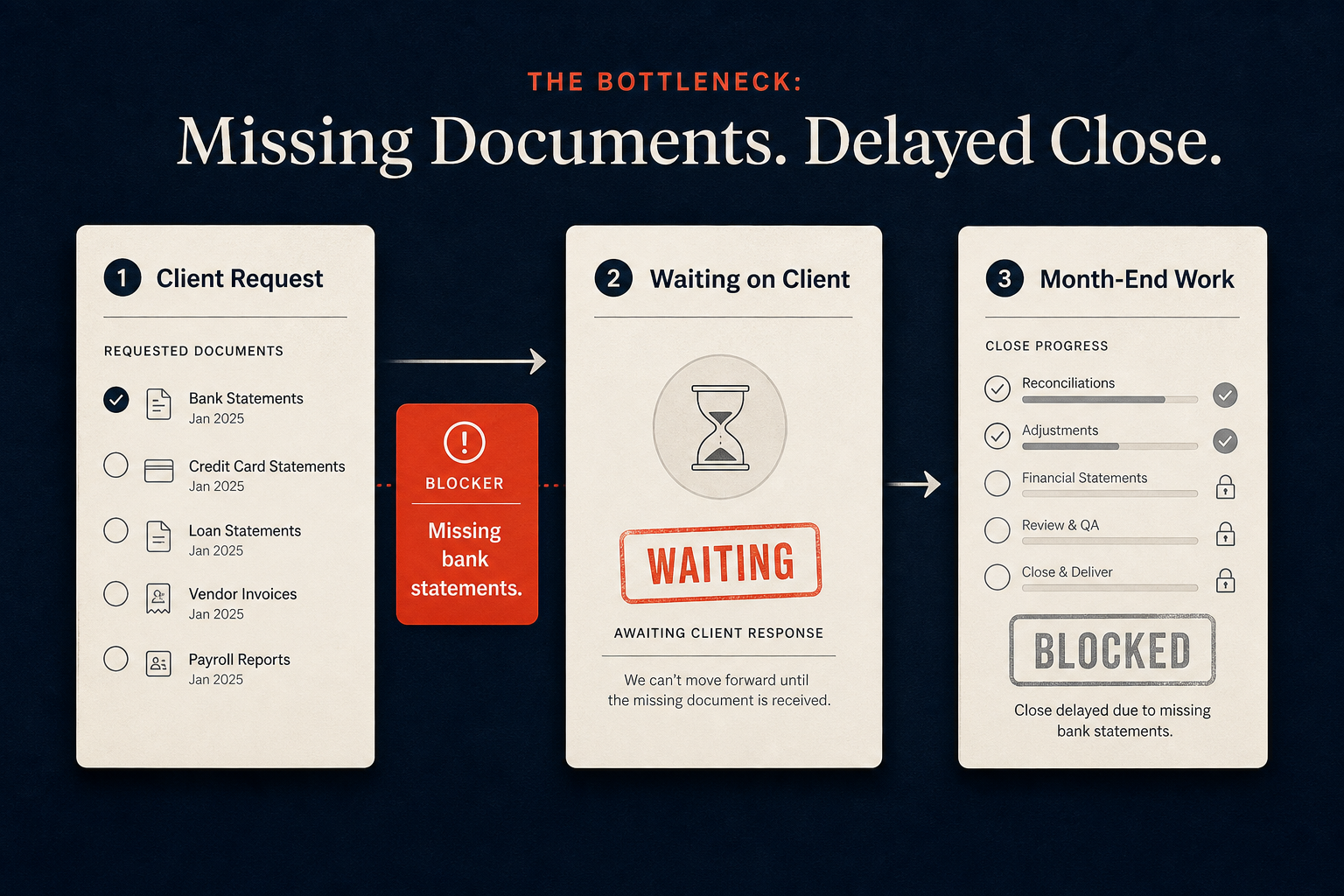
Every bookkeeping team knows the monthly document chase.
One client still owes bank statements. Another uploaded receipts, but not the receipt that answers the uncategorized transaction. A third sent a payroll report to the wrong thread. A fourth replied to an old email with a partial answer. A fifth says the file was already uploaded, and someone on the firm side has to figure out whether that means the right file, the right period, the right entity, and the right format.
On paper, this looks like a client problem.
Clients are late. Clients forget. Clients send incomplete information. Clients do not always understand what the bookkeeping team needs.
All true.
But that is not the whole problem. Client document chasing breaks bookkeeping teams because the request is usually separated from its accounting context.
The visible problem is the missing document. The real workflow problem is that the missing item, reason needed, client owner, firm owner, due date, received evidence, rejected evidence, current status, and next accounting action are scattered across email, portals, task lists, spreadsheets, accounting software, and staff memory.
That is why the same chase comes back every month.
A document request is not just a file request
When a bookkeeping team asks for a document, it is rarely asking for a file in isolation.
The team needs the document because something else depends on it. A reconciliation is blocked. A transaction cannot be categorized. A payroll entry needs support. A loan balance needs confirmation. A cleanup file cannot move forward. A reporting package needs an explanation before it goes to the owner.
That means every document request has hidden workflow objects attached to it:
- What exactly is missing?
- Why is it needed?
- Which client contact owns the answer?
- Which firm team member owns the follow-up?
- What period, entity, account, or transaction does it affect?
- What evidence has already been received?
- Was the received item accepted, rejected, or still under review?
- What happens if the item does not arrive before close?
- What is the next accounting action after it arrives?
If those objects are not managed together, the team is not really managing document collection. It is managing fragments.
That is when a request turns into a chase.
More reminders do not fix unclear request logic
Reminder tools are useful. So are request lists, upload links, portals, and standard monthly request templates. Public document-collection tools for accountants and bookkeepers commonly emphasize those features because the pain is real: firms need secure ways to request, receive, and track missing items.
But a reminder only repeats the request it was given.
If the request is vague, the reminder repeats vagueness. If the request is missing the accounting reason, the client may not know why it matters. If the client already uploaded something similar, the reminder may create frustration instead of clarity. If the team has not marked whether the prior upload was accepted or rejected, the reminder can trigger more back-and-forth.
"Please upload your documents" is not the same as:
"We still need the March bank statement for the operating account ending 4821. Without it, we cannot finish the reconciliation or close March reporting. The PDF uploaded yesterday was February, so this item is still open."
The second request is longer, but it carries context. It names the item, period, account, status, reason, and consequence. That is what lets the client respond correctly and lets the firm know what to do next.
Portals help when the workflow is clear
Client portals can centralize uploads. That can be valuable. A portal is usually better than loose attachments buried in email threads.
But a portal does not automatically create a clean document workflow.
The portal can hold the file. It does not, by itself, decide how requests should be grouped, which missing items block close, when a request should escalate, whether an upload satisfies the accounting need, or how unresolved items carry into next month.
That distinction matters for small teams.
A 2-10 person bookkeeping team does not have much room for status reconstruction. When a manager, reviewer, or owner has to ask "where are we on this?" someone usually has to rebuild the answer from several places:
- the portal upload history
- the email thread
- the accounting file
- the task tool
- the spreadsheet
- the staff member who last touched it
The team may technically have a document collection system, but the operating context is still scattered.
That is why the right question is not "Do we have a portal?"
The better question is: "Can anyone on the team see what is missing, why it matters, who owns it, what has already happened, and what happens next?"
The operational cost is not just time
Document chasing creates obvious time cost, but the larger cost is operational drag.
Staff context-switch more often. Reviewers reopen work they thought was ready. Managers spend time reconstructing status instead of moving work forward. Clients receive repeated requests that feel disconnected. Month-end close gets delayed by items that everyone knows are missing but no one can clearly route.
For a small team, this creates a compounding problem.
The person who knows the full context is often the busiest person in the firm. That person becomes the memory layer for the workflow. Questions route back through them because the system does not carry enough context on its own.
That is not a staff discipline problem. It is a workflow design problem.
When the workflow does not preserve context, every missing document becomes a small investigation.
What the workflow needs before AI is useful
AI can help with document-chase workflows, but only after the workflow objects are clear.
Before adding AI, the firm needs rules for:
- request templates tied to accounting scenarios
- owner and due-date assignment
- evidence received vs. evidence accepted
- rejected or incomplete document handling
- escalation when a missing item blocks close
- carryforward rules for unresolved items
- human review checkpoints for sensitive or judgment-heavy items
Those rules do not have to be complicated. In fact, for a small firm, they should be simple enough that the team can actually use them.
The point is to stop treating every chase as a fresh conversation.
The firm needs a workflow where the context travels with the request.
Where AI-assisted workflow design can help
Once the workflow is defined, AI-assisted support can be useful in narrow, practical ways.
It can help draft follow-up language from structured request data. It can summarize open items for a manager. It can prompt the team when a request lacks a reason, owner, or next action. It can help turn scattered notes into a cleaner status view.
But it should not make accounting judgments. It should not approve documents on its own. It should not replace review. It should not be described as a magic layer that fixes unclear operations.
The useful path is services-first workflow design.
Intelligence Solved starts with the bottleneck: the actual chase pattern that slows the team down. Then the workflow gets designed around the firm's real document requests, status rules, follow-up logic, review checkpoints, and human judgment points.
That is different from buying another generic tool and hoping the team changes around it.
The better first step
If document chasing is slowing your team down, do not start by asking which tool sends the most reminders.
Start with one recurring bottleneck.
Which document request keeps coming back? Which client answer blocks close? Which missing item creates the most manager follow-up? Which request forces your team to rebuild context every month?
Send that bottleneck to Intelligence Solved. The first useful step is not a software signup. It is diagnosing the workflow that keeps turning a missing document into a monthly chase.