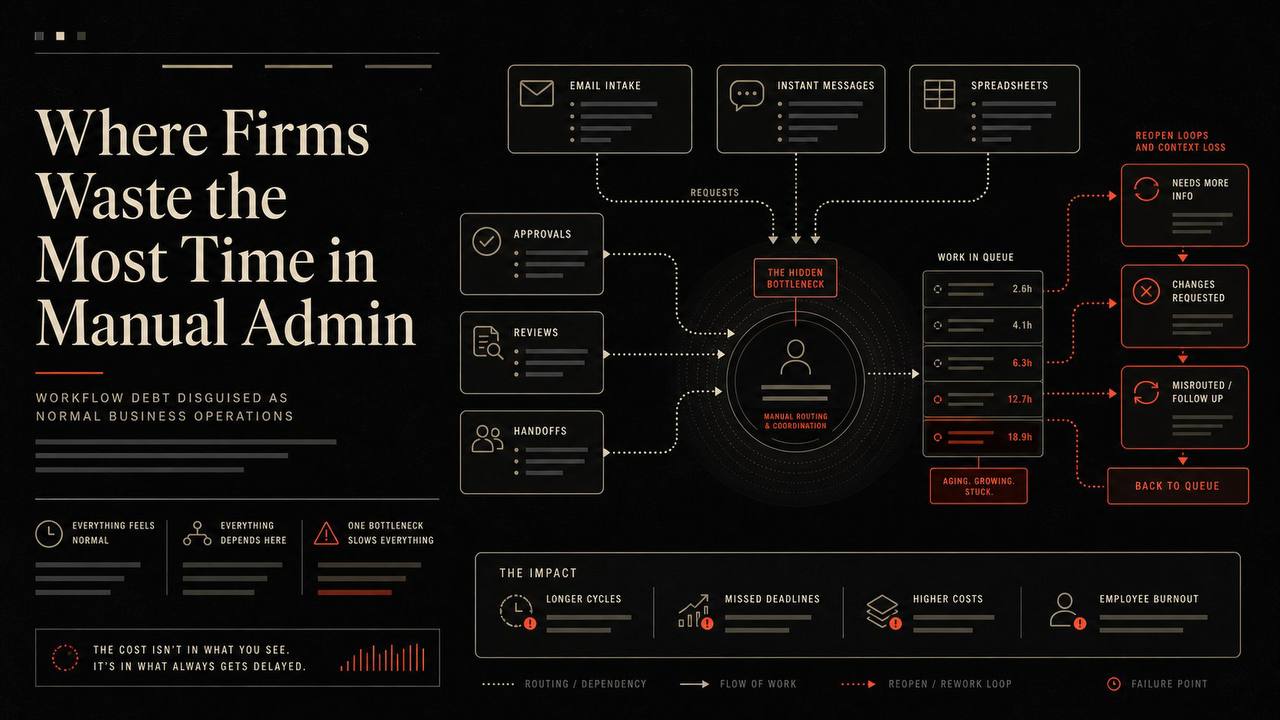
Corporate America does not have an AI problem.
It has workflow debt.
That is the cleaner diagnosis.
Because most companies do not actually suffer from a lack of AI tools, AI vendors, AI pilots, AI task forces, or AI people saying “agentic” with a straight face.
They suffer from something much less glamorous:
- handoffs that keep breaking
- approvals that vanish into calendar purgatory
- context that leaks out between systems
- work that keeps reopening
- and processes that only function because three competent people know how to “work around it”
Which is a nice way of saying: the workflow is bad, everyone knows it, and the organization has chosen to cope aesthetically.
Now AI shows up and, naturally, the first instinct is: “We need a strategy.”
Of course.
Because nothing has ever been made worse by a strategy deck, a steering committee, and twelve people using the phrase “future-state operating model” before lunch.
Meanwhile the actual workflow is still being held together by Slack, email, SharePoint, one spreadsheet with a deeply irresponsible filename, and Brenda.
No disrespect to Brenda.
Brenda is the last standing pillar of enterprise civilization.
But if your workflow only works because Brenda remembers what the process really is, that is not scale.
That is institutional folklore with benefits.
This is why so many AI initiatives sound intelligent and behave stupidly
On paper, the company is moving.
There is a roadmap. There is a pilot. There is a leadership update. Someone has definitely used the phrase “unlocking productivity at scale.”
Beautiful.
And yet the underlying process is still doing what it always did:
- losing context between people and systems
- requiring follow-up to move basic work forward
- depending on one reliable adult to catch what the workflow missed
- generating rework that should never have existed in the first place
- forcing smart people to spend real time reconstructing reality from fragments like they are digital archaeologists
So leadership thinks the company has an AI adoption problem.
Usually it does not.
It has a workflow debt problem that AI exposed in high definition.
That is a very different issue.
Because if you diagnose it incorrectly, you do what most organizations do: buy more tooling, run more pilots, hold more meetings, and somehow become more sophisticated at avoiding the obvious.
Which is honestly one of corporate America’s most refined skills.
AI is not magic. It is leverage applied to a workflow that has been forced to stop lying about itself.
That is the part I think gets missed.
AI does not automatically create clarity.
It does not fix ambiguity because you bought the enterprise tier.
It does not resolve ownership confusion because somebody put “copilot” in the product name.
AI becomes useful after the workflow is understood well enough to answer very boring, very adult questions like:
- where does this process actually break?
- where does context get lost?
- where does ownership become fuzzy?
- where is rework getting created?
- what still depends on memory, heroics, or the right person being online at the right moment?
- why does this process require three follow-ups and a gentle hostage negotiation to move six inches?
If a company cannot answer those questions, it is not really applying AI.
It is just giving its dysfunction a nicer interface.
Now instead of a broken process, you have a broken process with a dashboard, a copilot, and a quarterly update about transformation progress.
So. Progress.
Most enterprise workflow pain survives because it looks too small to be a crisis and too constant to be questioned
That is why it sticks around.
No single failure feels dramatic enough to trigger reform.
It is just:
- one more follow-up
- one more delayed approval
- one more missing input
- one more meeting that exists because nobody trusts the handoff
- one more smart person manually rebuilding context the system should have preserved automatically
Each incident seems minor.
But stack them across weeks, functions, and teams, and now you have a company quietly bleeding time, attention, trust, and momentum through a hundred “small” failures no one owns cleanly enough to fix.
That is workflow debt.
And unlike financial debt, companies love pretending this one is normal.
They call it:
- complexity
- cross-functional nuance
- stakeholder alignment
- evolving process
- temporary manual support
Which is adorable.
Because a lot of the time it just means: “the workflow is unstable, but the people involved are professional enough to keep the mess from becoming visible.”
That is not operational excellence.
That is emotional maturity covering for process negligence.
This is also why generic AI consulting usually misses the point
Because the real challenge is not “knowing AI exists.”
Congratulations to the market. We got that part.
The real challenge is being able to look at a workflow and say:
- this is where the process degrades
- this is where review stalls
- this is where the handoff stops being trustworthy
- this is where people are compensating manually
- this is where the company is paying an invisible tax every week
- this is the first bottleneck worth fixing
That is a different kind of competence.
It is less theatrical. Less LinkedIn-poetic. Less likely to get applause from people who love saying “reimagine.” And much more likely to produce something useful.
Because once you identify the right workflow failure point, the conversation gets real fast.
Now you are not talking about abstract transformation.
Now you are talking about actual operating leverage.
My bias: stop trying to transform everything. Fix the one workflow everybody secretly hates.
This is where I have become aggressively opinionated.
Most companies do not need a grand AI revolution as the first move.
They need one workflow to stop embarrassing them internally.
One recurring process that:
- keeps stalling
- keeps reopening
- keeps requiring follow-up theater
- keeps draining manager attention
- keeps forcing high-value people into low-value recovery work
- and somehow survives every redesign attempt like a corporate cockroach wearing a lanyard
That is where I would start.
Not because it sounds sexy.
Because that is where the real leverage usually is.
Scope that workflow properly. Figure out where it actually breaks. Tighten the structure. Clarify the handoffs. Then apply AI where it reduces real friction instead of just generating more polished confusion.
That approach is less exciting to the people who enjoy innovation theater.
It is much more exciting to the people who like systems that actually work.
The real opportunity is not “How do we use AI?” It is “Which workflow keeps failing in the same place?”
That is the better question.
Because when one ugly, expensive, repeated workflow gets fixed properly, the gains are not just technical.
You get:
- less rework
- less context rebuilding
- faster execution
- fewer rescue operations
- more reliable handoffs
- more trust in the process
- and fewer situations where the company’s operating model depends on the business equivalent of crossing its fingers
That is when AI stops being a talking point and starts becoming infrastructure.
And that is a much more interesting outcome than another pilot with a celebratory screenshot and no operational consequence.
If your company has one workflow everyone is quietly compensating for, that is probably where to start.
You already know the candidate.
It is the process that looks “manageable” in a status deck and completely unhinged in real life.
The one with too many follow-ups. Too much context recovery. Too much dependence on the right people remembering the right things at the right time. Too much invisible manual rescue for something that should have been dependable a long time ago.
Those are the workflows I care about.
If your company has one, reach out to me.
I am especially interested in the ones that seem fine from a distance and become deeply embarrassing the moment you trace how they actually work.