I thought this year was going to be about building better agents.
That is not what happened.
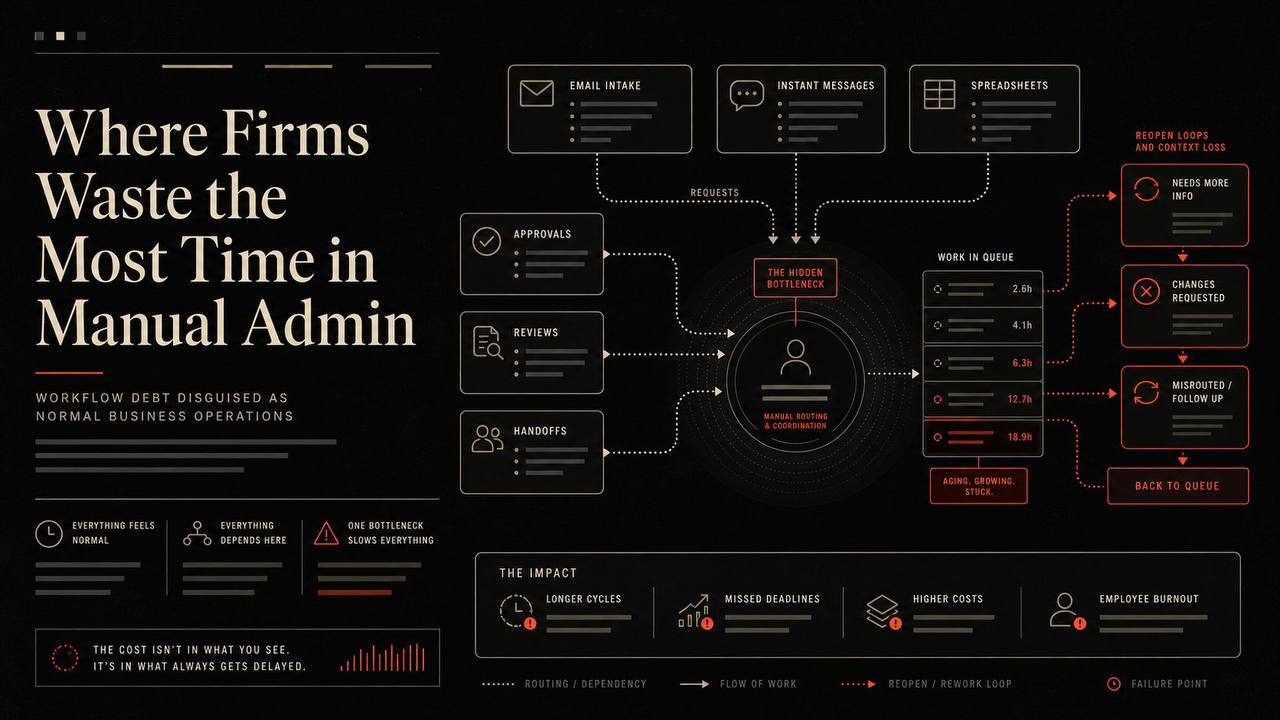
What actually happened is I got dragged, project by project, into a much less glamorous realization: the model is rarely the real bottleneck. The workflow is. The handoff is. The missing context is. The part where everybody says the automation is running, but somebody still has to reopen the file, chase the answer, reconstruct what happened, and decide whether any of it can be trusted.
That was the real story of what we built this year.
I was early enough to this wave that my starting point was not "should I try AI?" It was "how far can I push this?" I got into ChatGPT early through an invite code on a PowerPoint slide during a presentation. Not long after that, I taught myself how to install a local LLM on my own machine and started building a chatbot before most people around me were even treating this as an operating layer.
At that point, the excitement was real. It felt like the surface area had blown open. You could see the future poking through the wall.
But the more real the projects became, the less impressed I was by surface-level demos.
Once I got deeper into autoreconciliation software, custom ERP thinking, and accounting workflow pressure, the problem changed shape. It stopped being a toy question like "can the model answer this?" and became a much harsher operator question: where does the work actually live, what context survives from step to step, and who is responsible when the chain breaks?
That changes how you build.
Because when the workflow matters, you start noticing things people skip past when they are still in demo mode. You notice how much effort gets burned just gathering missing source material. You notice how often an "AI system" still depends on someone remembering what happened three steps ago. You notice that the cleanup work does not disappear just because the interface looks magical. In a lot of cases, it gets worse. More tools can mean more drift. More outputs can mean more rework. More automation can mean more fragile places where nobody knows what the system actually did.
That realization pushed everything else.
So the year became a build sequence.
Some of it looked like direct product work: AutoRecon26, ReviewedIt, AccountingVoice, Atmosera finance-foundation work, IntelligenceSolved.com. Some of it looked like agent experimentation and orchestration: Clawdbot, Hermes Agent, Codex, Claude, Obsidian, gbrain, Paperclip. Some of it looked like loop-building, with Ralph loops, self-improving code-factory ideas, n8n flows, and GoHighLevel systems.
From the outside, that can look like a pile of disconnected AI projects.
It was not.
Underneath all of it was the same pressure test: can this move from impressive output to dependable execution?
That is where my thinking changed the most.
Around March 2026, I stopped treating agents as the main event. I started treating them as tenants. Useful ones, sometimes powerful ones, but still tenants. The thing that matters is the property they are operating inside.
If the workflow substrate is weak, the agent does not save you.
It just fails in a more interesting way.
That was probably the biggest shift of the year for me. I moved from building agents to building the workflow layer agents can sit on top of.
That means structure.
It means runs, stages, handoffs, context files, scopes, evidence, constraints, and systems that can be checked after the fact.
It means the work has to live somewhere deterministic.
It means if an agent writes something, changes something, routes something, or decides something, there needs to be a legible trail behind it.
It means the workflow has to be able to survive the model being imperfect.
That is what starts turning "AI" from a cool conversation into something a business can actually use.
And for me, that shift changed what became possible.
Now the interesting part is not that I can spin up one more chatbot or one more prompt flow. The interesting part is that I can orchestrate real projects, personalized software, research, content, and operating systems from a phone because the surrounding workflow got stronger. The work is not floating in random chats anymore. It has a place to go. It has a state. It has a next handoff. It has boundaries.
That sounds less exciting than agent hype.
It is also a lot closer to the truth.
Most people do not need another inspiring demo. They need a workflow that does not leak.
They do not need one more AI tool screaming for attention. They need a system that keeps source material, decisions, review, and outputs tied together tightly enough that a human can still trust what happened.
That is especially true in real operational environments. Once the work touches accounting, finance, reconciliation, client communication, sensitive documents, or any process where someone is accountable for the final answer, the bar changes. "Pretty good" is not enough. "Usually works" is not enough. The system has to help a human move faster without making the underlying process harder to trust.
That is why I keep coming back to the same diagnostic question.
If your AI stack keeps underdelivering, is the real problem the model quality?
Or is it that the work still has nowhere deterministic to live and hand off?
That question matters because it changes what you do next.
If the real issue is the workflow layer, then buying another tool does not fix it. A better prompt does not fix it. A prettier dashboard does not fix it. You have to decide where context is breaking, where review is weak, where the handoffs are ambiguous, and what the first install should be if you want the system to become trustworthy.
That is the work I care about now.
Not AI as theater.
AI as an operating layer that can hold up under real use.
So when I look back at what we built this year, I do not mainly see a list of projects. I see a trail of proof that led to a harder-earned conclusion.
The biggest leverage did not come from building smarter agents.
It came from building the workflow they could survive inside.
If you are already using AI tools and still feel like someone on your team has to babysit the whole thing, that is probably not a tooling problem.
It is probably a workflow problem.
And if you want, send me the one process that keeps breaking. The one where context disappears, the chain gets fuzzy, or the output still has to be manually reconstructed before anybody trusts it.
That is usually where the real install starts.