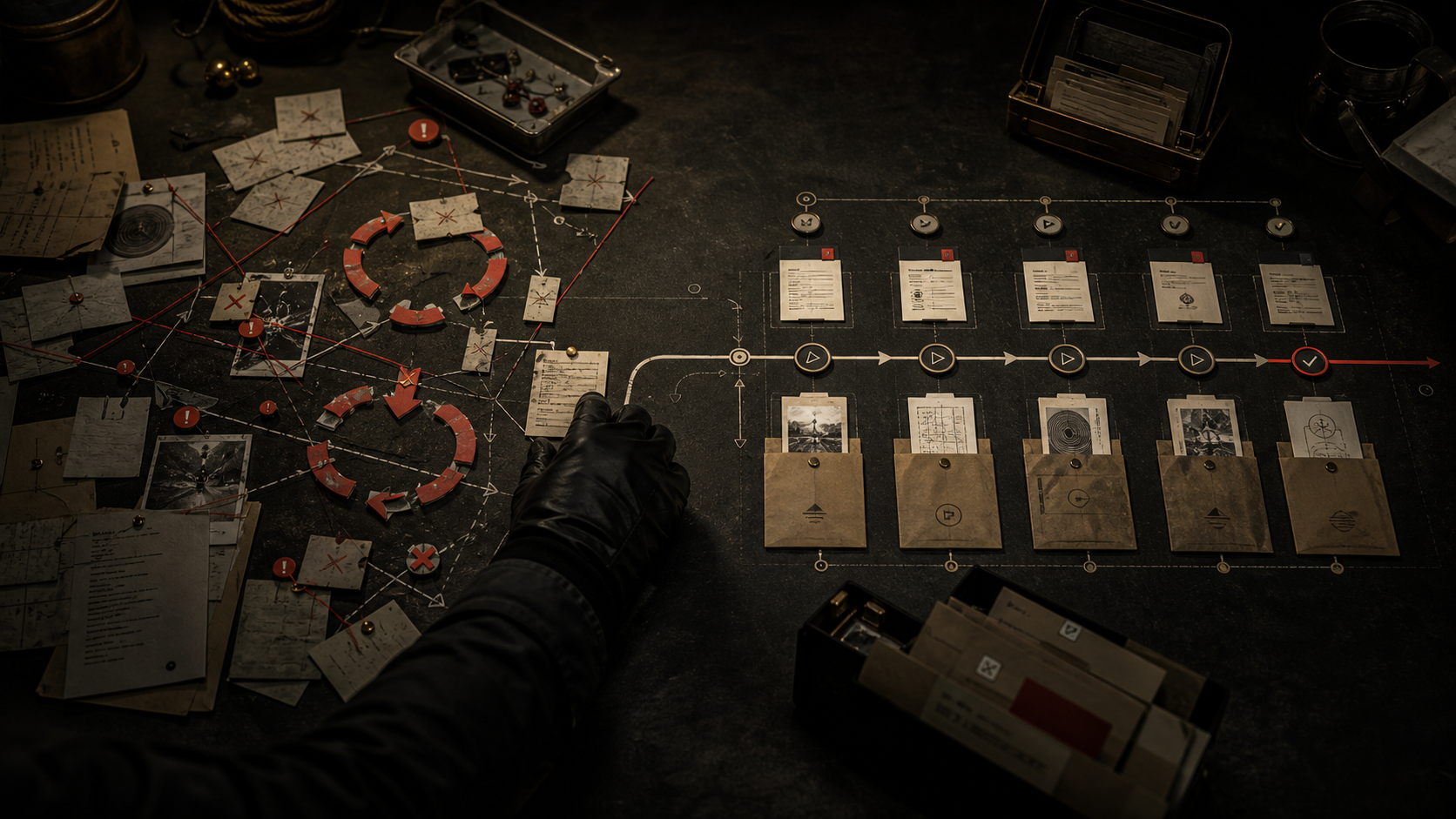
At this point, most business owners do not need help believing AI is real.
That part is over.
The AI webinars happened. The demos happened. The LinkedIn prophets emerged from the fog. Some founder somewhere has already said the word "agentic" with the confidence of a man who has never once had to chase down a missing receipt, reopen a close file, or explain to a client why final_FINAL_v7.xlsx was apparently not, in fact, final.
Beautiful. Inspirational. Meanwhile, back in the actual business, Karen is still manually moving numbers from one system into another like we are rebuilding civilization after a small electrical fire.
And your company still has 14 broken handoffs, 3 systems that do not talk to each other, 1 process everybody swears is documented, 0 people who can actually find the latest version of anything, and one possessed spreadsheet that apparently now has voting rights.
The real problem is not awareness
That is the problem. Not awareness. Not education. Not a lack of AI opinions. Execution.
Because big companies can afford AI theater. They can spend a fortune on strategy decks, pilot programs, internal task forces, and a dashboard that looks like the command center from a science fiction movie while Dave in accounting is still manually fixing exports in a CSV named final_v2_USE_THIS_ONE.xlsx.
Main Street cannot do that.
A real business does not need another keynote about the future. It needs fewer things breaking on Thursday. It needs less dumb rework on Friday. It needs fewer moments where the entire workflow collapses because one person is out sick and apparently that one person was serving as the unofficial backup server for the whole company.
What owners are actually frustrated about
Most owners already feel it.
They are not thinking: "If only I consumed a few more AI thought-leadership posts, surely peace would return to the kingdom."
They are thinking:
- Why does every new tool still need me to babysit it?
- Why does every automation work great until a real human being touches it?
- Why is the team still rebuilding context from scratch every time something gets stuck?
- Why does every process still end with somebody saying, "Just ask me, I know where it is"?
If AI matters this much, why does the business still run like a group project supervised by caffeine, denial, and one heroic employee with Stockholm syndrome?
Because knowing AI matters is not the same thing as getting it to do useful work inside a real company.
Why Main Street cannot afford AI theater
A lot of businesses have already learned that the hard way.
They tried a chatbot. They tried an automation. They tried a custom GPT. Everybody got excited for 72 hours. Somebody called it a game changer. Then it quietly moved into the same cemetery as the CRM cleanup, the SOP overhaul, and the shared drive reorganization.
The business itself? Still weird. Still manual. Still fragile. Still dependent on memory, heroics, and one dangerously underappreciated employee who should honestly be paid in equity, therapy reimbursement, and a percentage of the company.
Main Street deserves better than that. The beating heart of America should not get left behind just because the tools moved faster than operators had time to translate them into something practical.
That translation is the real work. It is not glamorous. It will never get as many likes as some guy yelling about the future of work while standing in front of a gradient background. But it is the work that actually matters.
What Intelligence Solved is built to do
That is why I built IntelligenceSolved.com.
I did not build it to sell AI like a magic trick. I built it to make AI useful in the real world. In real workflows. With real money on the line. With real operators. With real consequences when the process breaks.
This year, I founded IntelligenceSolved.com to build AI native software and autonomous business systems for finance, accounting, and business operations.
I have spent the year architecting and building AI powered applications using AI assisted software development with OpenAI ChatGPT, Anthropic Claude, and Claude Code.
I designed a one human, AI powered company by orchestrating autonomous AI agents that perform software development, research, business intelligence, documentation, quality assurance, and operational workflows.
Which is a fancy way of saying I built a company where the AI does real work instead of starring in a demo like a pageant contestant for the future.
I built ReviewedIt, an AI powered journal entry review operator that applies accounting controls and explainable decision logic to improve review quality and consistency.
I built autoRecon26, an AI assisted financial reconciliation platform that automates reconciliation workflows and accelerates the financial close process.
I also develop multi agent AI systems using OpenClaw, Hermes Agent, Paperclip, Ollama, n8n, Docker, Qdrant, AnythingLLM, Model Context Protocol, and retrieval augmented generation.
Which, again in plain English, means I spend a lot of time taking shiny AI ideas, removing the startup perfume, and forcing them to survive contact with accounting, operations, documentation, QA, and the normal chaos of how businesses actually run.
The first practical next step
You do not need ten more tools. You do not need an AI committee. You do not need to turn your operations manager into a part time philosopher of automation.
You need the first real win. The first workflow that actually works. The first system that survives contact with real life. The first implementation that does not fall apart the second a human behaves like a human.
That is how momentum changes. The team starts trusting it. The owner stops treating AI like a science fair project. The business starts using it like an actual operating advantage.
So if your business already has AI, but it also still has broken handoffs, manual nonsense, and a possessed spreadsheet quietly running half the company, email me. Call me. DM me.
We will figure out where the workflow is actually breaking, what is still depending on you, and what the first practical fix should be.
No hype. No theater. No pretending the prompt itself is the strategy. Just real execution.