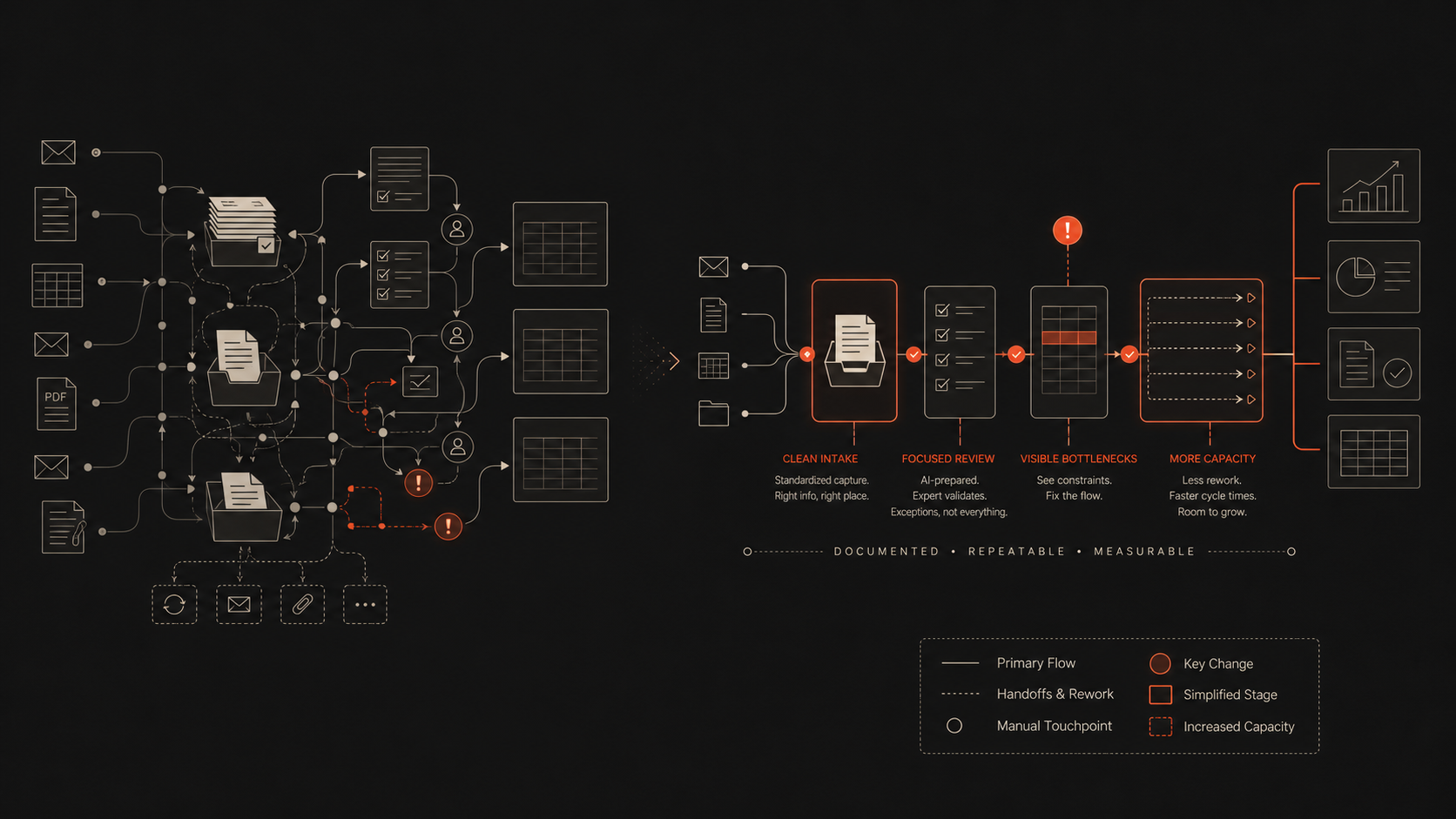
The first thing that changes in a small firm when AI starts working is not the brand, the org chart, or some dramatic overnight reinvention. The first thing that changes is the shape of the day. That is the real signal.
When AI actually starts helping inside a small accounting or bookkeeping firm, the workflow begins to require fewer low-value touches. That is where the shift starts. Not in theory. In operations.
What changes first
1) Fewer manual touches before review
The front end gets lighter. Documents come in cleaner. Extraction gets easier. Recurring coding becomes less manual. Routine reminders stop needing the same human effort every cycle. The workflow does not become effortless, but the low-value contact surface starts shrinking.
That matters because it changes where the team spends its attention. Instead of burning energy on repeated routine actions, people can move more quickly toward the work that actually needs them.
2) Review becomes more exception-focused
Routine items move faster. Weird items get surfaced more intentionally. Senior people spend more time where they should: unusual transactions, gray-area classifications, messy support, control issues, and client-specific judgment calls. That is a healthier operating shape than asking the most expensive people in the room to keep sorting routine volume manually.
3) The real bottleneck becomes obvious
Once repetitive processing gets lighter, the next true problem is easier to see. Usually it is not “we need more AI.” Usually it is late client documents, overloaded review, bad handoffs, recurring cleanup work, or unclear ownership. Good automation does not just reduce work. It exposes workflow weakness.
4) Senior time leaks less
A lot of senior time gets wasted on chasing context, checking routine prep, restarting stalled files, and resolving preventable reopen loops. When the workflow improves, that leak gets easier to reduce. The team starts protecting high-value attention instead of spending it on operational reconstruction.
5) Capacity improves before headcount changes
This is one of the best early signs. The firm starts absorbing more work before hiring more people. Not because the team became superhuman, but because fewer hours are being burned on repetitive low-value touches. Capacity opens before the org chart changes.
6) Process discipline matters more, not less
This surprises people. Strong automation does not reduce the need for standards. It makes weak standards easier to see. Messy intake, vague prep rules, loose handoffs, and inconsistent review all become more obvious faster once the workflow gets tighter elsewhere.
7) Hero culture weakens
A lot of small firms are still being held together by memory and heroics. When AI starts working inside a stronger workflow, the firm depends less on one person carrying the whole month. That is a real maturity shift. The system begins to hold more truth, and fewer people need to act like the memory layer for everything.
What does not change first
What usually does not change first is strategy, positioning, or staffing structure. Those may evolve later, but they are not the first proof. The earliest proof is operational: fewer touches, cleaner review, more visible bottlenecks, and less dependence on individual heroics.
How to tell whether the progress is real
Ask whether the workflow now reaches review with less friction. Ask whether the same monthly blocker is easier to see. Ask whether staff are reopening fewer files for preventable reasons. Ask whether senior people are spending less time reconstructing status. If the answer is yes, the AI is probably helping in a real way.
If the answer is no, the firm may have added tools without improving the operating model underneath them.
Closing thought
The first change is not abstract. It is operational. The workflow requires fewer low-value touches. Review gets more focused. Bottlenecks become clearer. Capacity opens up. Hero culture weakens. That is what real progress tends to look like first in a small firm when AI starts working.