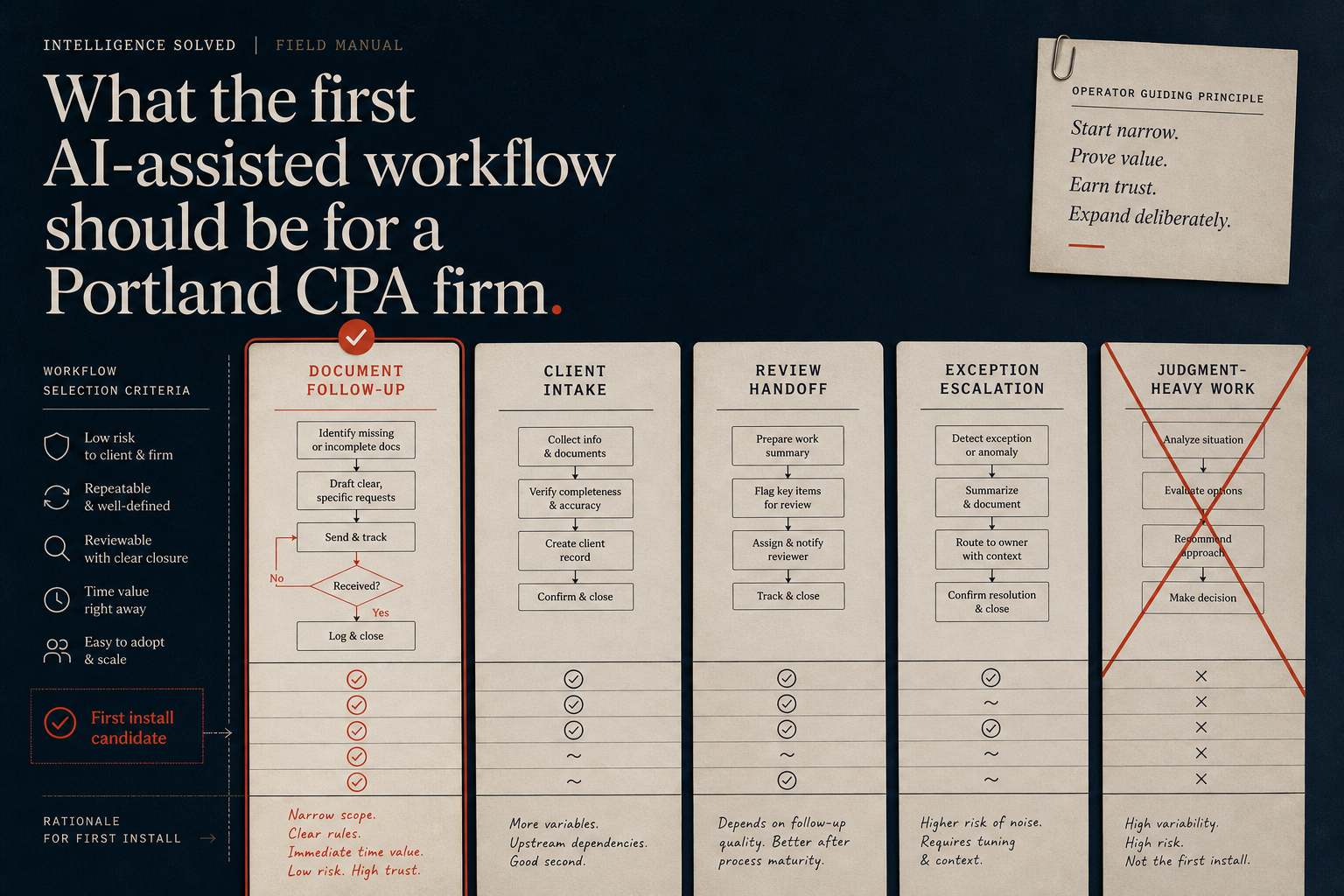
When a CPA firm starts thinking seriously about AI, the conversation often becomes too broad too quickly. Teams talk about transformation, automation, or the future of accounting before they have agreed on the first repeated workflow worth improving. That sequence creates confusion. It encourages firms to compare tools before they have named the actual operating bottleneck. It also creates pressure to find a dramatic use case when the best first win is usually much narrower and much more procedural.
The better question is not what AI can do in the abstract. The better question is which recurring workflow already behaves like a machine should be helping, but is still being held together by inboxes, memory, repeated drafting, and manual context reconstruction. Current source-backed guidance supports a restrained answer. NIST’s AI Risk Management Framework emphasizes governance, oversight, and risk-aware deployment.[1] IFAC guidance commonly supports pairing technology with process redesign and workflow clarity.[2] AICPA and CIMA resources reinforce documented responsibilities, quality management, and professional accountability.[3] CPA.com and related accounting-technology resources support practical, staged technology adoption rather than vague experimentation.[4]
Taken together, those sources support a useful implementation rule: the first AI workflow should not be the most ambitious workflow. It should be the first workflow where the task is sufficiently repetitive, bounded, and reviewable that the firm can improve coordination without blurring who owns the final accounting judgment.
The wrong way to choose a first AI workflow
The most common selection mistake is to start with the highest-visibility accounting decision rather than the highest-friction coordination layer. Firms ask whether AI can help classify unusual transactions, resolve difficult tax judgments, or accelerate reviewer throughput on edge cases. Those questions sound strategic, but they are usually poor entry points. The work is too ambiguous, the exception rate is too high, and the professional judgment burden is too central to the task.
Governance and quality-management guidance does not support casual deployment in those lanes.[1][2][3] The issue is not whether a model sometimes produces plausible output. The issue is whether the firm can supervise, verify, and own the result consistently. High-judgment tasks are hard to govern first because the workflow itself often depends on nuanced interpretation, incomplete records, and material exceptions. That makes them weak candidates for an early implementation.
A first workflow should therefore not be chosen for prestige or theoretical leverage. It should be chosen for controllability. If the firm cannot clearly define the expected input, the routine output, the review boundary, and the escalation path, the workflow is probably not a good first candidate.
This is also why “AI can help everywhere” is not a useful selection rule. A first pilot should narrow uncertainty, not multiply it. When the workflow itself is hard to describe, the pilot becomes a test of improvisation rather than a test of disciplined implementation.
The first AI workflow should be easy to govern before it is impressive to describe.
The right way to choose a first AI workflow
A better selection lens is to look for a workflow that repeatedly consumes skilled labor even though much of the burden is procedural. In many CPA firms, that means a lane built around recurring follow-up, open-item tracking, intake clarification, handoff summarization, or status visibility. Those tasks may not define the accounting conclusion, but they often define how much friction the firm pays before it reaches the conclusion.
That is why the first useful AI workflow is often located around the accounting work rather than inside the final judgment. A model may be quite valuable when it helps draft routine requests, summarize unresolved items, or structure a review handoff. In those contexts, the firm is not delegating professional judgment. It is reducing repetitive coordination work that can be reviewed quickly and governed more clearly.
This selection logic is also consistent with transformation guidance that treats technology as part of workflow design rather than as a free-standing answer.[2][4] A workflow-first choice gives the firm a practical test: does this step become easier to trust, easier to review, and easier to measure once AI assists with the procedural layer?
Another way to frame the decision is to ask whether the workflow already has a stable “before” picture. If leadership cannot describe what currently triggers the task, what a routine completion looks like, and why the work is often reopened, then the lane may still be too fuzzy to automate well. Good first workflows usually have pain that is obvious even before the technology enters. Once that boundary is clear enough to install, the AI workflow implementation for accounting firms path turns the diagnosis into a bounded handoff.
Why client document and information follow-up is such a strong early candidate
For many CPA firms, the clearest early-fit workflow is the document and information follow-up layer around recurring client work. IRS guidance telling taxpayers to gather all tax-related paperwork and wait until all relevant documents are received before filing supports a broader intake principle: downstream work becomes unstable when inputs are incomplete.[5] In practice, firms experience that instability as repeated chases for statements, payroll details, K-1s, loan documents, owner clarifications, and other support that is required before prep or review can proceed cleanly.
This lane is attractive as a first AI workflow for several reasons. The communication pattern repeats. The requests are often structurally similar. The next action is usually procedural. The outputs can be reviewed quickly. And the value is easy to see because the workflow either becomes easier to track or it does not. A model can help draft missing-item requests, summarize open items, or convert scattered notes into a consistent status summary. A human still determines whether the support is substantively sufficient and whether the file can move forward.
That separation is what makes the workflow defensible. The model supports coordination around the file; it does not own the accounting conclusion inside the file.
It also makes the pilot easier to explain internally. Partners, managers, and staff can usually see immediately what part of the process is being assisted and what part remains fully human-controlled. That clarity reduces the chance that the team will overtrust the system simply because it generated polished output.
Why this workflow usually wins the first-pass test
- the task repeats across many files and cycles
- the expected output is similar enough to standardize
- human review of the generated output is fast
- the workflow pain is already visible to the team
- the firm can measure whether the queue becomes easier to manage
These are practical reasons, not hype reasons. That is exactly what makes them suitable for a first implementation.
The first AI workflow should reduce context rebuilding
One of the most expensive hidden tasks in a CPA workflow is context rebuilding. Someone has to reread the thread, re-check what is missing, restate what the client already sent, clarify whether the issue is routine or unusual, and explain the current status to the next person. This work is rarely labeled as the primary bottleneck, but it quietly consumes a large share of experienced attention.
That is one reason a first AI workflow should usually be chosen for its ability to reduce context rebuilding. A useful early implementation may summarize what has been received, what remains open, which follow-up has already occurred, and what should happen next. That summary does not replace review. It shortens the path to review by making the file easier to understand.
Firms sometimes overlook this because they are looking for tasks that sound more technical. But the more modest win is often the more durable one. If a reviewer or manager can approach a file with less procedural uncertainty, the workflow has already improved in a meaningful way.
This is also one reason the first workflow should usually sit near the handoff layer. Handoffs are where missing context becomes most expensive. If AI can help the next person understand what is known, what is missing, and why the file is waiting, then the process becomes more legible without the model making the accounting call itself.
Bounded and reviewable beats broad and impressive
Early AI selection should favor bounded workflows over broad mandates. A bounded workflow has a known trigger, a known expected output, a clear reviewer, and an explicit exception route. That makes it inspectable. A broad mandate, by contrast, invites uncontrolled variation. Different staff use the tool differently, outputs are trusted inconsistently, and no one can clearly say what the model is allowed to do or how the results should be checked.
NIST AI RMF and related governance guidance are especially relevant here because they emphasize risk-aware controls, monitoring, and accountability.[1] Those principles are much easier to apply inside a single repeated workflow than across a vague firmwide adoption effort. The first AI workflow should therefore be small enough that leadership can answer practical supervision questions, not just strategic ambition questions.
For example, it should be possible to say what inputs are allowed, what the AI output is supposed to produce, what a human must verify, and what kinds of cases leave the standard lane. If those answers are unclear, the workflow is not yet ready to be the first one automated.
Human review boundaries should be explicit before the pilot starts
A first AI workflow is safer when the human-review line is declared before the firm starts testing output. Governance and professional guidance consistently support oversight and accountability.[1][2][3] In practice, that means the team should state whether the model is only drafting, whether the model may summarize but not decide significance, and whether certain files automatically trigger escalation outside the AI-supported lane.
This may sound obvious, but many early pilots fail because the boundary is implied instead of defined. Staff assume the tool is only for drafting until someone begins relying on it more heavily during a busy week. Reviewers assume the output was already checked by the preparer. Managers assume the workflow is more advanced than it actually is because the model touched it. These are supervision failures as much as technology failures.
The simplest version of a strong review rule is often enough: AI may draft the communication or summary; a human confirms accuracy, completeness, and next action before the workflow moves forward. That keeps the output inside a visible control environment.
It is also worth deciding in advance what the reviewer is expected to verify. Is the reviewer checking factual completeness, checking the state label, confirming escalation, or confirming client-facing wording? The more explicit that review task is, the less likely the pilot is to create ambiguous trust.
Questions that should be answered before launch
- What exactly is the model allowed to generate?
- Who reviews the output before it changes client-facing or workflow state?
- Which facts move the file out of the routine lane and into exception handling?
- What evidence will show whether the pilot improved the workflow?
If those questions are unanswered, the first workflow is probably not sufficiently governed yet.
What not to automate first
A CPA firm should be particularly careful not to make its first AI workflow one that quietly asks the model to own professional judgment. That includes unclear account classification, material exception resolution, contradictory evidence analysis, or final client-facing conclusions on ambiguous matters. Even if the model appears useful, these tasks usually carry too much risk and too much interpretive nuance to serve as an early proving ground.
The reason is not fear of technology for its own sake. It is that early wins should improve trust in the system, not create new uncertainty about who made the decision. A workflow that sits too close to final accounting judgment makes it harder to maintain that trust, especially in a small firm where review capacity is already stretched.
By contrast, a workflow built around repeated follow-up, status summarization, or unresolved-item packaging can create value without requiring the firm to blur accountability. That is why narrower support workflows are usually more defensible as the first install.
Exception handling should be designed into the first workflow, not discovered later
Every repeated workflow has exceptions. The mistake is to assume that a narrow pilot eliminates the need to plan for them. A stronger approach is to define from the beginning which cases remain in the routine lane and which cases trigger escalation. In a document or information follow-up workflow, for example, a routine missing item may stay in the AI-supported lane, while contradictory support or unusual fact patterns move immediately to human review.
This is consistent with governance-oriented thinking because it keeps the model inside a bounded surface and makes escalation visible.[1][2] It also protects the firm from a common false positive in early pilots: the workflow looks successful only because the model handled the simplest cases and the team quietly resolved the hard cases off to the side without naming them. Explicit exception rules make the pilot easier to assess honestly.
Once those exception boundaries are visible, the firm can better judge whether the workflow is truly a good candidate. If almost every file leaves the routine lane, the workflow may be too variable to serve as the first AI workflow. If most files stay in the lane and the exceptions are easy to identify, the fit is much stronger.
This also helps the firm avoid overstating the success of an early pilot. A workflow that performs well on routine cases but depends heavily on silent human rescue for edge cases is not ready to be described as broadly solved. Designing the exception boundary early keeps the evaluation honest.
The first pilot should be chosen so its success is easy to observe
There is a practical advantage to picking a workflow where improvement becomes visible quickly. Leaders do not need a universal ROI number to know whether the pilot helped. They need proof that the process became easier to trust. Did open items become easier to see? Did follow-up language become more consistent? Did reviewers spend less time reconstructing status? Did blocked work become easier to separate from active work?
These are workflow-quality questions, and they are often more valuable than generic productivity claims. A first pilot should be designed so the team can answer them honestly. That is one reason document and information follow-up is such a strong early lane. The before-and-after state is easier to inspect than in many judgment-heavy workflows.
It also means the firm can talk about success in operational language rather than in speculative transformation language. If the workflow is more legible, if the state of the file is easier to understand, and if the reviewer spends less time reconstructing what happened, then the pilot is teaching the team something real about where AI belongs. That kind of learning is more durable than a one-time demo effect because it changes how the firm chooses future workflows.
Another advantage of an observable pilot is that it disciplines internal reporting. Instead of telling leadership that the firm is “experimenting with AI,” the team can say whether one repeated lane became easier to route, easier to summarize, or easier to review. That kind of evidence is modest, but it is also much more credible.
Useful early proof objects
- number of follow-up touches per file
- share of files with a clear unresolved-items summary
- reviewer time spent rebuilding status context
- age of open items waiting on client response
- share of AI-assisted items that required full rewrite or escalation
These are not universal benchmarks. They are practical indicators that help the firm decide whether the workflow is becoming more orderly.
Workflow selection matters more than AI stack selection at first
CPA firms can lose momentum by over-focusing on vendor comparison before they have identified the right first lane. The more important decision is usually the workflow choice itself. If the workflow is weakly chosen, even a capable tool may produce disappointing results. If the workflow is well chosen, the firm often has more flexibility in how it supports the task technically.
This matters because early AI adoption should build operational confidence, not just software familiarity. A well-chosen workflow teaches the team what good governance looks like, how human review should be structured, and where later expansion might make sense. A poorly chosen workflow teaches only that the tool is risky or overhyped, even when the real problem was selection discipline.
That is why the first AI workflow is as much an operating-design decision as a technology decision. It should prove that the firm can narrow scope intelligently, maintain clear review boundaries, and improve one repeated lane before trying to modernize the whole practice at once.
In many firms, this changes the buying conversation itself. Instead of asking which platform promises the most features, leadership begins by asking which workflow state is unstable, which step repeats often enough to standardize, and which outputs are simple enough to inspect. That sequence tends to produce better implementation choices because the workflow is doing the selection work, not the demo.
A realistic first-workflow rollout sequence
A practical rollout often follows a simple sequence. First, choose one repeated workflow that already generates visible coordination drag. Second, define the states, owners, and exception rules. Third, decide what the model may draft, summarize, or classify. Fourth, preserve human review before any state changes or client-facing actions finalize. Fifth, measure whether the workflow is easier to trust after the change.
This sequence is intentionally narrower than the typical AI launch narrative. It is also more consistent with current professional and governance guidance.[1][2][3][4] The firm is not trying to prove that AI can transform every service line. It is trying to prove that one repeated workflow can become cleaner, lighter, and easier to supervise.
That usually produces a better first internal story as well. Instead of announcing a sweeping initiative, leadership can explain that the firm is improving one visible coordination lane while keeping professional judgment and formal review exactly where they belong. That framing lowers the emotional temperature around adoption because the workflow change sounds practical rather than existential.
It also creates a more honest basis for expansion. If the first lane works, the firm learns which governance habits, review rules, and exception boundaries are transferable. If it does not, the firm has failed inside a narrow surface that can be repaired without creating broad operational confusion.
That discipline is important because first pilots often set the cultural tone for everything that follows. If the first workflow is chosen carefully and governed clearly, the team learns that AI belongs inside explicit operating rules. If the first workflow is chosen loosely, the team learns to treat AI as improvisation. The first lesson tends to persist.
The first successful AI workflow is not the one with the biggest promise. It is the one that makes one repeated lane meaningfully easier to run without weakening control.
Why the first workflow should feel familiar to reviewers
A strong first workflow usually feels familiar to the people who will supervise it. That matters because supervisors should not have to learn a radically new operating logic just to determine whether the workflow is still safe. If the lane is built around status clarity, missing-item follow-up, unresolved-items packaging, or pre-review summarization, reviewers can usually compare the AI-assisted output against the workflow they already know. That makes supervision more realistic.
Familiarity does not mean the firm should keep inefficient habits forever. It means the first implementation should improve a known lane before trying to redesign the whole practice at once. In governance terms, this reduces adoption risk because oversight stays connected to existing human understanding rather than to a black-box promise.[1][2][3]
This is another reason narrow coordination layers often outperform more glamorous use cases as the first install. Reviewers can quickly tell whether the output clarified the workflow or merely created another artifact to inspect. That distinction is central to whether the pilot will build confidence or create fatigue.
Why repeated communication workflows often surface first
Many early-fit workflows share a communication-heavy profile. The team is repeatedly requesting missing information, summarizing open items, routing updates, clarifying what is still required, or packaging the state of a file for the next handoff. Those tasks can be labor-intensive even when the underlying accounting judgment has not begun yet. They are also easier to standardize because the structure of the communication often repeats even when the client details change.
That repetition is important because it gives the firm a clearer basis for evaluating whether AI assistance is helping. If a request draft becomes easier to review, if a status summary becomes more legible, or if the next person can understand the handoff faster, then the workflow is improving in ways the team can observe directly. Those are stronger early signals than a general feeling that the tool is impressive.
Under an ultra-conservative evidence bar, this should still be framed carefully. The claim is not that communication-heavy workflows are always the best answer for every CPA firm. The claim is that governance and workflow guidance support starting where the work is repetitive, bounded, and easy to supervise, and many communication-heavy coordination lanes fit that description better than judgment-heavy lanes do.[1][2][3][4]
The first workflow should clarify ownership, not blur it
Another useful selection test is whether the workflow becomes easier to own once AI enters. If the introduction of AI makes it harder to tell who is responsible for the output, the lane is probably a poor first candidate. A better first workflow makes ownership more visible because the generation step, the review step, and the escalation step can all be named separately.
This matters in practice because hidden ownership drift is one of the fastest ways for a pilot to lose credibility. Staff assume the reviewer owns the decision. Reviewers assume the preparer verified the output. Leadership assumes the workflow is under control because the tool is being used carefully. A bounded first workflow should reduce that ambiguity, not multiply it.
That is why the workflow should be describable in operating verbs. Who drafts? Who checks? Who decides whether the file can move forward? Who handles exceptions? If those verbs are unclear before the tool enters, the workflow may still need design work before it is ready for AI support.
Why strong first pilots are conservative by design
Some leaders worry that a conservative first pilot looks too modest. In reality, conservatism is often what makes the first pilot credible. A narrow scope protects the firm from confusing tool novelty with workflow improvement. It also aligns better with the sources that emphasize governance, risk management, oversight, and professional responsibility.[1][2][3]
A conservative pilot does not reject ambition. It sequences ambition. The firm first learns how to govern AI inside one lane where the costs of ambiguity are lower and the benefits of clarity are easier to inspect. Only after that discipline exists does broader expansion become believable. This order of operations usually creates a stronger long-term result than trying to leap directly into high-judgment automation.
It also keeps the internal conversation healthier. The team can debate one workflow design instead of debating the future of the profession every time the tool comes up. That tends to make adoption less ideological and more operational.
What a bad first pilot usually feels like from inside the firm
Bad first pilots often produce a recognizable pattern. The output looks polished, but no one is fully sure what was checked. Reviewers spend as much time re-verifying the work as they would have spent building it manually. Edge cases quietly leave the lane, but the pilot is still described as successful. Staff become cautious because they sense the workflow is asking them to trust more than leadership has explicitly authorized.
Those symptoms matter because they show that the workflow is not merely underperforming technically. It is underperforming operationally. The lane is not giving people clearer review, clearer ownership, or clearer exception handling. In that environment, calling for more adoption usually makes the system less trusted, not more.
A good first workflow should feel almost boring in comparison. The task is clear. The output is modest. The reviewer’s job is visible. The exception path is known. The workflow becomes easier to manage rather than more exciting to talk about. That is usually the more reliable sign that the first pilot was chosen well.
How the first workflow shapes the firm’s next choices
The first workflow matters beyond its immediate output because it becomes a template for later selection decisions. If the first implementation is well-scoped, well-reviewed, and honest about exceptions, the firm develops a repeatable way to ask whether a second workflow is ready. The team stops selecting workflows because they sound advanced and starts selecting them because they pass concrete governance and operating tests.
That shift is valuable even if the first pilot remains small. A firm that learns how to separate bounded coordination tasks from judgment-heavy tasks has already improved its implementation discipline. It can now evaluate future candidates with better questions about supervision, fit, review, and observability.
In that sense, the first workflow is not only a productivity test. It is a selection-discipline test. It reveals whether the firm can make a sober implementation decision under real operating constraints.
What to bring into the first-workflow planning conversation
Before the pilot begins, leadership should be able to bring a simple operating picture into the discussion: the workflow name, the trigger that starts it, the states it moves through, the owner, the reviewer, the common routine outputs, and the facts that force escalation. That picture does not need to be elaborate. It does need to be explicit enough that the team can see what the model is and is not being asked to do.
This planning conversation is also the right place to decide which evidence will be used to judge whether the workflow improved. If that evidence is left undefined, the firm may later confuse polished output with real operating improvement. A modest measurement plan makes the pilot more honest.
Most importantly, the planning conversation should preserve the distinction between procedural support and professional judgment. The model may help the workflow move. The human still owns the accounting conclusion.
Questions a CPA firm should ask before picking its first AI workflow
- Is the task repetitive enough that the expected output is usually similar from case to case?
- Can we describe the workflow states clearly enough that a human can verify the output quickly?
- Does the task sit around professional judgment rather than inside the final judgment itself?
- Do we know which cases should escalate immediately out of the routine lane?
- Would success reduce hidden coordination labor, or only produce more text more quickly?
- Can we tell whether the pilot worked without relying on vague productivity claims?
If the answers are unclear, the firm usually needs more workflow design before more AI deployment.
The bottom line
The first AI workflow a CPA firm should automate is usually not the most complex accounting task. It is the first repeated coordination layer that is narrow enough to standardize, reviewable enough to supervise, and important enough to reduce hidden drag once it improves. Governance, professional, and accounting-technology guidance all support starting with clear scope, defined oversight, and process discipline rather than with broad speculative adoption.[1][2][3][4]
For many firms, that points toward the document and information follow-up layer, unresolved-items summaries, or another bounded workflow that reduces context rebuilding without handing professional judgment to the model. That is a smaller promise than most AI marketing makes. It is also the promise most worth keeping, because it gives the firm one lane it can actually trust before expanding further.
That narrower approach is not a compromise. It is usually the fastest path to a real operating win because it lets the firm improve a known source of friction without creating a new source of governance uncertainty. The first AI workflow should teach the team how to control the tool, not how to admire it.
Once a firm can point to one workflow that is clearly scoped, clearly reviewed, and meaningfully easier to run, future expansion decisions get better. The firm stops asking, “Where can we force AI into the practice?” and starts asking, “Which next workflow is now clear enough to deserve support?” That is a much stronger operating posture.
If you want to choose the first AI workflow without guessing
Intelligence Solved helps CPA and accounting teams scope one bounded workflow, define the human-review line, and install AI only where the process is narrow enough to trust.
Sources
- NIST, AI Risk Management Framework, nist.gov.
- IFAC Knowledge Gateway, digital transformation and practice guidance, ifac.org/knowledge-gateway.
- AICPA/CIMA professional resources and quality management standards resources, aicpa-cima.com and quality management standards.
- CPA.com resources on AI and firm technology adoption, cpa.com.
- IRS, “Get ready to file in 2025: IRS highlights what taxpayers should know before filing in 2025,” irs.gov.