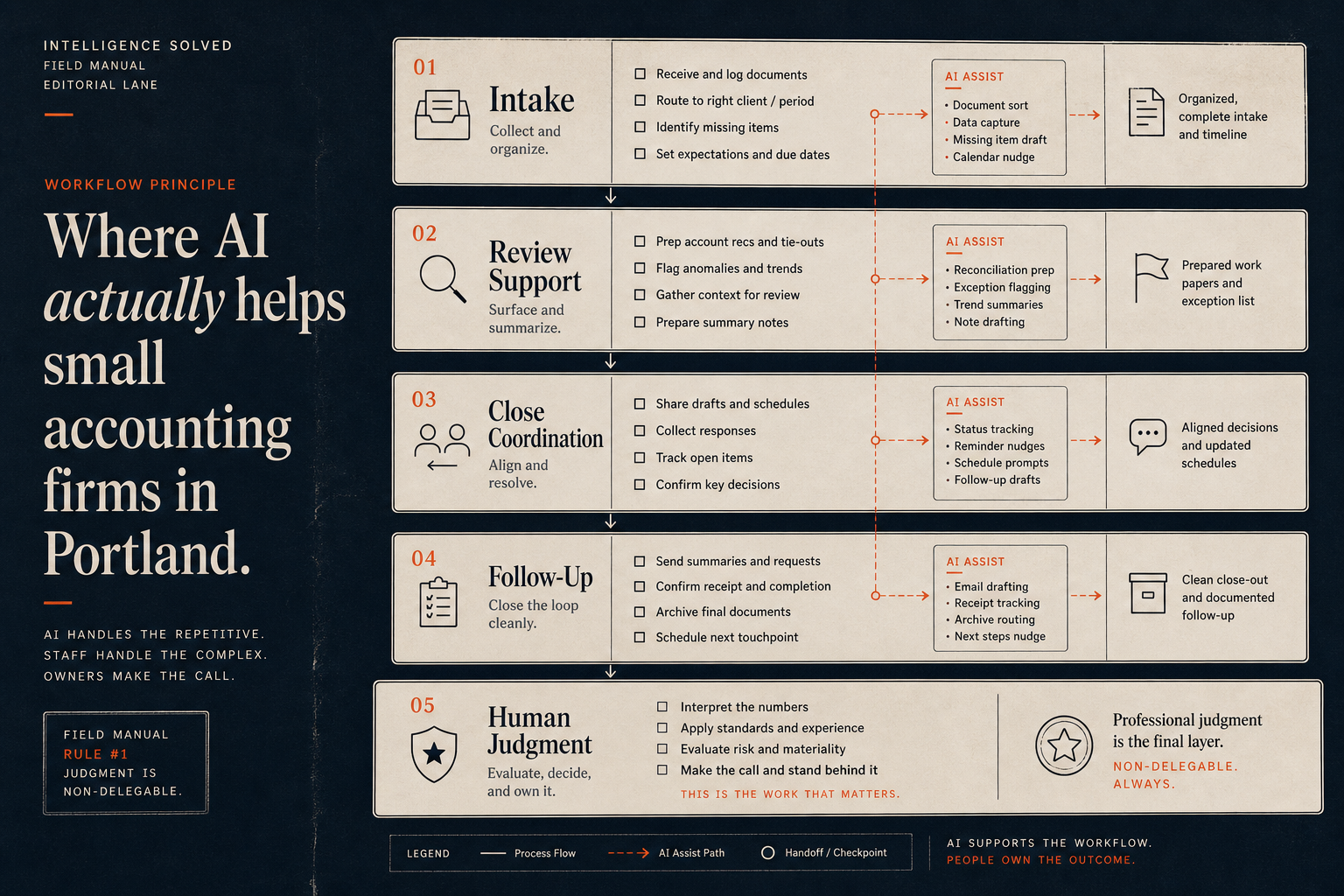
Most of the public AI discussion aimed at accounting firms is still too broad to be useful. It jumps quickly to replacement narratives, sweeping productivity promises, or generic software categories. That framing creates noise because it starts from the tool instead of the workflow. Small firms rarely experience their operating problems as “lack of AI.” They experience them as document chasing, repeated clarifications, delayed approvals, overloaded reviewers, fragmented close communication, and too much context living in people’s heads instead of in the process.
That is why the better question is not whether AI matters in accounting. The better question is where AI can help without asking the firm to surrender judgment, controls, or accountability. The strongest source-backed guidance available today points toward a restrained answer. NIST’s AI Risk Management Framework emphasizes governance, risk management, oversight, and accountability.[1] IFAC’s digital transformation guidance commonly supports pairing technology with process redesign rather than treating technology as a substitute for operating discipline.[2] AICPA and CIMA professional resources consistently reinforce documentation, human responsibility, and quality-management expectations.[3] Finance operations literature from sources such as Deloitte, BlackLine, and APQC repeatedly points to repetitive manual gathering, exception handling, and fragmented workflows as chronic friction layers.[4][5][6]
Taken together, those sources support a conservative operating principle: AI tends to help small accounting firms most when it is applied around repetitive coordination work inside a process that the firm can already describe clearly. That is a narrower claim than “AI transforms accounting,” but it is also far more useful for a firm deciding what to change first. When the firm is ready to move from category thinking to one scoped process, see the AI workflow implementation for accounting firms path.
AI is a workflow tool first, not a judgment substitute.
One of the easiest ways to waste time in AI adoption is to start with the question, “What can this model do?” That question usually leads to demos rather than durable workflow improvement. A more grounded question is, “Which recurring tasks consume skilled attention even though the task itself is mostly coordination, drafting, routing, or summarization?” In a small accounting firm, those tasks often sit around the accounting work rather than at the center of final judgment.
That distinction matters because professional and governance guidance does not support casual automation of high-risk judgments. NIST AI RMF emphasizes that AI systems should be governed according to risk and monitored with human accountability.[1] AICPA/CIMA and IFAC guidance likewise support professional oversight, documented responsibilities, and appropriate review boundaries.[2][3] In plain language, that means the safer early uses of AI are usually support functions around the workflow: drafting follow-up, summarizing open items, classifying routine status states, preparing review context, or helping a team see what is waiting where.
By contrast, the least safe early uses are the ones people often market most aggressively: letting AI make final calls on unclear accounting treatment, approve ambiguous exceptions, or resolve contradictory records without tightly defined human review. Even where the model appears capable, the workflow and accountability burden remain with the firm. That is why a workflow-first lens is more honest than a capability-first lens.
Good AI use in a small accounting firm usually starts where the work repeats and the judgment does not.
Where AI tends to help first: repetitive coordination layers.
Finance transformation and close-management literature consistently returns to recurring friction around manual collection, fragmented systems, exception handling, and workflow visibility.[4][5] For a small firm, those themes often show up in very practical places. Staff spend time drafting the same reminder in slightly different words. Managers re-explain missing items to multiple people. Reviewers reconstruct file history because the file does not carry enough context forward. Owners ask where work stands because the queue is not easy to read from the system alone.
Those are promising AI surfaces because the firm is not asking the model to decide the accounting. It is asking the model to support the coordination layer around the accounting. Under an ultra-conservative evidence standard, the precise productivity gain should not be overstated. But it is still reasonable to say that these tasks are more defensible starting points because they are repetitive, bounded, and easier to review than final accounting judgments.
Common early-fit categories
- drafting routine follow-up messages for missing documents or unanswered questions
- summarizing unresolved items before review
- turning scattered notes into a structured handoff summary
- classifying routine workflow states such as waiting on client, incomplete, ready for prep, or pending review
- surfacing recurring exceptions that already have a defined escalation path
These categories are not exciting because they sound futuristic. They are useful because they address hidden labor that repeats every week or every month. In a small firm, that hidden labor is often where leaders first feel pressure but cannot easily trace it to a single headline task.
The workflow must already be narrow enough to trust.
AI helps less than people expect when the workflow itself is still vague. If a firm cannot define what makes a packet review-ready, if staff use several intake channels interchangeably, or if open items are tracked through personal memory rather than visible states, then any AI layer added on top will inherit the same ambiguity. The technology may produce more motion, but not necessarily more control.
That is why IFAC’s emphasis on process redesign matters so much here.[2] The lesson is not merely that technology and process should both be considered. The deeper lesson is that technology has an easier time helping when the process has already been made legible. A draft reminder can be helpful if the workflow clearly knows what is missing. A summary can be useful if the file has a defined unresolved-items state. A routing suggestion can be useful if ownership and next-step rules already exist.
In practical terms, small firms should usually define the lane before they automate the lane. That means clarifying a single repeated workflow, naming the statuses, deciding what evidence is required to move forward, and documenting who owns each stage. Only then does an AI layer become easier to evaluate. Otherwise the team risks mistaking output generation for workflow improvement.
Document intake is often the most visible early opportunity.
IRS guidance telling taxpayers to gather all tax-related paperwork and wait until all relevant documents are received before filing is tax-season guidance, but it also reinforces a broader intake principle: incomplete input states create downstream instability.[7] Small accounting firms see the same logic in monthly work, document collection, cleanup engagements, and recurring close support. If the intake state is unclear, the rest of the workflow pays for it repeatedly through re-requests, clarifications, and partial starts.
This is one reason AI can help more around intake coordination than around final accounting treatment. The workflow often repeats. The requests recur. The missing-item language is similar from file to file. The next step is usually clear once the status is known. That does not mean the model should decide whether the support is substantively sufficient. It means the model can assist with the repetitive communication and summarization surrounding that judgment boundary.
A safe early implementation example, framed as an operating recommendation rather than as a universal rule, is to use AI to draft standardized follow-up messages based on a structured missing-items list that a human has already defined. Another is to summarize what has been received, what remains open, and what should be escalated before the reviewer opens the file. In both cases, the model is helping the process carry context more consistently. A human still owns the accounting significance of the missing item.
Why intake support is such a common starting point
- the communication pattern repeats frequently
- the next action is often procedural rather than judgment-heavy
- the outputs are easy for a human to review quickly
- the workflow value is visible because fewer clarifications get recreated manually
- the firm can test the change in one lane without redesigning the whole practice
That is a more realistic first step than asking AI to “do bookkeeping.” The support layer is narrower, and the accountability lines remain much easier to see.
Review support is useful when it reduces context rebuilding.
Small-firm reviewers often spend time on a kind of labor that does not appear in official role descriptions: rebuilding context. They read email trails, check which documents were received late, determine whether a preparer already noticed a discrepancy, and infer whether an open item is routine or unusual. That is not pure accounting analysis. It is coordination work wrapped around review.
Source material on quality management and workflow control supports the value of documentation, monitoring, exception handling, and clearer process visibility.[3][5][6] Under that lens, AI can help where it turns scattered procedural context into a concise review packet or unresolved-items summary. The objective is not to let the model sign off on the work. The objective is to help the reviewer spend more of their attention on the real judgment layer and less on reconstructing the history of the file.
For example, a reviewer may benefit from a short summary that states: what was requested, what remains missing, which open items were already surfaced by the preparer, and which items were escalated because they sit outside routine treatment. A human still evaluates whether those summaries are complete and whether the accounting conclusion is sound. But the summary can reduce the amount of repetitive reconstruction work needed to get to that point.
AI is at its most practical when it helps the file explain itself before a reviewer touches it.
Close coordination and status visibility are stronger targets than high-risk accounting decisions.
Close and monthly bookkeeping environments often suffer from invisible waiting. A task looks active even though it is blocked on a document, a clarification, or an approval. Leaders then see a large queue but cannot easily separate active work from stalled work. Finance operations literature often treats cycle time, exception aging, and close visibility as meaningful operating dimensions.[4][5][6] That makes workflow visibility a more credible AI surface than final accounting decisions on unusual items.
Here again, the model is not replacing judgment. It is helping the firm keep the queue legible. AI may help summarize blocked reasons, convert notes into structured statuses, or prepare a short daily digest of which files are waiting on which next step. Those uses can be valuable because they improve coordination without asking the system to own a professional conclusion.
This also explains why AI is often disappointing when firms apply it first to the most intellectually complex part of the process. Complexity does not automatically equal fit. In many cases it means the task has too much ambiguity, too many edge conditions, or too much implicit judgment to be a sensible early automation target. The lower-risk gains are often sitting in the surrounding workflow, where the repeatability is higher and the review boundary is clearer.
What small firms should not ask AI to own first.
There is a persistent temptation to use AI as a shortcut around scarcity of experienced review capacity. That temptation is understandable, especially in small firms where the same people carry both production and oversight responsibilities. But a conservative reading of the available guidance does not support treating AI as a substitute for human judgment on ambiguous, material, or exception-heavy accounting matters.[1][2][3]
That means early implementations should avoid letting AI independently finalize unclear classifications, approve unsupported balances, resolve contradictory source evidence, or decide whether an unusual fact pattern can be treated as routine. Even if the model appears useful in some instances, the control and accountability structure is not strong enough to justify starting there. A firm benefits more by protecting those boundaries explicitly and using AI around the work, not through it.
Poor early-fit categories
- final approval of ambiguous account treatment
- resolution of contradictory or incomplete evidence without documented review
- automatic handling of unusual or high-risk exceptions that lack a standard path
- client-facing conclusions that bypass human signoff
- workflow changes where no one can clearly name the owner, reviewer, or exception route
Putting those boundaries in writing is part of readiness. It keeps a small pilot from quietly turning into uncontrolled reliance.
Exception handling is where weak AI implementations usually reveal themselves.
Routine coordination work is attractive because the expected output is relatively consistent. Exceptions are different. They arrive with incomplete records, contradictory explanations, unusual timing, or edge-case facts that do not fit the normal lane. Finance and governance guidance repeatedly treats exception handling as a control-sensitive area, whether the source is talking about reconciliation breaks, financial-close issues, or general risk management.[1][4][5] That is one reason exception-heavy workflows are poor candidates for broad unattended automation.
For a small accounting firm, the practical lesson is not that AI is useless around exceptions. It is that exceptions should usually trigger tighter human involvement, not looser oversight. AI may still help summarize what is known, organize the evidence, or identify which standard path failed. But once the file leaves the routine lane, the system should make escalation easier to see rather than making the judgment disappear behind generated text.
This is an important design principle because many firms discover too late that their pilot worked well only while the cases were ordinary. Once the workflow encounters ambiguous source support or an unusual transaction pattern, the output quality becomes less reliable and the review burden rises. That is not proof that AI has no value. It is proof that the workflow needs a more explicit exception boundary.
Questions that help define the exception boundary
- What facts automatically move the file out of the routine lane?
- What missing or contradictory support requires named human escalation?
- Which outputs may be drafted by AI but cannot move forward without reviewer confirmation?
- How will the system signal that a routine pattern no longer applies?
These questions do not slow adoption. They prevent false confidence.
Human review is not a fallback. It is part of the design.
Small firms often talk about human review as though it begins where automation stops. Governance-oriented guidance suggests a stronger framing. Human review should be designed into the system from the start.[1][2][3] That includes defining what the model is allowed to draft or summarize, what a human must confirm before anything moves forward, how exceptions are escalated, and how outputs are monitored for reliability.
This matters because many AI implementations fail not because the tool is useless, but because the review boundary is vague. Staff are unsure whether the output is merely a first draft or a trusted artifact. Reviewers receive AI-assisted work without a consistent standard for what must be rechecked. Managers assume that because the model touched the file, the file is somehow more advanced than it really is. Good governance corrects that confusion by naming the role of the human clearly.
For a small accounting firm, that often means simple rules: AI may draft; a human confirms. AI may summarize; a human decides significance. AI may classify routine states; a human owns escalation for anything unusual. Those rules are operationally stronger than broad claims about augmentation because they can actually be followed in the workflow.
Workflow selection matters more than AI stack selection at the beginning.
Many firms spend too much energy comparing tools before deciding what workflow problem they are trying to solve. That is backward. The first meaningful decision is usually not which vendor or model to adopt. It is which repetitive workflow deserves improvement and whether that workflow is already stable enough to measure. Source-backed transformation guidance supports this sequence because technology tends to perform better when paired with process clarity, ownership, and redesign.[2][4][6][8]
A small firm can often make more progress by asking a few operator questions than by shopping broadly for features. Which recurring task burns attention every week? Which stage depends on repeated drafting or follow-up? Which queue creates rework because context keeps getting rebuilt? Which handoff becomes cleaner if a structured summary exists first? Those questions point to the workflow. Only after that should the firm evaluate what technical support fits.
This is also a safer way to control implementation scope. Instead of launching a generic firmwide AI initiative, the firm picks one bounded lane, defines success in workflow terms, and tests whether the new layer reduces coordination burden without weakening trust. That is easier to verify and easier to stop if it fails.
A narrow pilot is easier to govern than a broad mandate.
Governance-oriented frameworks are often discussed at a high level, but they become practical when a firm uses them to limit the scope of an early pilot.[1][2][3] A bounded workflow gives leadership a better chance to define what the model can touch, what must remain human-controlled, what outputs will be reviewed, and what evidence will be collected to determine whether the change is worth keeping. Those questions are much harder to answer in a vague firmwide rollout.
That is one reason narrow pilots are not merely easier operationally; they are also easier to supervise. The firm can look at a single repeated lane and ask whether the AI is reducing context rebuild, reducing repetitive drafting, or clarifying blocked states. If the answer is no, the experiment can stop without creating confusion across the rest of the practice. If the answer is yes, the firm has a more trustworthy pattern for where to expand next.
In a small accounting environment, this measured approach is often more important than speed. A broad mandate may create pressure to use AI before the workflow is ready. A narrow pilot creates pressure to understand the workflow well enough to test it responsibly.
Metrics should focus on workflow quality, not just output volume.
AI initiatives are often judged too quickly by high-level output stories: more files touched, more messages sent, more summaries generated. Those are activity measures, not necessarily improvement measures. For small accounting firms, the better indicators are usually closer to the workflow: how many follow-up touches were avoided, how often the first review pass had enough context, how many items still escalated unexpectedly, or whether reviewers spent less time reconstructing status.
The sources in this area support monitoring, visibility, cycle-time awareness, and exception handling, even if they do not prescribe a universal scorecard for every small firm.[1][3][4][5][6] That leaves room for a practical operating recommendation: define success in terms of a cleaner process state, not just more AI output. If the team now has more drafted messages but still cannot tell what is missing on a file, the workflow did not improve enough.
Useful early proof objects
- percentage of AI-assisted items that still require full manual rewrite
- review reopen rate after AI-assisted prep or summary
- open-item aging for workflows where AI assists with follow-up
- time spent rebuilding file context before review
- share of AI-assisted outputs that needed escalation beyond the routine lane
Those proof objects help a small firm ask whether the implementation made the process easier to trust. That is a much stronger question than whether the model produced something quickly.
Why small firms should start with one bounded lane instead of broad adoption.
Broad adoption sounds ambitious, but it usually creates more variables than a small firm can govern comfortably. NIST AI RMF, IFAC, and professional guidance all support risk-aware, controlled implementation rather than unbounded experimentation in high-stakes workflows.[1][2][3] In practice, that means a firm should usually start with one repeated lane where inputs, outputs, ownership, and review checkpoints are already fairly visible.
That lane might be monthly document follow-up for a recurring bookkeeping service, unresolved-items summaries before controller review, or status digests for a close queue. The exact first lane will vary. The more important principle is that it should be narrow enough for the team to describe, monitor, and adjust. If the pilot is too broad, leadership will struggle to tell whether the AI helped, whether the workflow was well chosen, or whether failures came from weak process design rather than weak model output.
Starting small also makes the governance conversation more concrete. The firm can say what the AI is allowed to do, what it is not allowed to do, what must be reviewed, and what counts as an exception. Those boundaries are much harder to establish inside a vague “use AI across the practice” initiative.
What a practical early implementation sequence looks like.
A useful early sequence often begins with workflow diagnosis, not software rollout. First, define the repeated workflow and where coordination burden is showing up. Second, document the states, ownership, and review boundary. Third, identify which step is repetitive enough for AI assistance and easy enough to inspect. Fourth, test the support layer in a narrow lane with human review intact. Fifth, measure whether the process became easier to trust, not just faster to generate output.
This sequence is intentionally less dramatic than broad AI messaging. It is also more consistent with the source-backed posture in current professional and governance guidance.[1][2][3][8] A small firm does not need to prove that AI can do everything. It needs to prove that one workflow can become more orderly without sacrificing control.
The first win is not “AI everywhere.” It is one workflow that is clearer, lighter, and easier to govern than it was before.
Questions worth asking before choosing an AI workflow.
- Is the task repetitive enough that the desired output is usually similar from case to case?
- Can we describe the workflow states clearly enough that a human can review them quickly?
- Does the task sit around the judgment layer rather than inside final accounting judgment?
- Do we know who owns the output, who reviews it, and what counts as an exception?
- If the model is wrong, can we catch the error before it becomes a client-facing or accounting conclusion?
- Would success make the workflow more legible, or would it only create more generated text?
If the firm cannot answer those questions clearly, the better move is usually more workflow definition before more AI deployment.
The bottom line
Where AI Actually Helps Small Accounting Firms is not a mystery, but it is narrower than the market often suggests. The strongest source-backed interpretation is that AI helps most around repetitive coordination layers: intake communication, unresolved-items summaries, handoff context, workflow visibility, and other support tasks that are easier to monitor than final professional judgment.[1][2][3][4][5][6]
That does not make AI a minor tool. It makes it a practical one. When a small firm starts with one bounded workflow, protects human review, defines ownership, and measures whether the process becomes easier to trust, AI can reduce hidden labor in a way that actually matters to operators. When the firm starts with vague ambition or judgment-heavy tasks, the implementation usually creates more uncertainty than value.
The firms that benefit first are often not the firms chasing the biggest narrative. They are the firms willing to make one repetitive workflow legible enough that technology can help without blurring accountability. That is a smaller claim than hype. It is also the one most worth acting on.
If you want to find the first AI workflow worth installing
Intelligence Solved helps accounting teams scope one bounded workflow, define the human-review line, and install the support layer only where the process is already clear enough to trust.
Sources
- NIST, AI Risk Management Framework, nist.gov.
- IFAC Knowledge Gateway, digital transformation and practice guidance, ifac.org/knowledge-gateway.
- AICPA/CIMA professional resources and quality management standards resources, aicpa-cima.com and quality management standards.
- Deloitte finance transformation and controllership resources, deloitte.com.
- BlackLine educational resources on financial close, reconciliations, and exception handling, blackline.com.
- APQC process and finance benchmarking resources, apqc.org.
- IRS, “Get ready to file in 2025: IRS highlights what taxpayers should know before filing in 2025,” irs.gov.
- CPA.com resources on AI and firm technology adoption, cpa.com.