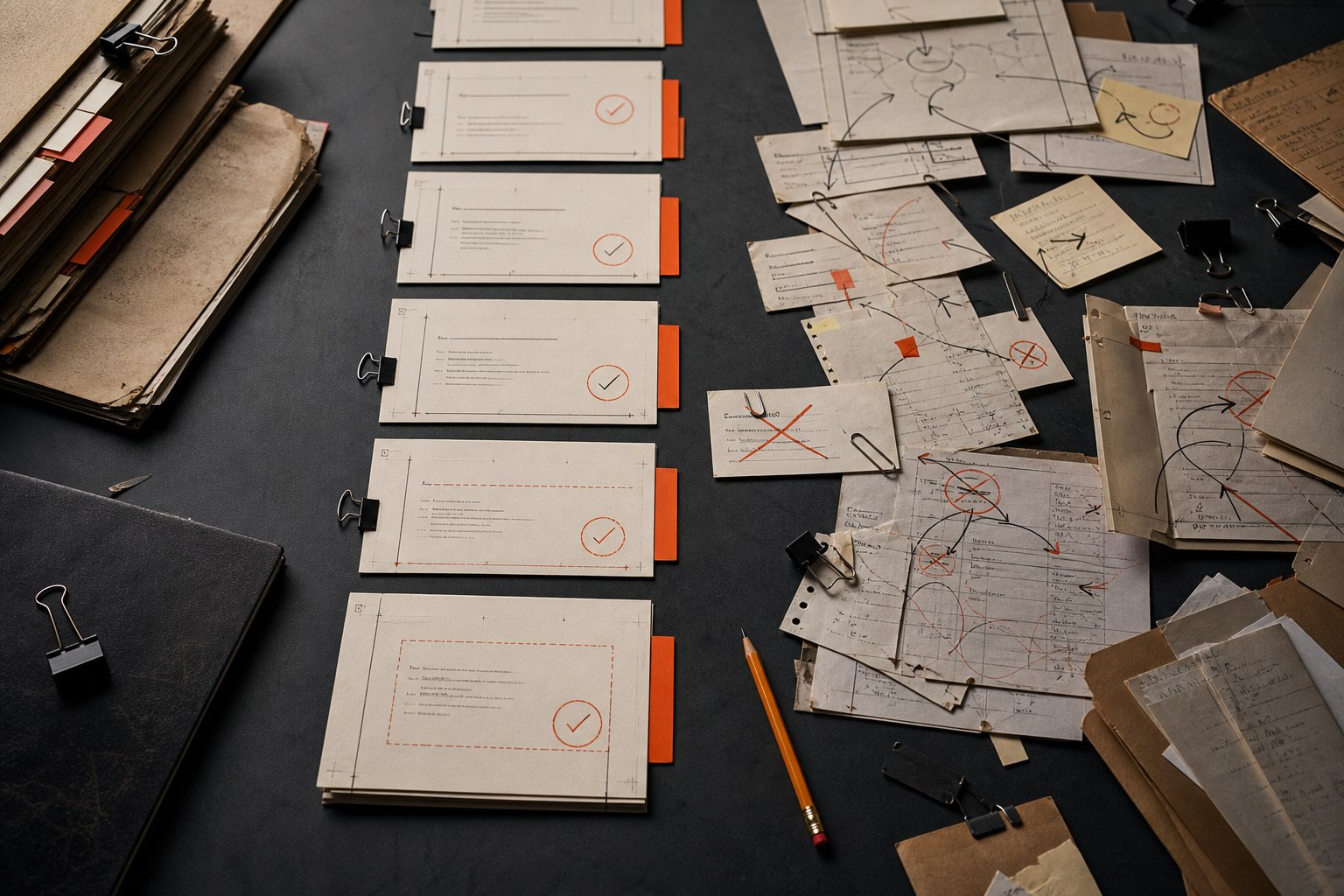
Luke Pierce made a point I think more operators are quietly realizing now.
Everybody wants AI.
Trust matters.
And the build is maybe 30 percent.
The rest is process.
That is exactly right.
The market does not need more convincing that AI is real.
That part is over.
The webinars happened.
The dashboards glowed.
The phrase "agentic workflow" has now been spoken by enough men in quarter-zips that it has officially lost all nutritional value.
What companies actually need now is not another demo.
They need an implementation process.
A real one.
Not "we do discovery."
Not "we partner closely with your team."
Not six meetings, a Miro board, and one heroic PDF explaining that the future is bright.
I mean a process that can survive real work.
Source documents.
Review loops.
Missing context.
Exceptions.
Client follow-up.
Owner anxiety.
The file reopening on Friday because the workflow looked complete on Wednesday but quietly fell apart on Thursday.
That is the actual game.
The real problem is not AI awareness
Most companies do not have an AI-awareness problem anymore.
They have a trust problem.
And underneath the trust problem, they usually have a workflow problem.
Because the second the conversation moves from "can AI do something impressive?" to "can we actually let this touch real work?" people get honest very quickly.
That is when the real questions show up:
- Who reviews this before it goes out?
- What happens when the input is incomplete?
- What happens when the model is uncertain?
- What happens when the workflow hits an exception?
- Who owns the next step?
- Why does this still somehow end with Karen opening the spreadsheet and manually fixing the thing everybody thought was automated?
That is implementation.
Not the demo.
Not the screenshot.
Not the keynote.
What people think AI implementation is
A lot of people still think implementation looks like this:
- show a few tools
- pick a favorite
- connect some systems
- automate a few steps
- call it transformation
That version sells well in pitch decks.
It does not survive real operations.
Because the hard part is almost never "can the model generate something useful?"
The hard part is whether the surrounding workflow is clear enough, narrow enough, and trustworthy enough to let the output matter.
What implementation actually is
This is much closer to the real work:
- identify where the workflow keeps reopening the file
- decide which step is worth fixing first
- map what currently happens in ugly detail
- define what AI can prepare versus what a human must approve
- decide how exceptions get surfaced
- decide what evidence has to travel with the output
- build one narrow install the team can actually use next week
- run it in live conditions and watch where it breaks
That is the work I care about.
Not AI as theater.
AI as an operating layer that can hold up under real use.
The process we actually use
If somebody asks what our implementation process actually looks like, here is the honest answer.
Stage 1: Diagnose the workflow, not the tool request
When someone says they want AI, we do not start by asking which model or agent they want.
We start by asking where the workflow keeps breaking.
Where does work stall?
Where does review bounce it back?
Where do open items lose ownership?
Where does someone have to reconstruct context manually?
Where does the owner still have to step in because the system cannot be trusted to finish the lane?
In accounting, finance, and operations, this is usually not mysterious.
It is usually painfully familiar.
The chase for missing documents.
The review-prep mess.
The status ambiguity during close.
The exception queue nobody really owns.
The follow-up lane that exists partly in inboxes, partly in memory, and partly in whatever cursed spreadsheet refuses to die.
If you start with the tool request, you usually get theater.
If you start with the workflow diagnosis, you can actually install something.
Stage 2: Pick one workflow, not the whole business
This matters more than people think.
We are not trying to automate the entire company in one grand, cinematic motion while a founder nods through a slide deck like he is signing a peace treaty.
We are trying to pick one workflow that is:
- narrow enough to install
- painful enough to matter
- visible enough to prove value
- safe enough that the team will actually use it
That first win might be intake triage.
It might be review-support packet building.
It might be missing-document follow-up.
It might be open-item tracking.
It might be one ugly patch of month-end that keeps eating hours for no good reason.
The point is not to sound ambitious.
The point is to produce one trustworthy operational change.
Stage 3: Map the current-state workflow in ugly detail
This is where a lot of fake implementation energy dies.
Because once you map the workflow honestly, you find out very quickly whether the business has a software problem or a clarity problem.
We map:
- the trigger
- the source inputs
- who owns each step
- the handoff points
- the review gates
- the reopen loops
- the exception paths
- the output artifact
- the places where people are silently improvising
This part is not glamorous.
It is also where most of the truth lives.
If a team cannot point to the current workflow on paper, they are usually not ready for a serious automation install yet.
They are still operating on folklore.
Stage 4: Define the human-review boundary before any build
This is one of the most important parts.
Before anything gets built, we decide what the machine is allowed to do, what it is allowed to prepare, and what a human still has to approve.
That means defining things like:
- what is draft-only
- what is recommendation-only
- what requires human signoff
- what evidence must accompany the output
- what happens when inputs are incomplete
- what happens when confidence is low
- what never gets auto-sent without review
We are not trying to remove the human from the process just so someone can write a dramatic LinkedIn post about the future.
We are trying to create cleaner handoffs into the human decisions that actually matter.
That is how trust gets built.
Stage 5: Build the smallest usable install
The first build should not be a moonshot.
It should be the smallest thing that makes one workflow meaningfully better.
That might mean:
- a layer that triages incoming source material
- a system that drafts missing-item follow-up with context attached
- a review-support packet builder
- an exception summary lane
- a workflow status surface that stops everyone from playing detective
The goal is not applause.
The goal is repeatability.
If the team cannot use it next week, it is still basically a concept car.
Very cool.
Very shiny.
Absolutely useless for the school run.
Stage 6: Run it live and watch where it breaks
This is where the real information comes from.
Demos lie.
Live conditions tell the truth.
The first real run usually reveals some combination of:
- source inputs are messier than expected
- exceptions are more common than the team admitted
- ownership was fuzzier than it looked on paper
- review packets are too long or too vague
- people still do key parts of the workflow from memory
- clients reply through the wrong lane
- one step still secretly depends on a human rescue mission
Good.
That is useful.
The first live run is not failure.
It is the first honest read on whether the workflow can survive reality.
Stage 7: Stabilize the lane before expanding
If the first workflow starts working, we do not immediately declare digital transcendence and start "scaling AI across the enterprise" like we are auditioning for a conference keynote.
We stabilize the lane.
We tighten the inputs.
We clean up the review logic.
We clarify the ownership.
We make sure the workflow can hold up under repetition.
Only then do we expand.
Because narrow wins stack.
Theater does not.
Why this matters now
This is why Luke's point lands.
Demand is not the hard part anymore.
A lot of owners already know enough to want help.
The hard part is whether somebody can be trusted to install something that does not create more operational debt.
That is the difference between:
- someone who can show you AI
- and someone who can help you operationalize it
The second person is much rarer.
What we are actually selling
We are not selling generalized AI enthusiasm.
We are not selling a dashboard religion.
We are not selling abstract transformation language designed to make the proposal feel expensive.
We are selling the first trustworthy workflow win.
One lane.
One boundary.
One install.
One proof point the team can actually feel in real work.
That is where momentum starts.
That is where trust starts.
That is where AI stops being a side hobby for the owner and starts becoming part of the operating layer.
If your AI efforts keep stalling
If you already know AI matters, but nothing dependable has changed inside the workflow, then the next move is probably not more inspiration.
It is diagnosis.
Send me the workflow that keeps breaking.
The one that keeps reopening the file.
The one where context disappears, review bounces the work back, exceptions pile up, or the owner still has to step in to save the lane.
Email me.
Call me.
DM me.
We will figure out whether the real problem is the tool.
Or whether nobody installed a process your team can actually trust.