AI Workflow Integration for Accounting Firms: Stop Making Your Senior Bookkeeper the API
QuickBooks is balanced. The portal is updated. The spreadsheet is current. Yet only one person can explain which version is authoritative and what the reviewer still needs. That is not integration. That is a human holding the system together.
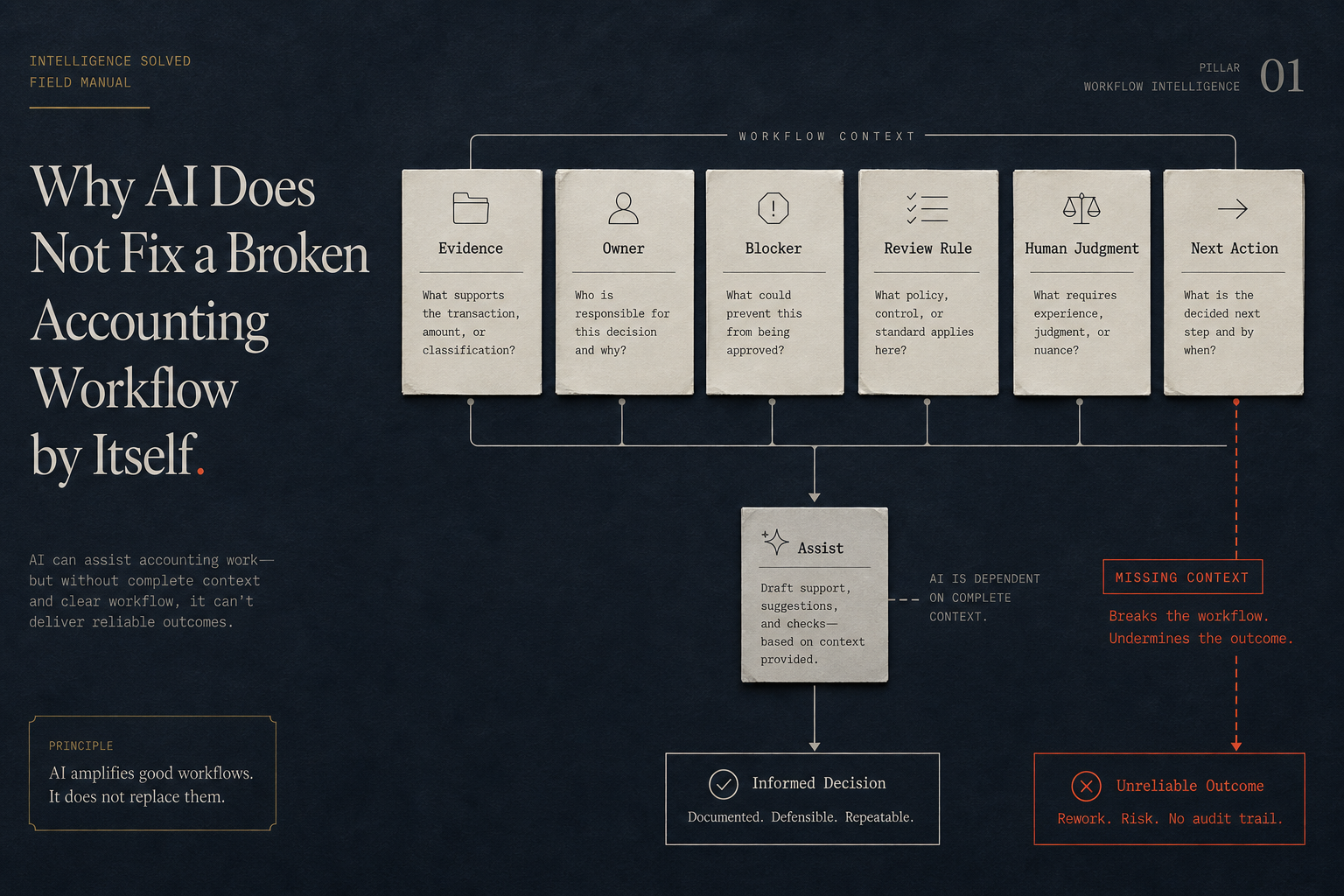
Can they name the source of truth, the last change, the next owner, and the exception path? If not, the tools are connected but the workflow is not.
The useful question is not “can these systems talk?” It is “can the next reviewer understand what happened without chasing the person who set it up?”
The handoff breaks where the context disappears.
A client document arrives in email. A note lands in the task system. A value changes in the spreadsheet. The accounting platform shows the result, but not always the reason. By review time, somebody is reconstructing the story from four places.
That is why accounting software workflow integration must include ownership, review state, source context, and exceptions. A connector can move data. It cannot decide what the reviewer is allowed to trust.
What should the next person be able to see?
- Where the work entered and which source is authoritative.
- What changed and what evidence supports the change.
- Who owns the next decision.
- Which exception stops the workflow.
- What the reviewer still needs before approval.
A four-question test for the handoff you think is integrated
Use the questions on one real client or close handoff. The gaps are more valuable than a feature comparison because they tell you where an integration would actually earn its place.
Which document, system, or person is authoritative when two versions disagree?
Can the next reviewer see the decision, transformation, or instruction that moved the work forward?
Is the human review owner named before the exception arrives?
Does incomplete context create a visible stop, or does the workflow quietly pass a bad handoff downstream?
The context-carrying handoff
We connect one real handoff to the tools and people that already carry it, then make source, change, owner, review, and exception visible. The point is not to make the stack look clever. The point is to make the next decision safer to inspect.
- One bounded integration target
- Real systems, documents, and review language
- Human approval and stop conditions
- Normal and exception path testing
Find where context leaves one system and becomes somebody’s private memory.
Prevents connector-first wasteCarry the information the next owner needs, not every field a tool can expose.
Keeps the workflow readableMake uncertainty visible instead of letting an incomplete handoff look complete.
Keeps accountability intactRun the case where email, portal, spreadsheet, and ledger do not line up.
Finds the real failure modeBuilt around the places accounting work actually changes hands.
The authority is knowing that the integration risk is often not the API. It is the missing document, stale note, unclear owner, or reviewer who cannot tell why the number changed.
QuickBooks, portals, spreadsheets, email, and task systems each carry part of the work. The handoff must carry the reasoning too.
Public-company close deadlines and audit standards leave little room for a workflow that cannot explain its own state.
The first question is what can be made usable inside the current operating context, not which new platform gets added.
Confidentiality, exceptions, professional judgment, and approval remain owned by people.
One workflow scope + install: $3,500 upfront.
The current package scopes, installs, tests, and hands off one workflow in 21 days. Optional $1,500/mo support comes after the first workflow is live enough to evaluate. Review the full package before you decide whether the integration problem belongs in a fit call.
Start with the integration point where your team is still carrying context by memory.
- Bounded workflow scope
- Review and exception rules
- Tested handoff and operator context
Continue only when the first workflow proves which next handoff deserves attention.
- Maintenance and tuning
- Operator support
- Next integration when ready
Questions worth answering before integration
No. The first scope should connect the handoff that is costing the firm clarity, not create a larger map than the team can review.
That is a workflow rule to make explicit. The integration should show which source governs and stop when the evidence is not sufficient.
It can assist bounded steps. Accountable approval, confidentiality, and exceptions remain human-led.
That is a useful answer. The fit decision should separate a missing workflow boundary from a missing connection.
Which handoff would expose the problem if your senior bookkeeper took Friday off?
Review the price and package first. Then bring the handoff, the systems involved, and the moment where context disappears.