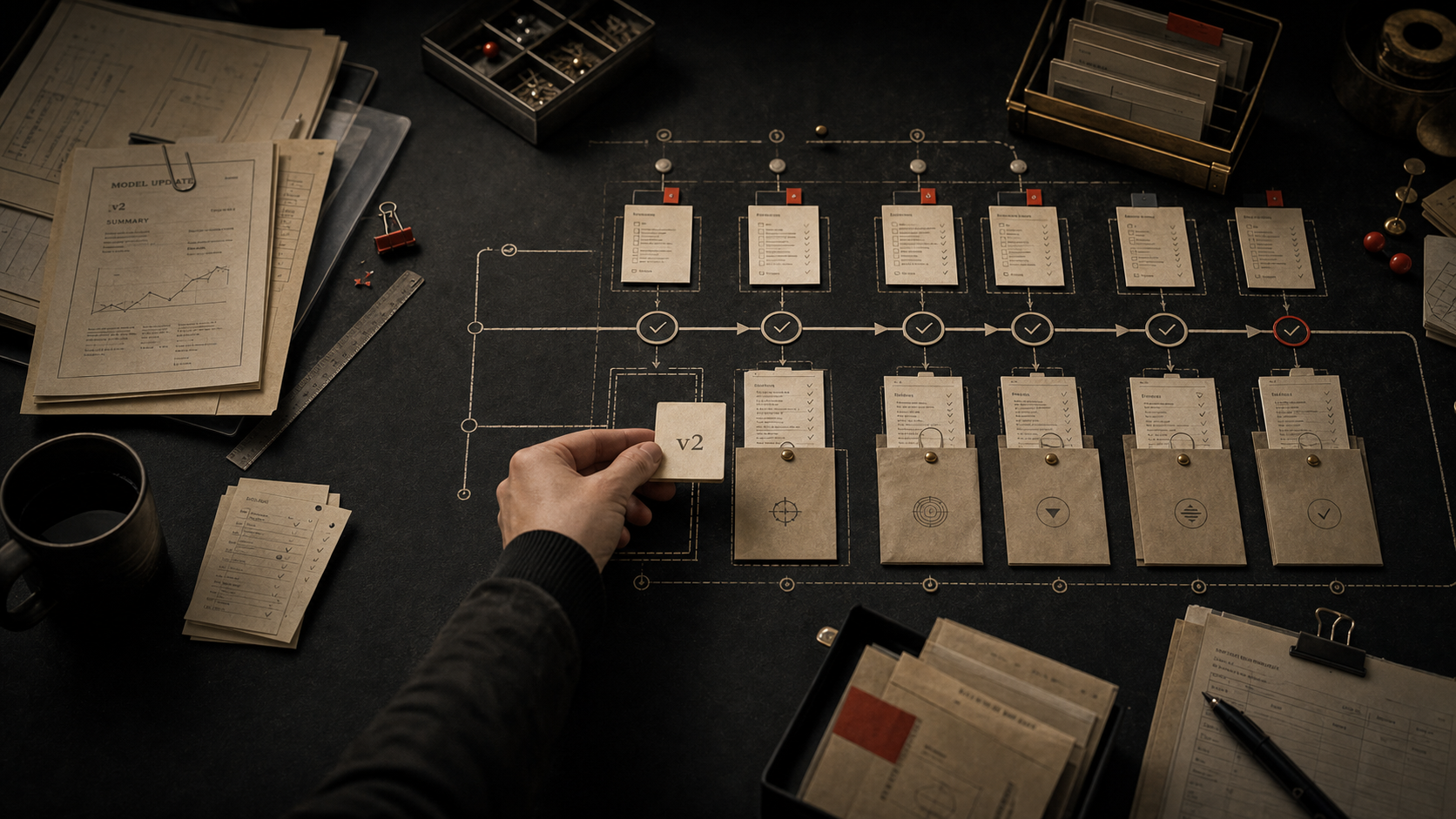
Every time a new model drops, the business internet reacts like someone opened the stadium gates five minutes before the World Cup final and yelled, "Run wherever your feelings take you."
Everybody starts sprinting.
New leaderboard. New benchmark. New demo clip. New founder thread. New "everything just changed" post written by someone whose actual workflow still depends on one person named Chris remembering where the approved version lives.
And now a business owner is supposed to believe this is the moment they need to re-evaluate the whole operation.
Again.
But here is the truth.
The reason model releases feel disruptive to most businesses is not because the models are too powerful.
It is because their workflow infrastructure is too weak.
That is the actual problem.
At Intelligence Solved, we design workflows so well that model releases do not force the business to stop, panic, rescope the process, hold a meeting called something like "AI Strategic Readiness Sync," and act surprised that no one can explain what version of the brief is current.
Our infrastructure is built to be model-agnostic.
So when a new model comes out, it does not break the workflow.
It makes the workflow better.
That is the difference between a real operating system and a glorified pile of prompts wearing a blazer.
Most businesses are not suffering from model change. They are suffering from workflow fragility.
A lot of businesses think they have an AI system.
What they actually have is:
- a few prompts
- some chat history
- one operator who "just knows how to do it"
- a loose approval process that depends on whoever is still online
- and a silent but dangerous dependency on one tool behaving one exact way forever
That is not infrastructure.
That is superstition with a subscription.
And superstition always looks strong right up until reality asks even one follow-up question.
Then suddenly:
- nobody knows what a complete input actually looks like
- context is trapped across Slack, Docs, email, notes, and memory
- review happens whenever someone remembers to say, "Hey, should we check this?"
- outputs vary from person to person
- handoffs get weird
- and the team starts acting like the model personally betrayed them
The model did not betray them.
The workflow exposed them.
That is why so many businesses overreact to model releases. They are not actually dealing with a model problem. They are dealing with the fact that the operation was brittle the whole time.
The release just turned on the lights.
The wrong question businesses ask every time a model drops
When a new model comes out, most businesses ask:
Should we switch?
That is usually the wrong question.
The better question is:
If the model changed tomorrow, would the workflow still run cleanly?
If the honest answer is no, then the issue is not model selection.
The issue is that the workflow was never properly designed in the first place.
Because when workflow infrastructure is strong, the model is not the system.
It is one component inside the system.
An important component? Yes. A valuable component? Absolutely. The whole system? No.
And when a component improves, the system should benefit from the upgrade.
It should not go into emotional collapse and start scheduling emergency meetings with titles like "navigating the next wave of AI transformation."
If your process can only function when one model behaves one exact way in one exact interface, you do not have durable infrastructure.
You have a workaround with good lighting.
Great teams survive change because they have structure, not because they guessed the future correctly
One thing elite teams in sports constantly prove is this: they do not rebuild the sport every time they change a player.
They have shape. They have structure. They have role clarity. They have decision rules. They have an operating system for performance.
That is why they can absorb change and still function.
Same thing here.
If your business can only produce stable output when one exact person, one exact tool, and one exact model are all available under ideal conditions, then you do not have workflow resilience.
You have workflow luck.
At Intelligence Solved, we do not build for luck.
We build for repeatability.
That means:
- the work starts with controlled intake
- context is packaged deliberately
- checkpoints are defined
- human review is explicit
- handoffs are structured
- outputs are versioned
- and the model layer is replaceable without blowing up the operation
That is why new model releases do not create chaos in a well-designed workflow.
They create lift.
Better models are only dangerous to bad systems
This part matters.
A better model is not automatically helpful.
If the workflow around it is sloppy, a stronger model just helps you generate bad process faster.
That is not transformation. That is acceleration in the wrong direction.
It is like putting a racing engine into a shopping cart and then acting shocked when the parking lot becomes a legal event.
A better model will not fix:
- unclear intake
- missing context
- fuzzy ownership
- no review checkpoints
- undocumented decisions
- broken handoffs
- inconsistent approval rules
- a team that cannot tell the difference between a draft and a deliverable
That is why "just use the newest model" is such shallow advice.
If the workflow is weak, the new release may improve output quality at the margin while making operational inconsistency even more obvious.
Now your team is producing faster.
Wonderful.
They are just producing confusion in 4K.
What Intelligence Solved means by model-agnostic infrastructure
When we say *model-agnostic infrastructure*, we do not mean a vague philosophical preference for optionality.
We mean the workflow logic does not live inside one vendor.
The workflow logic lives in the workflow.
That sounds obvious. It should be obvious. It is apparently not obvious enough.
Here is what that means in practice.
1. Intake is defined before the model touches anything
Weak workflow: Somebody says, "Can you make something about AI for operators?" and everyone pretends that is a complete brief.
Strong workflow: The workflow starts with defined intake, required fields, locked scope, and clear success conditions.
That means the model is working from a stable starting point instead of interpreting vibes and trying its best.
2. Context is assembled on purpose
Weak workflow: The context is:
- whatever was said in the meeting
- two links in Slack
- a screenshot with no file name
- a PDF nobody read
- and one operator's memory
Strong workflow: The context is packaged deliberately so the next stage gets exactly what it needs.
That means the operation does not collapse because the original operator went on vacation, changed roles, or stopped being the human middleware layer.
3. Checkpoints exist
Weak workflow: Everything happens in one long blob of activity, and the team only notices a problem when the final output feels "a little off."
Strong workflow: There are explicit stages, pass/fail conditions, and boundaries around what each step is allowed to do.
That means the workflow can catch drift before drift becomes damage.
4. Human review is real, not decorative
Weak workflow: "We'll have someone glance at it before it goes out" is treated like a control system.
It is not.
That is not a process. That is a wish wearing business casual.
Strong workflow: Human review happens at defined checkpoints with defined review criteria.
That means the team knows:
- what requires approval
- what counts as acceptable
- what must be rewritten
- what can move forward
- and what cannot leave internal status yet
5. Outputs are versioned and traceable
Weak workflow: Nobody can tell:
- which file is current
- what was approved
- what changed
- or whether the last version was the one with the strong CTA or the paragraph that sounds like it was written by a committee and a tranquilizer dart
Strong workflow: Artifacts are stored in a way that preserves decisions, outputs, and downstream permissions.
That means the workflow has memory without relying on human memory.
6. The model layer is replaceable
This is the hinge point.
Weak workflow: The whole operation is secretly built around one model's quirks.
Strong workflow: The workflow remains stable while the model layer improves.
That is what makes new model releases valuable instead of destabilizing.
When the architecture is right, model improvement creates upside.
When the architecture is wrong, model improvement creates turbulence.
The real advantage is not "we use AI." It is "we can absorb improvement without reinvention."
That is what most businesses still do not understand.
The goal is not merely to use AI.
The goal is to build an operating environment where AI improvements compound.
That requires workflow design.
Because the business value is not in being impressed every week.
The business value is in being able to say:
- our intake still works
- our context still arrives where it should
- our approvals still work
- our handoffs still work
- our outputs are still traceable
- and now that the model improved, our results improved too
That is a completely different level of maturity.
Most people are still acting like new model releases are plot twists.
We treat them like upgrades.
If a new model release forces a rebuild, you never had infrastructure
This is the test.
If the model changes tomorrow, what happens?
If your honest answer is:
- we need to rethink how the whole process works
- we need to redo the prompt stack from scratch
- we need to retrain everyone on the workflow again
- we need to figure out where the missing context lives
- we need to manually re-check everything because we no longer trust the flow
...then you do not have infrastructure.
You have a fragile workaround that happened to be working for the moment.
And to be clear, this is why so many businesses feel stuck.
They think their problem is adoption speed.
It is not.
Their problem is that every new tool has to be bolted onto a workflow that was never designed to handle change cleanly.
So instead of compounding capability, they compound confusion.
The stack gets fancier. The operation gets messier. Everyone gets tired. And then somebody recommends another dashboard like that is going to heal the family.
At Intelligence Solved, we build the workflow first so the model can do its job
This is where our positioning matters.
Intelligence Solved is not in the business of selling AI excitement.
We are in the business of designing workflow systems that produce durable business value.
That means we build around:
- intake discipline
- context control
- checkpoint logic
- review architecture
- clean handoffs
- output traceability
- model flexibility
So when better models show up, the business does not need to start over.
The workflow already knows how to operate.
The stronger model simply improves the engine inside that operating structure.
That is why model releases are inconsequential *to the stability of the workflow*.
Not because models do not matter.
Because the workflow design is strong enough that the model can improve without destabilizing the business.
That is the actual win.
A weak workflow treats every release like a threat. A strong workflow treats it like free leverage.
That is the belief shift.
Weak workflow thinking says:
- what if this changes everything
- what if our prompts stop working
- what if we picked the wrong vendor
- what if we have to redo the whole system
Strong workflow thinking says:
- good, the engine got better
- good, the output may improve
- good, cleanup may decrease
- good, the same workflow may now produce more value
That is the difference between chasing tools and building infrastructure.
One group gets emotional whiplash from the market.
The other group captures improvement.
What this looks like inside a real Main Street operation
This matters even more for Main Street businesses because they do not have infinite slack.
They do not have ten extra operators sitting around waiting to manually rescue every broken handoff.
They do not have the luxury of turning every tool release into a quarter-long internal research project with twelve owners, nineteen comments, and one person saying, "Let's circle back once the landscape settles," as if the landscape has ever once sent a calendar invite.
They have real work.
Invoices still need to go out. Content still needs approval. Client follow-up still needs to happen. Documents still need to move. Someone still needs to know what the next step is without conducting a séance over last week's Slack thread.
That is why workflow quality matters so much.
In a small or mid-sized business, fragile process is not an abstract inefficiency.
It shows up as:
- missed handoffs
- duplicated work
- owner bottlenecks
- staff hesitation
- inconsistent output
- delayed approvals
- and a constant low-grade feeling that the whole thing is one missing person away from turning into folklore
When the workflow is strong, model improvements become a gift.
When the workflow is weak, model improvements become another thing the owner has to supervise personally.
And that is the opposite of leverage.
How disciplined operators evaluate a new model release
A disciplined operator does not look at a launch and immediately ask, "How fast can we rebuild around this?"
They ask better questions.
Questions like:
- where in our workflow does the model layer actually matter most
- what would improve if the model got stronger here
- what would stay stable because the process is already defined
- what inputs, review rules, or handoffs would remain unchanged
- where do we still have hidden dependence on one person's memory or one tool's quirks
That is how adults evaluate a release.
Not by panic-posting. Not by starting a fresh prompt graveyard in another folder. Not by rebranding normal confusion as innovation velocity.
A strong operator treats the new model like a component evaluation.
If it improves the engine, great. Install the improvement. Measure the effect. Keep the workflow stable.
That is a much healthier posture than rebuilding the whole machine every time the market coughs.
The hidden tax of model-chasing
There is also a tax people rarely talk about.
Every time a company chases the latest tool without fixing the workflow, it creates invisible drag:
- the team loses trust in the process
- fewer people know what the current standard is
- approvals become slower because everyone is double-checking each other
- owners get pulled back into work they thought they had delegated
- and the company confuses motion with progress
That tax compounds.
Soon the business is spending more energy adapting to the stack than extracting value from the stack.
That is backwards.
The stack should serve the workflow.
The workflow should serve the business.
The owner should not have to spend every month performing emotional customer support for a process that was never properly built.
A lot of AI strategy is just expensive panic with nicer vocabulary
This is also why so much AI strategy feels unserious.
It is often just panic in loafers.
People say things like:
- we need to stay ahead
- we need to adapt quickly
- we need to remain competitive
- we need a framework for evaluating model evolution
And somewhere inside all that language is a business quietly admitting:
We do not trust our workflow to survive change.
That is the real confession.
Because a business with properly designed workflow infrastructure does not need to treat every release like a board-level identity crisis.
It can evaluate improvements rationally and incorporate them without operational melodrama.
No ceremonial war room required. No forty-slide transformation deck required. No founder posting "we're all in" because they tested a new model for twelve minutes and briefly felt immortal.
Just better workflow performance. Calmer operations. Less reinvention. More compounding value.
The best AI implementations are boring in the best possible way
Great infrastructure is often a little boring from the outside.
Not because it lacks power.
Because it lacks chaos.
Things are defined. Context is where it belongs. Approvals happen where they are supposed to happen. Handoffs are clean. The operation does not rely on heroics.
Nobody has to perform archaeological research to find the final version.
That kind of boring is what scale looks like.
And when a new model lands, you do not get panic.
You get an upgrade path.
That is what businesses should want.
Not drama. Not dependency. Not constant reinvention.
A calm system that keeps getting stronger.
What this changes for an owner immediately
If you are the owner, founder, or operator, this reframing should change where you put your attention.
Instead of asking, "Which model should we bet the company on?" ask:
- where does work currently stall
- where does context leak
- where do approvals become vague
- where does quality depend on one person's memory
- where would a stronger model help only if the process around it stopped wobbling
Those are much better questions.
Because they point toward leverage.
They move you away from tool anxiety and toward operational clarity.
And operational clarity is what lets a business benefit from AI without becoming emotionally hostage to every launch cycle.
That is the practical value of this argument. It gives the owner a cleaner place to intervene.
It replaces launch panic with operational diagnosis and turns vendor noise into a much simpler management question.
Not in the hype.
In the workflow.
Here is the diagnostic question that actually matters
Forget the hype cycle for a minute.
Ask this instead:
If the model changed tomorrow, would your workflow still run cleanly?
Would intake still be controlled? Would context still arrive where it needs to go? Would human review still happen at the right points? Would the next person in the chain know exactly what to do? Would outputs remain traceable? Would the system still function without the original operator having to explain the whole thing all over again?
If the answer is yes, you are building real infrastructure.
If the answer is no, then model selection is not your biggest problem.
Workflow design is.
What Intelligence Solved builds
We build workflow systems that are strong enough to survive tool changes, model changes, staff changes, and context loss.
We build operations where the model layer can improve without forcing the business to rebuild the whole machine.
We build infrastructure that turns new releases into upside instead of disruption.
That is why our workflows are model-agnostic by design.
And that is why new models do not wreck the work.
They make the work better.
Final word
Model releases matter.
But they should not have the power to destabilize a properly designed operation.
If they do, the workflow was never strong enough.
The real advantage is not access to the newest model.
The real advantage is having workflow infrastructure so solid that when the newest model arrives, the business simply gets better output from the same well-designed system.
That is the standard. That is the work. And that is what Intelligence Solved is actually building.
Call to action
If your current AI workflow would break the moment the model changes, you do not need more hype.
You need better infrastructure.
If your team is still depending on scattered context, undocumented handoffs, and one operator who "just knows how it works"...
If every new model release creates another round of confusion, rework, and internal chaos...
If you want workflows that improve when better models arrive instead of falling apart...
Email `View the offer` and have Intelligence Solved scope the workflow.
Not the prompt. Not the tool stack. Not the latest demo.
The workflow.
Because the businesses that win are not the ones chasing every release.
They are the ones building systems strong enough to turn every good release into leverage.
And if that is the kind of operation you want, email `View the offer` and let Intelligence Solved scope it with you.