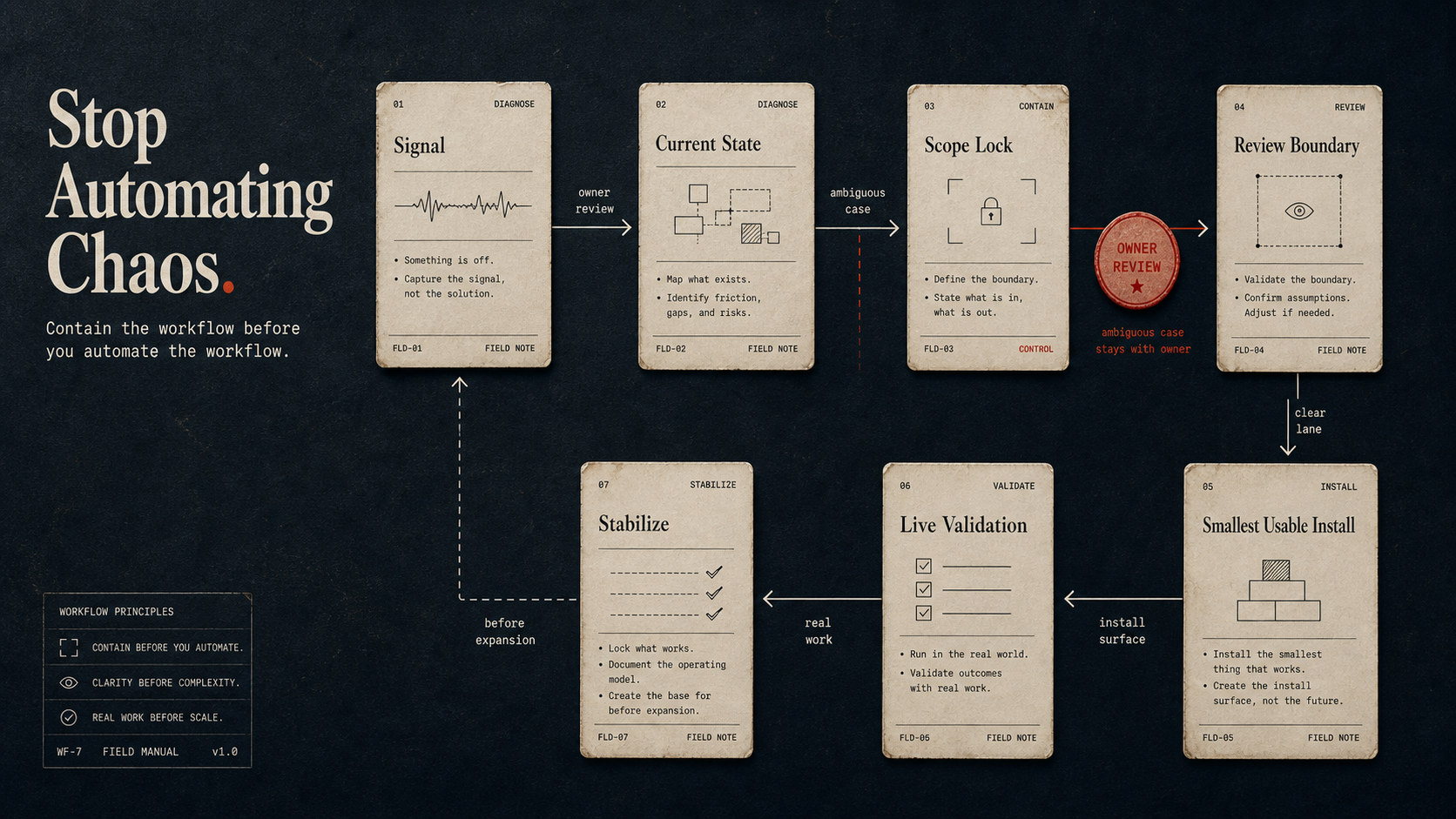
Most AI implementation disappointment starts the same way.
A business thinks it has a tooling problem. What it actually has is a workflow problem.
Something is still blurry. Approvals are still trapped in one person’s head. Exceptions are still being handled manually. The owner is still rescuing edge cases after the fact. Nobody has actually defined where judgment stays human and where a system is allowed to route work automatically.
Then somebody tries to solve all of that with software.
That is how businesses end up automating chaos.
At Intelligence Solved, our onboarding process exists to stop that from happening.
We do not treat onboarding as a polite kickoff ritual. We treat it as the control layer that determines whether a workflow is actually ready for implementation.
That is why our process is structured the way it is. And that is why clients walk away satisfied: not because we dazzled them with a demo, but because we helped them leave with a contained problem, a clear path, a real owner boundary, and a build they can actually trust.
The promise in plain English
When a client goes through our onboarding process correctly, they should walk away with four things:
- a clear understanding of how we operate
- a clear explanation of why we operate that way
- a clear picture of what will and will not be automated first
- confidence that the implementation is being built around real work, not a fantasy diagram
That matters because satisfaction in implementation does not come from hearing “yes” to every idea. It comes from knowing the right problem was accepted, the wrong problem was rejected, the risky parts stayed governed, and the next step is grounded in reality.
The core idea behind how we operate
We operate from one belief:
A workflow should be contained before it is automated.
That means we do not begin with the tool request. We begin with the workflow that keeps breaking.
If a company says:
- “We need AI for intake.”
- “We need follow-up automation.”
- “We need a dashboard.”
- “We need something that stops things from falling through the cracks.”
we do not assume the request itself is the right implementation scope. We assume it is a signal.
Our job during onboarding is to figure out:
- what the real lane is
- where the workflow is blurry
- where approvals actually live
- where exceptions appear
- where human judgment must remain in the loop
- whether the requested automation surface is even the right one
That operating discipline is the difference between a build that looks good in a demo and a build that survives contact with real work.
Why we do it this way
Because most implementation failures are not software failures first. They are operating-boundary failures first.
If the workflow is still fuzzy, better software just gives the confusion a nicer interface.
If approvals still live in somebody’s head, automation does not magically create governance.
If one lane has never been properly bounded, a larger rollout just spreads uncertainty faster.
If nobody defines what counts as a standard case versus an ambiguous or high-risk case, the team either overtrusts the system or rejects it the first time it behaves imperfectly.
So we do the work in an order that reduces risk instead of multiplying it. That order is not bureaucracy. It is implementation hygiene.
How our onboarding process actually works
Step 1: We diagnose the workflow, not the tool request
Clients usually arrive with symptoms. Something is too manual. Something gets dropped. Something takes too long. Something depends on the owner catching a miss and fixing it personally.
Those symptoms matter, but they are not yet the scope.
During onboarding, we diagnose the workflow underneath the request. We want to know:
- where the work really starts
- what information arrives incomplete
- where handoffs break down
- what has to be escalated
- who makes the final call when a case is unclear
- what the team says happens versus what actually happens
This is the first place clients feel the difference. We are not just asking what software they want. We are asking what work keeps breaking, who carries the risk, and what the system will be expected to survive.
Step 2: We map the current state in ugly detail
Most businesses already have a process. The problem is that it usually exists in fragments.
Part of it lives in inboxes. Part of it lives in Slack, text messages, or side conversations. Part of it lives in memory. Part of it lives in “the way the experienced person handles it.” Part of it lives in the owner noticing problems late and rescuing them manually.
If that hidden reality never gets surfaced, the automation inherits the mess.
So we map the ugly version, not the flattering version.
That means documenting:
- the real intake path
- the real approvals
- the common exceptions
- the hidden labor
- the duplicate work
- the delays
- the escalation points
- the difference between “moved forward” and “actually done”
Clients walk away satisfied here because this is often the first time the real workflow has been named honestly. And once it is named honestly, it can be improved honestly.
Step 3: We lock the scope to one lane
This is where a lot of AI projects go off the rails.
The business wants transformation. The team names five related problems. Everyone starts talking about the whole operating system at once.
That sounds ambitious. In practice, it usually creates a moving target.
We do not start with a moving target. We start with one lane.
One workflow. One bounded job. One install surface that can be tested in reality.
That scope lock is how we keep the work truthful. It allows us to say:
- this is in scope
- this is out of scope
- these cases can route cleanly
- these cases remain ambiguous or high-risk
- these cases still need human judgment
Clients do not become satisfied because we promised to fix everything. They become satisfied because we made the first lane understandable, defensible, and real.
Step 4: We define the human-review boundary before the build
A weak implementation treats human review like a patch. A strong implementation defines it up front.
This is one of the most important parts of how we operate.
We explicitly decide:
- what the system can route automatically
- what still requires approval
- what counts as high-risk
- what should be escalated to the owner
- where an override is necessary
- what should never be trusted without human review
This matters for two reasons. First, it protects the business. Second, it protects trust.
Clients should never feel like they are being forced to choose between speed and control. A good onboarding process gives them both: speed where the workflow is clear, and human control where the risk actually lives.
That is one of the biggest reasons clients leave the process satisfied. They understand that we are not trying to remove judgment recklessly. We are trying to place judgment where it belongs.
Step 5: We require real ownership and real readiness
A contained design still is not enough. The work also needs an owner, an access path, representative examples, and permission to move from theory into reality.
That means onboarding is not complete just because the idea sounds good. We also need:
- a real workflow owner
- human or commercial acceptance to proceed
- the right access path
- representative examples or corpus for testing
- named reviewers or test users
- a concrete success standard
Why do we insist on that? Because design without authority, examples, and ownership creates fake confidence.
A client should not walk away with the false impression that a clever blueprint alone equals a working implementation. They should walk away knowing exactly what is ready, what is missing, and what the next responsible step is.
That clarity is part of the satisfaction. We do not blur “designed” and “ready.” We separate them on purpose.
Step 6: We install the smallest usable version first
We do not try to win the architecture award on day one. We try to build the smallest usable version that can do real work without collapsing.
That means the first install should be:
- narrow enough to test honestly
- strong enough to handle real workload
- simple enough to debug
- bounded enough that everyone knows what it is supposed to do
A lot of firms overbuild too early. They try to solve every adjacent problem at once. They produce big diagrams, broad promises, and weak operating proof.
We would rather produce a smaller lane that actually works.
Clients walk away satisfied here because the implementation feels grounded. It feels like something that can be trusted, tested, and improved—not a sprawling transformation promise with no proof surface.
Step 7: We validate against live conditions
Demo success is not implementation success.
A workflow is only real once it touches the mess it is supposed to survive. That means incomplete inputs, strange edge cases, unusual escalations, and the real behavior of the team under pressure.
So our process does not stop at “this makes sense on paper.” It moves toward live validation.
That validation is where assumptions get exposed. Good. That is the point.
We would rather discover the brittle parts in a controlled validation window than let the client discover them after a broader rollout.
This is another reason clients leave satisfied. They know we are not protecting our ego. We are protecting the implementation.
Step 8: We stabilize before we expand
A lot of companies want to move from “it worked once” to “roll it out everywhere.” That is usually too early.
The first lane still has to become reliable. The team still has to trust the boundary. The exceptions still have to be understood. The handoffs still have to work without heroics.
So we stabilize before we expand.
That means we make the lane:
- predictable
- clear
- understandable
- recoverable
- repeatable
Then we scale. Not before.
Clients walk away satisfied because they can feel the difference between a fragile experiment and a governed system. We are building toward the second one.
What a client should expect to walk away with
By the end of a good onboarding process, a client should be able to say:
- “I understand the lane we are actually solving first.”
- “I understand why that lane was chosen.”
- “I know what stays human and what can be routed automatically.”
- “I know what is required before a real build can proceed.”
- “I know what success looks like for the first install.”
- “I am not being sold a vague transformation story. I am being given a controlled implementation path.”
That is the satisfaction standard we care about.
Not that every possible idea was approved. Not that every adjacent workflow got bundled into one promise. Not that we said yes to a larger scope than the business can safely support.
Real satisfaction comes from clarity, containment, honesty, and trust.
What makes this different from generic AI vendors
A generic AI vendor often leads with the tool. We lead with the workflow.
A generic vendor often sells possibility. We define boundaries.
A generic vendor may describe onboarding in soft language like discovery, alignment, or solution tailoring. We are more direct.
We are looking for:
- workflow blur
- hidden approvals
- owner rescue behavior
- unstable exception handling
- scope drift
- missing authority
- false readiness
And we are fixing those conditions before they become implementation failure.
That is less flashy. It is also a much better way to earn trust.
Who this process is for
This process is for owners and operators who suspect the real problem is not just the software.
It is for teams dealing with:
- recurring workflow breakdowns
- approvals bottlenecked in one person
- incomplete intake
- tribal knowledge carrying too much of the work
- repeated exceptions that surprise the system
- implementation fatigue from trying tools before defining the lane
If that is your environment, onboarding is not a formality. It is the first serious control system in the implementation.
The bottom line
Our onboarding process is designed to do three things before scale ever enters the conversation:
- contain the right problem
- define the right human-review boundary
- establish the smallest trustworthy path into implementation
That is how we operate. That is why we operate that way. And that is why clients leave the process satisfied.
They are not left guessing what happens next. They are not left wondering what was really in scope. They are not left with a glamorous promise and a fragile system.
They leave with a clear lane, a real plan, a named control boundary, and a build path grounded in reality.
That is the standard.
Send the workflow that keeps breaking.
If you want to know whether your workflow is actually ready for AI implementation, start with the lane that keeps breaking. We will diagnose the workflow, define the real boundary, and tell you plainly whether you need a tool, a contained install, or a process correction before either one.
See the offer before booking