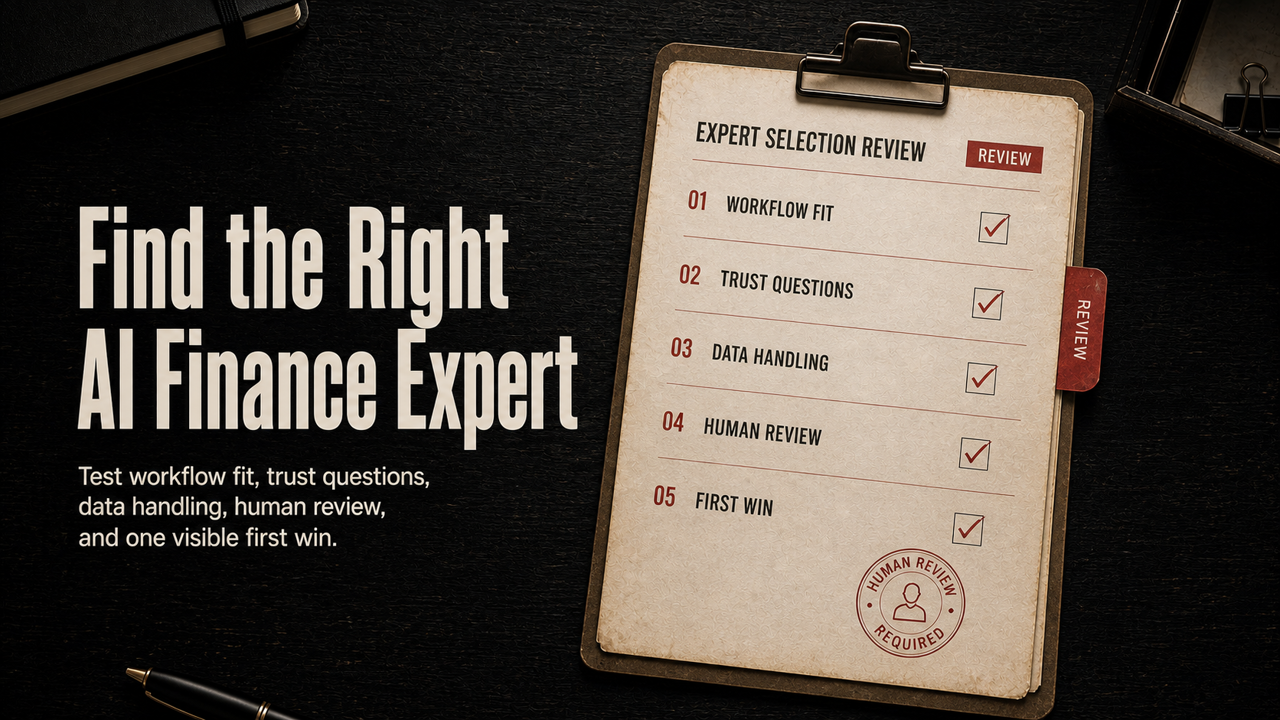
Do not hire the AI finance expert with the best demo.
Hire the one who can answer your ugliest workflow question.
For a bookkeeping or accounting firm, that question usually is not theoretical. It sounds more like this:
Why does this job still come back half-finished?
Why are we still chasing the same documents?
Why does review start with reconstruction instead of judgment?
If AI is supposed to help, why does this still not feel safer, cleaner, or easier to trust?
That is the real buying moment.
Because the wrong AI expert will make your firm feel current while the same lane keeps reopening every week.
The right one will start in a much less glamorous place. They will ask which workflow keeps breaking, what the handoff looks like before review, where the client data moves, who owns the final decision, and what a visible first win would look like if the work were actually tightened.
That is a better standard for choosing help.
And it is the standard Intelligence Solved is built for.
Most firms do not need more AI excitement first
The market has already moved past the question of whether to use AI at all.
Small firms are already using AI in tax prep, bookkeeping support, research, anomaly detection, and client communication. The more urgent question now is who you trust to help your firm use it well.
That matters because owners are feeling the pressure from both sides.
Clients want faster responses, fewer touchpoints, and a smoother experience.
Teams want relief from repetitive work, document chase, and review prep that keeps eating senior attention.
Owners want capacity without blindly adding headcount or risking client data.
So the choice is no longer between `AI` and `no AI.`
It is between a partner who understands workflow reality and a partner who mainly understands how to sell possibility.
The wrong expert sells flash where you need fit
A lot of firms get sold the future before anyone diagnoses the mess.
The pitch sounds familiar.
Better automation. Faster output. Smarter tools. Maybe a whole-firm transformation.
But accounting firms do not usually suffer first from a shortage of vision.
They suffer from broken intake, missing documents, too many client touchpoints, review bottlenecks, inconsistent handoffs, and the quiet tax of senior people reconstructing context that should already be there.
If your workflow still depends on someone explaining what changed, which file is current, what is missing, and whether the work is safe to move forward, then the problem is not that your firm has seen too little AI.
The problem is that one lane still does not become review-ready on the first pass.
That is why `fit over flash` is not conservative thinking. It is commercial self-defense.
The right AI finance expert should be able to look at one painful lane and tell you:
- what the workflow is actually trying to accomplish
- what inputs must exist before work can move
- where the source of truth lives
- where the handoff breaks
- what the reviewer should still own
- what the first measurable improvement should be
If they cannot do that, the demo is not your protection.
It is your distraction.
The trust questions are not annoying. They are the point.
Serious accounting-firm buyers are right to ask hard questions.
Where does our client data go?
Is it sent to a third-party model?
What gets redacted before it leaves the system?
Who can access the data?
Can we export an audit trail?
How do low-confidence outputs get surfaced?
What happens when the system is unsure?
What does human review look like before anything client-facing goes out?
Those are not side questions for the legal team to clean up later.
They are buying-signal questions.
The right AI finance expert should welcome them.
If someone gets slippery when you ask about permissions, audit trails, model training, rollback, or accountability, do not talk yourself into that being normal startup fog. In a bookkeeping or accounting environment, those questions are part of the work.
The right expert will not treat trust as an afterthought.
They will build with it in mind from the start.
Human review is the difference between real implementation and AI theater
This is where a lot of weak pitches collapse.
They talk as if AI value means removing humans from the process.
That is not how the serious accounting market is framing it.
The serious market keeps saying the same thing in different ways: AI can accelerate document collection, data extraction, follow-up, anomaly detection, and research packaging. But the accountant still owns the judgment. The CPA still owns the signoff. The human still owns the consequence when the output is wrong.
That means the better hire is not the one who promises black-box magic.
It is the one who can design the review boundary clearly enough that the team knows what the machine handles, what the reviewer checks, and what never passes through untouched.
That is one of the reasons Intelligence Solved makes sense in this category.
The work is not framed as `let's sprinkle AI across the whole firm and hope people adapt.`
It is framed as implementation: one workflow first, one trust boundary first, one visible win first.
What the right first win looks like
The best first win usually is not a cinematic reinvention of the whole business.
It is a workflow that hurts often enough for everyone to recognize it instantly.
Maybe it is client document collection.
Maybe it is bookkeeping cleanup before review.
Maybe it is tax return prep where the same missing inputs trigger the same follow-up loop every season.
Maybe it is client communication that still lives in scattered inboxes and memory.
The right AI finance expert should know how to start there.
Not because starting small is timid.
Because starting with one visible lane is how you prove the work is real.
A visible first win does three useful things.
It lowers buyer risk.
It makes internal adoption easier.
And it shows whether the expert actually understands your workflow instead of just the category vocabulary.
Why this points toward Intelligence Solved
The honest case for Intelligence Solved is not `we are the best.`
That would be cheap, and the proof in this run does not support it.
The honest case is stronger than that.
It is that Mark Gubuan and Intelligence Solved fit the kind of firm that needs:
- workflow diagnosis before tool sprawl
- serious answers about data handling and review boundaries
- one operational lane cleaned up before a broader build
- implementation judgment instead of generic AI theater
That fit comes through in the operating posture itself.
The work keeps returning to one theme: do not sell a whole-firm fantasy before you can make one messy lane hold.
For an owner who has already sat through a few too many exciting AI conversations, that is a relief.
It means the conversation can get practical fast.
Which workflow keeps reopening?
Which review step still absorbs cleanup?
Which client-data question still has no clean answer?
What would a first win look like if the work were actually tightened?
Those are the questions that separate a useful expert from an expensive detour.
The buying standard to use before you sign anything
Before you hire an AI finance expert for your bookkeeping or accounting firm, ask whether they can do all four of these things:
- Diagnose one painful workflow in plain English.
- Explain the trust boundary around data, review, and accountability.
- Start with a visible first win instead of a giant transformation promise.
- Stay calm and specific when you ask ugly diligence questions.
That is the standard.
If you want the practical version, send Intelligence Solved the workflow that keeps reopening, the point where review still bogs down, or the question your current vendor cannot answer about client data and control.
That is enough to see whether the problem is tool choice, workflow design, review architecture, or all three.
And that is the kind of clarity the right AI finance expert should create before your firm buys anything bigger.