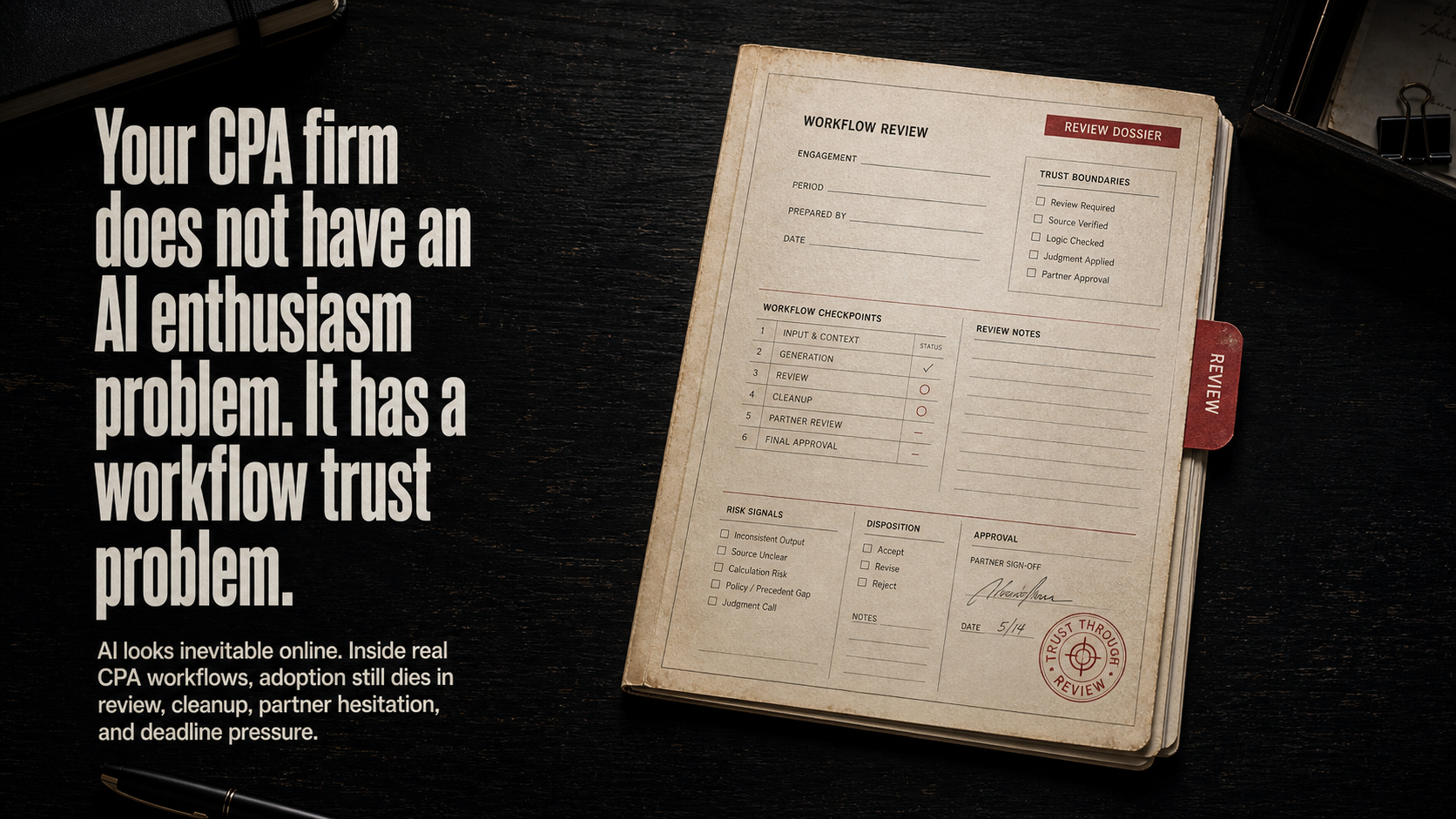
AI looks inevitable online. Inside real CPA firms, adoption still dies in the same four places: review exposure, cleanup burden, partner hesitation, and deadline-week collapse.
Spend ten minutes online and it sounds like AI is already settled.
The demos are smooth. The threads are confident. The talking point is always some version of the same idea: firms that are moving slowly just need more initiative.
Then you get back to an actual CPA workflow.
The preparer is not sure what is safe to trust. The manager can already feel the cleanup rolling uphill if the draft is even a little wrong. The partner still cannot see the review boundary clearly enough to bless live client work. And nobody wants to be the person who moved bad output forward during a week when the file was already late.
That is where a lot of AI initiatives quietly lose air.
What gets labeled low initiative is often something more specific and more dangerous: the workflow still does not feel safe enough to use.
That matters because the cost is not abstract. It shows up as reopened files, longer review notes, managers rebuilding context by hand, partners slowing approvals, and teams learning that the safest career move is to avoid the step until somebody else proves it will not blow back on them.
If you want adoption to move before the next pressure cycle, you do not need a bigger internal pep talk about AI. You need one workflow that answers three ugly questions clearly: what is safe to trust, who owns cleanup, and what happens when the week gets ugly.
The internet has normalized AI. Your workflow has not.
This is part of why the conversation gets so distorted.
Culturally, AI feels everywhere. Operationally, it is still scarce in the places where actual accounting work lives.
Leaders see nonstop AI discourse and assume the remaining blocker must be attitude. If the market has already accepted it, why is the team still moving this slowly?
Because a post and a workflow do not live under the same burden of proof.
A post can be shallow and still get applause. A demo can be wrong and still get shared. A workflow cannot hide like that.
A weak workflow shows up in the ugliest possible places: reopened files, missing source trails, reviewer distrust, messy handoffs, and staff learning very quickly which new shortcut turns into a private liability.
That is why AI can feel culturally inevitable and still be operationally rare. One world runs on attention. The other runs on consequence.
Managers do not kill adoption. Cleanup does.
A lot of AI-assisted steps look efficient right up until the file hits review.
The draft got produced faster. Fine.
Now the manager has to figure out what the draft actually did, whether anything material got flattened or skipped, whether the source trail is clear enough to trust, and whether fixing the output will take longer than doing the step properly in the first place.
That is where the mood changes.
What looked like speed starts looking like a disguised transfer of labor. The work moved faster at the top of the workflow, but the uncertainty moved downstream with it.
Managers notice that immediately.
They stop calling it a time-saver because they know what usually happens next. The file comes back with enough polish to be dangerous and enough ambiguity to force manual reconstruction. Nobody trusts the surface. So the manager rebuilds context by hand, again, while the clock keeps moving.
That is not resistance to innovation. It is pattern recognition.
If one reviewer becomes the shock absorber for every half-trustworthy draft, that reviewer becomes the brake. Adoption slows because the workflow deserves to be slowed.
Staff hesitation is usually self-protection, not a mindset problem.
From the outside, hesitation looks behavioral.
Inside the workflow, it often looks rational.
A preparer is not trying to be difficult when they pause before using a tool that still has blurry trust rules. They are trying not to become the person who trusted the wrong output, handed it forward, and created a mess for the next reviewer.
That social risk matters more than a lot of leadership teams admit.
If the firm says, "we want more AI adoption," but never makes the trust line visible, every use becomes personal.
Use it and it works? Great. Use it and it creates a bad file trail, a missed nuance, or a cleanup spiral? Now the workflow has a name attached to it.
People feel that immediately. Especially in firms where review culture is already tight and nobody wants to volunteer as the cautionary tale from busy season.
That is why low initiative is often the wrong diagnosis. The behavior you are seeing may be the team reading the incentives correctly.
Partner hesitation is a control problem.
Partners responsible for client standards are not mainly asking whether AI is exciting.
They are asking whether the workflow proves control.
Where does human review become mandatory? What is safe to trust and what always needs verification? Where are confidentiality boundaries held? Who owns the final judgment? What happens when the output is wrong on a week when nobody has spare time?
If those answers stay fuzzy, approval drags.
That drag gets blamed on culture all the time. In reality, the workflow may be asking leadership to approve a risk posture nobody has actually designed.
No serious partner wants to sign their name under "we will figure it out in review."
That is not anti-AI behavior. That is basic stewardship.
The firms that move are not the ones with the loudest AI language. They are the ones that install one controlled workflow where trust rules stop being implied and start being visible.
Busy season tells the truth faster than any pilot.
A workflow can look promising in a calm week and still die the moment pressure stacks.
That is not a contradiction. It is the test.
If the rules are fuzzy, people fall back to manual habits. If the review line is vague, the reviewer redoes the work. If ownership is unclear, nobody wants to stand next to a bad output when the file is due.
This is where respectable pilots go to get buried.
Everything looked fine when everyone had enough time to double-check the output. Then the inbox fills, client answers come in late, deadlines stack, and one bad draft creates a cleanup spiral that poisons the whole idea.
That moment does more damage than the original error.
Once a team sees that the shortcut collapses under real pressure, trust drops fast. Staff stop volunteering to use it. Managers stop routing work through it. Partners stop wanting their name anywhere near it.
If a workflow only works when everybody has extra patience, it is not ready. It is a demo with good manners.
The real bottleneck is the AI Implementation Trust Gap.
The AI Implementation Trust Gap is the distance between executive interest in AI and the operating conditions employees need before they will use it confidently in live client work.
In a CPA firm, that gap usually looks the same every time: reviewers rebuilding context manually, managers inheriting cleanup, staff treating usage like personal exposure, partners slowing approval because the control line is still implied, and everyone quietly wondering whether the time saved up front will be repaid with interest during review.
That gap does not close because the firm talks harder about innovation. It closes when one workflow becomes specific enough to trust.
One owner. One review boundary. One definition of what the assist is allowed to do. One rule for what happens when the output is wrong. One answer to whether the step still holds up when the week gets ugly.
That is not smaller than strategy. That is the part strategy has to survive.
Start with one workflow that already hurts.
Do not begin with a firmwide AI plan.
Start with one workflow where the drag is already visible.
Pick the lane where reviewers are already reopening files, where context keeps getting rebuilt by hand, where client answers come in messy, or where the ugliest cleanup shows up right before a deadline.
Then ask:
Where does trust break? Where does review ownership blur? Where would a wrong output create the most expensive cleanup? What rule would make the step feel safer to use, not just faster to test? Would anyone still trust it on a Thursday night in busy season?
That is how adoption starts moving in the real world. Not with a better AI narrative. With one workflow that people can use without feeling exposed.
The payoff is not more AI. It is controllable progress.
A firm that closes the AI Implementation Trust Gap does not remove judgment from the work.
It gets something more useful than that.
It gets a workflow where people know what the assist is for, what still requires human review, who owns the edge cases, and what happens when the output is wrong. That means less hidden rework, less review drag, fewer stalled handoffs, and a better chance that one useful workflow survives contact with real deadlines instead of dying as another polite pilot.
If AI keeps showing up in conversation but not in production, do not start by assuming your team needs more enthusiasm.
Start by diagnosing where the workflow still feels unsafe to trust.
Pick one real CPA workflow. Make the trust boundary visible. Pressure-test it under deadline conditions. You will know pretty quickly whether the problem is low initiative, weak workflow design, or both.