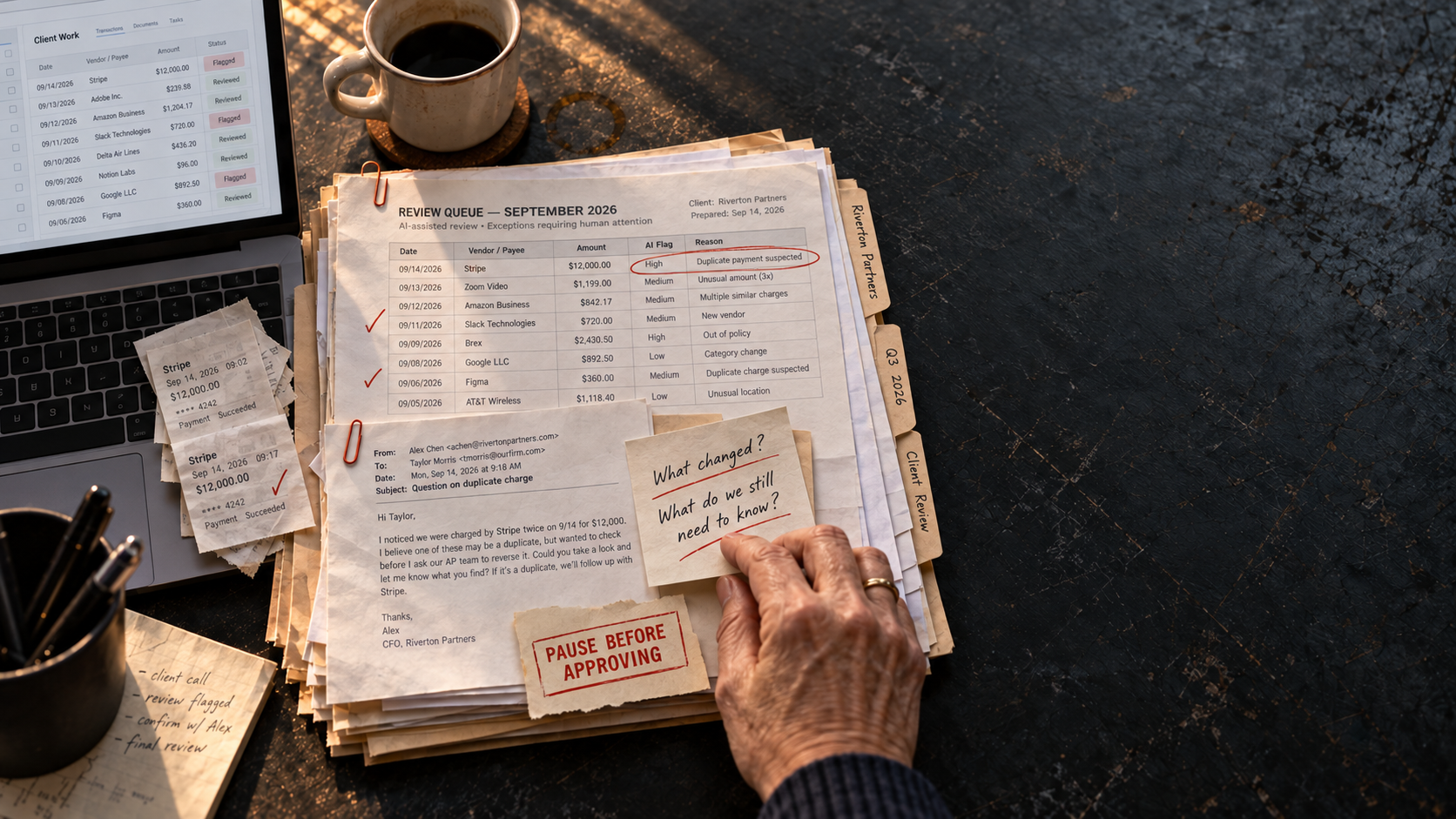
AI-assisted accounting work can move quickly and still leave partners less sure about what the work means. The fix is not nostalgia for manual work. It is a new thinking practice built into the workflow before volume outruns judgment.
A firm owner can feel the problem before they can name it.
The client-service team is moving faster. Staff have drafts sooner. Summaries appear without the old back-and-forth. Classifications, review notes, and recommended next steps show up before the partner has had time to sit with the file.
On paper, this looks like progress.
Then review gets weird. The partner is not only checking whether an output exists. They are trying to reconstruct what happened, what changed, why the answer is safe enough to use, and which client decision the work is supposed to support. The work got faster, but the understanding did not automatically come along for the ride.
That gap is cognitive debt.
AI did not remove the need to think. It moved the place where thinking has to happen.
Before AI entered the workflow, a lot of partner judgment was hidden inside the manual thinking interval.
That interval was not glamorous. It looked like slow review, re-reading client context, comparing an odd number against last month, asking why a staff note sounded too confident, or noticing that a clean-looking workpaper still did not explain the decision behind it.
Some of that time was inefficient. Some of it was the place where the firm understood the work.
AI-assisted workflows can compress the inefficient parts and the useful thinking parts at the same time. That is the risk. When output arrives faster, the partner may lose the old pause where meaning, exception handling, uncertainty, and client context used to surface.
The mistake is assuming the thinking problem disappeared because the manual step disappeared. It did not. The thinking has to be rebuilt somewhere else.
More output can create less understanding.
AI-assisted information volume is not just "more work done faster." It is a stream of outputs, summaries, drafts, classifications, and recommendations that someone still has to interpret.
If the firm treats that stream as self-explanatory, the debt starts piling up.
A summary sounds reasonable, but nobody can quickly point back to the source detail that matters. A recommendation looks tidy, but the reviewer cannot tell which assumption carries the risk. A client-ready note reads cleanly, but the partner has not decided whether the underlying issue needs a judgment call, a client question, or a workflow change.
That is when the firm becomes efficient enough to lose track of its own reasoning.
The painful part is social, not just operational. Nobody wants to be the partner who slows down the new AI-assisted lane because the work "feels off." Nobody wants to reopen a file after the team thought it was done. Nobody wants to ask a staff member to explain an output that the system produced in seconds but the firm never made intelligible.
So the firm keeps moving. The debt compounds quietly.
The answer is not vague human oversight.
"Keep a human in the loop" is too soft to solve this.
A human can be in the loop and still not know what decision they own. A reviewer can glance at an AI-assisted output and still fail to notice that the workflow skipped the one question that mattered. A partner can approve a next step and still be unable to explain what changed, what remains uncertain, or why the output is reliable enough to use.
The useful fix is a review-and-decision practice.
That practice is a recurring checkpoint inside the workflow where leaders ask specific questions before the next automated or semi-automated step continues:
- What changed in the work or the client context?
- What judgment is required now?
- What remains uncertain?
- What decision does this output support?
- What should a human own before the workflow moves forward?
This is not a committee meeting. It is not a prompt library. It is not a dashboard pretending to be governance. It is a deliberate place where thinking re-enters the work.
The owner needs an intelligibility test.
The simplest control is an intelligibility test:
"Can we explain what this output means, why it is reliable enough to use, and what decision it supports?"
That question forces the firm to separate speed from judgment.
If the answer is yes, the workflow can move. If the answer is no, the next step is not "try another tool" or "train everyone harder." The next step is to locate the missing thinking interval. Did the workflow skip interpretation? Did the output lose its source trail? Did the reviewer inherit a conclusion without the assumptions behind it? Did the client-service team produce a polished answer before anyone named the decision?
That is where workflow architecture matters.
Accounting firms do not need AI-assisted work to be slower for the sake of being slower. They need the right pauses in the right places. A file can move quickly and still preserve judgment if the workflow makes interpretation visible before the partner is asked to approve, explain, or defend the work.
Build the thinking practice before you scale the volume.
A practical starting point is one live workflow, not the whole firm.
Pick one recurring lane where AI-assisted output is already increasing volume: intake summaries, cleanup review, month-end close prep, CAS reporting notes, client-response drafting, or open-item triage.
Then mark the places where the old manual thinking interval used to happen. Where did someone previously notice exceptions? Where did client context enter the work? Where did the reviewer decide whether the output was good enough, incomplete, or risky? Where did the partner turn information into judgment?
Now rebuild those moments deliberately.
Add a review-and-decision checkpoint before the work moves to the next step. Require the output to pass the intelligibility test. Name the decision owner. Capture what changed in the workflow when the answer was unclear.
That one practice can keep AI-assisted work from becoming a faster pile of half-understood information.
The point is not to make the firm less efficient. The point is to keep efficiency from eating the thinking practice that made the work safe to trust in the first place.
If your firm is adding AI to client-service work and you want the workflow to stay intelligible instead of just faster, ask Intelligence Solved to help inspect where thinking needs to re-enter the workflow. Review the offer and use that page as the next step toward a workflow architecture review.