The gap nobody's naming
Ask ten accounting firm leaders if their firm has "adopted AI," and most will say yes. Ask what changed about how work actually moves through the firm, and the story gets thinner.
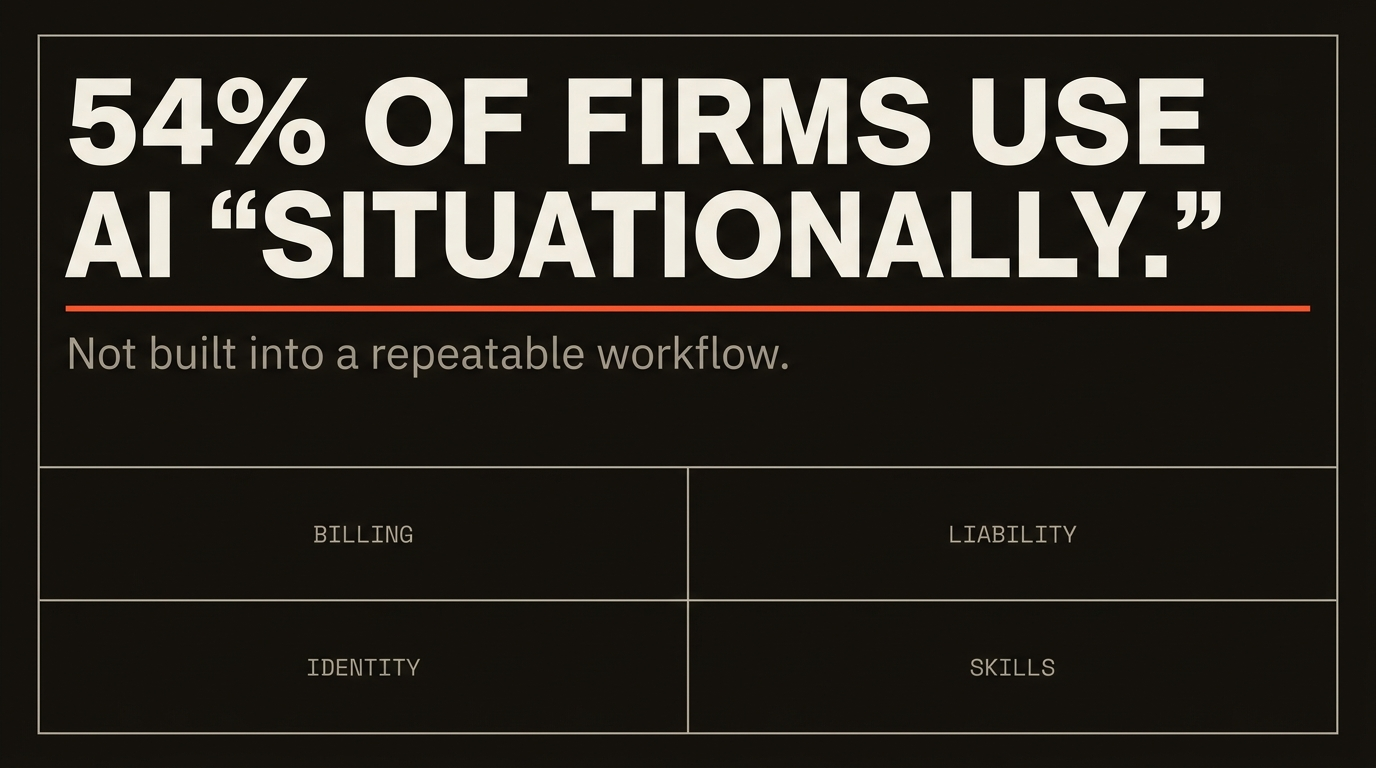
That's not a vibe. It shows up in the data. In one 2026 survey, 60% of firms said they now use AI for tax research at least weekly — up from just 33% a year earlier. Usage is climbing fast. But in a separate 2026 survey of the same population, 54% of firms said they use AI "situationally" — reaching for it when it feels helpful, rather than building it into a repeatable workflow.
Put those two numbers together and you get the real picture: adoption is rising, but most of it is a tool getting layered onto an unchanged process, not a workflow getting rebuilt around AI. That's the difference between "AI-assisted" and "AI-native," and it's a meaningfully different business decision — not just a matter of trying harder or waiting for better tools.
If your firm is in the 54%, this isn't a discipline problem. It's usually one of four specific, well-documented reasons. Naming which one you're actually dealing with is the fastest way to stop mistaking caution for strategy.
The Four-Mechanism Resistance Map
| Mechanism | What it looks like inside a firm | Why it's not irrational |
|---|---|---|
| 1. Billing | AI cuts task time, but hours billed is still the number that pays the bills | Under hourly pricing, going AI-native can directly cut your own revenue — the incentive runs backward |
| 2. Liability / judgment | Partners keep AI output at arm's length from anything that touches a filed return or an audit opinion | Professional skepticism — the trained habit of not accepting outputs at face value — is the job. Current AI outputs don't always clear that bar for load-bearing calls |
| 3. Identity | "This is what I trained a decade to be good at" | Documented in the accounting literature: the work is tied to professional identity, and automation of it can feel like more than a process change |
| 4. Skills / capacity | The firm doesn't have the internal bandwidth to redesign a workflow, not just operate a new tool | Named directly in industry survey data as the single largest cited barrier to further AI adoption |
Use this as a five-minute internal exercise: for your firm's stalled AI initiative, which row is actually true? Most firms assume it's #4 (we just need more training) when the real blocker is #1 (nobody wants to say out loud that going faster means billing less).
What each mechanism looks like in the data
Billing. Firms that kept traditional time-based pricing grew revenue 2.1% annually, according to Deloitte's 2025 Professional Services Benchmark — versus 8.7% annual growth for firms that shifted to value-based pricing. Separately, 40% of tax and accounting professionals say they see AI as a threat to their current business model and revenue, not just a tool to learn. That's not resistance to technology. That's a firm correctly reading its own incentive structure.
Liability and professional judgment. In a global survey of roughly 1,000 audit and accounting professionals, 88% agreed that AI carries a real risk of undermining professional judgment. But — and this matters — 66% of that same group were already using AI in select functions, and 53% said AI improves audit quality. This isn't a profession refusing AI. It's a profession using AI for the parts it trusts and holding the line everywhere else. Separately, peer-reviewed field research on auditors documents a real, measurable tendency to under-use automation even when it's available, and less experienced staff show "automation bias" — accepting AI's outputs without enough scrutiny, at exactly the career stage where they're supposed to be learning how to catch errors by hand.
Identity. Peer-reviewed research on accountant online communities documents something close to a professional identity crisis playing out in response to automation — practitioners collectively making sense of what it means when a skill they built a career on gets automated. (A comparable, separately documented pattern shows up in medicine, another high-expertise, judgment-based profession — worth naming as a parallel, not as accounting-specific proof, since the direct accounting evidence here is real but thinner than the billing and liability evidence above.)
Skills and capacity. In an AICPA & CIMA global survey, 50% of finance professionals cited a lack of human capital, skills, and talent as the single biggest AI adoption challenge — ahead of safety/security concerns (47%) and doubts about the technology's maturity (42%). Separately, 51% of accountants in a 2026 ACCA survey said they're still worried about AI's effect on their jobs — though in the same survey, 82% said they're confident in their own ability to learn and apply AI, and 52% are already regular users. Worry and confidence are showing up in the same people. That's not blanket resistance — it's an unresolved tension.
It's not universal — here's the counter-example
TFMA, an accounting firm, didn't add an AI tool on top of its existing bookkeeping process. It replaced manual reconciliation and cleanup with a platform where AI runs continuously inside the general ledger itself — not a separate step, a different foundation. The firm reported a 70% increase in workflow efficiency and used the freed-up capacity to shift toward advisory work. It's one firm's result, not a guaranteed outcome for every firm that tries the same move — but it's a real, named example that going AI-native is possible without waiting for a perfect industry-wide solution.
What this means before you touch another AI tool
Buying another AI subscription doesn't resolve any of the four mechanisms above. A billing-mechanism problem needs a pricing conversation. A liability-mechanism problem needs a defined human-review boundary — decide explicitly what AI is and isn't trusted to touch, and put it in writing, rather than leaving it as an unspoken partner-level instinct. An identity-mechanism problem needs the firm to be honest that this is a change-management conversation, not a software rollout. A skills-mechanism problem needs a workflow redesign project, not a training webinar.
None of this requires an AI system making unsupervised judgment calls on a client's return or opinion — every one of these transitions still runs through the same human review your firm already trusts. The question isn't whether to remove that review. It's whether your workflow, your pricing, and your team are actually built to work with AI instead of just having AI sitting next to the old process.
Where Intelligence Solved fits
If you already know which of the four mechanisms is live in your firm, the next step is a scoping conversation, not another tool demo. Email mark@intelligencesolved.com and we'll walk through what an AI-native version of one specific workflow — not your whole firm at once — would actually look like, with the human review built in from the start.